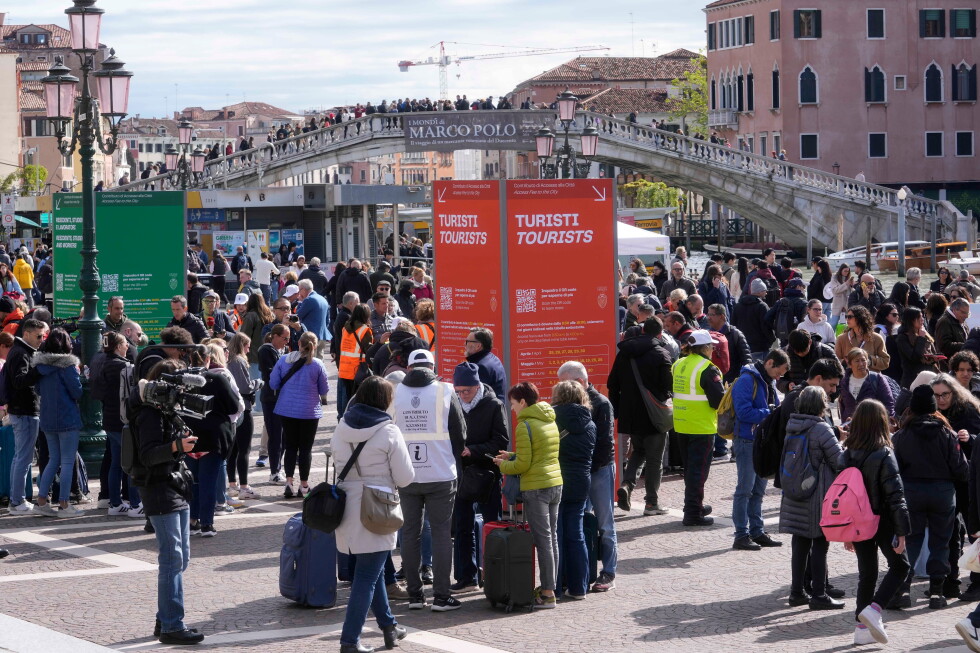
MILAN (AP) — Facing persistent overcrowding in its UNESCO-listed historic center, Venice’s newly elected mayor is pushing for an overhaul of the city’s three-year-old day-tripper entry fee system, proposing a dynamic surge-pricing model that would push the top charge as high as 50 euros ($59) on the city’s busiest visitor days. The plan requires national government approval via an amendment to Italy’s special legislation governing the iconic canal city, and early discussions with Italy’s tourism minister have already taken place.
Mayor Simone Venturini, who took office last month after serving as the city’s top tourism official when the initial day-tripper fee was rolled out in 2024, laid out the proposal in an exclusive interview with the Associated Press on Friday. He explained that the current flat 10-euro charge for last-minute reservations has failed to meaningfully deter mass visits on peak dates, leaving the historic core chronically overcrowded and straining local infrastructure. Rather than implementing a blanket higher fixed fee, Venturini’s administration wants to adopt a demand-based pricing structure, where entry costs rise in line with visitor numbers on the busiest days.
Under the framework, the 50-euro rate would only apply as a maximum upper limit to give the city flexibility to test different price points, Venturini clarified. For example, if daily bookings surpass a 40,000-visitor threshold, additional arrivals would face a incremental surcharge that could land between 20 and 30 euros, rather than automatically hitting the 50-euro cap. “It doesn’t mean everyone who comes to Venice would pay 50 euros,” he noted, adding that researchers are still collaborating with the city to identify sustainable crowd thresholds and appropriate pricing tiers.
Beyond curbing overcrowding, the dynamic pricing model is designed to generate much-needed revenue for the city’s ongoing maintenance costs. “We spend 100 million euros a year just to maintain Venice physically, and nobody gives us that money. Not Europe. Not the Italian state. International critics don’t pay it either. It’s paid by the people of Venice, and in part through tourism taxes,” Venturini said. He added that waste management alone creates extraordinary costs for the city, since all waste collection must be done manually via boats and handcarts, a burden created almost entirely by the daily influx of day-trippers who generate significant trash during their visits. Currently, revenue from the entry fee only covers a small fraction of Venice’s tourism-related management costs, he said.
Venturini also pushed back on critics who have called for a hard daily cap on total visitor numbers, noting that such a limit is not permitted under current Italian law. He addressed population concerns that highlight the steady decline of Venice’s permanent resident community: latest data from local housing advocacy group Ocio puts the number of registered residents in the historic center below 48,000, while the number of available tourist beds has climbed to more than 51,500. Venturini argued that the official resident count understates the actual year-round population, as many students and seasonal workers live in the city full-time without updating their official registration. Even so, he acknowledged the need to reverse long-term depopulation: “That doesn’t mean we are satisfied. We need to do more.”
The proposal has already drawn sharp criticism from multiple groups, including housing advocates, activists, and opposition politicians. Critics have long argued that the existing entry fee fails to address overcrowding while effectively turning the entire historic city into a paid tourist attraction, and argue the new dynamic pricing model doubles down on a flawed approach. The 50-euro upper limit has drawn particular backlash for being prohibitively expensive for middle-class visitors, especially families traveling on a budget. Critics also say city leaders are overly focused on managing tourist flows rather than implementing policies that would incentivize permanent residents to move back to the historic center.
A look back at the entry fee’s performance since launch shows steady revenue growth as the city expanded the program: during the 2024 test phase, Venice collected 2.4 million euros from more than 485,000 day-trippers across 29 peak days. Last year, the city expanded the scheme to 54 days and doubled the last-minute fee to 10 euros, pushing total revenue up to 5.4 million euros. Six additional peak days have been added to the schedule this year, though full data on arrivals and revenue has not yet been published.
Venturini emphasized that the overarching goal of the policy reform is not to generate extra revenue or gate off the city, but to improve the quality of experience for both residents and visitors on days when unregulated crowds would otherwise overwhelm Venice’s fragile infrastructure and historic sites.