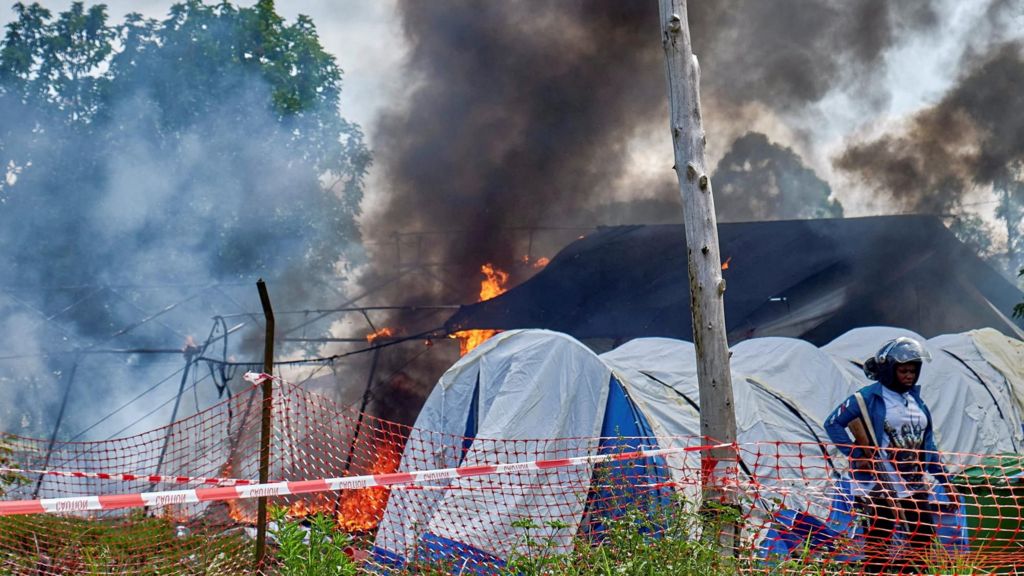
A wave of violent public unrest has broken out at the epicenter of an expanding Ebola outbreak in the eastern Democratic Republic of the Congo (DRC), exposing deep rifts between public health authorities and local communities over the response to the deadly virus. The unrest erupted after an angry crowd set fire to a section of Rwampara General Hospital in Ituri province, where nearly all current Ebola cases have been recorded. The confrontation was sparked when medical teams blocked family members from retrieving the body of a 28-year-old local footballer for a traditional burial, after medics recorded his death as a confirmed Ebola fatality.
Witnesses and local officials report that protesters threw projectiles at hospital staff and set ablaze temporary tents that served as Ebola isolation wards. One healthcare worker was hit and injured by flying stones before law enforcement intervened to restore order, firing warning shots to disperse the crowd. Local politician Luc Malembe Malembe, who witnessed the chaos, confirmed that two isolation tents were completely destroyed, along with the young man’s body that had been held for safe burial. Initial reports that six Ebola patients being treated in the tents escaped during the unrest were later refuted by medical charity Alima, which operates the isolation site, confirming all patients are accounted for and continue to receive care at the hospital.
Misinformation and deep public distrust have been cited as core drivers of the violence. The victim’s mother publicly stated she believes her son died of typhoid fever, not Ebola, a sentiment shared by many in the local community. Jean Claude Mukendi, security coordinator for the Ebola response in Ituri, noted that the young man was a well-liked local figure, and many upset residents failed to understand the contagious nature of the virus. Malembe added that widespread lack of public education has fueled dangerous conspiracy theories across parts of eastern DRC: many people, particularly in remote, underserved areas, believe Ebola is a fabrication invented by outside non-governmental organizations and hospitals to profit from donor funding. As of the latest official reports, the outbreak has killed more than 130 people across the country, with official death tolls varying between 139 reported by the World Health Organization (WHO) and 159 counted by Congolese health authorities, out of over 600 suspected total cases.
The unrest unfolded as the cross-border and regional spread of the virus accelerates, prompting growing international concern. The WHO has already designated the outbreak a Public Health Emergency of International Concern, though it has not yet characterized the situation as a global pandemic. Two confirmed cases have already been detected in Uganda, DRC’s northern neighbor, prompting Ugandan authorities to shut down all cross-border public transport, including passenger ferries on the shared Semliki River border crossing, to slow transmission.
Compounding risks, the outbreak is caused by the rare Bundibugyo strain of Ebola, for which no licensed vaccine is currently available. WHO officials estimate it could take up to nine months to develop and deploy a targeted vaccine for this specific strain. Just days after the hospital violence, M23 rebel forces that control large swathes of eastern DRC confirmed the first Ebola case in South Kivu province, hundreds of kilometers south of the current epicenter in Ituri. The infected patient, who had traveled to South Kivu from the unimpacted city of Kisangani in Tshopo province, died before a formal diagnosis could be confirmed. International observers warn that the spread of the virus into territory controlled by non-state actors creates major new challenges for outbreak response, as aid groups face barriers accessing at-risk communities in these regions. M23 has stated it is willing to collaborate with international health partners to contain the virus, but the group has never previously managed a large-scale public health emergency like an Ebola outbreak.
The crisis has already had ripple effects beyond the affected regions: DRC’s national men’s football team announced it would cancel its planned pre-World Cup training camp in Kinshasa directly due to the outbreak. Global health officials continue to stress the urgent need for expanded public outreach and education to counter misinformation that is undermining outbreak control efforts, particularly around critical safety measures such as the WHO-recommended safe and dignified burial protocol for Ebola victims, which requires trained teams to handle remains with full protective equipment to prevent new infections.