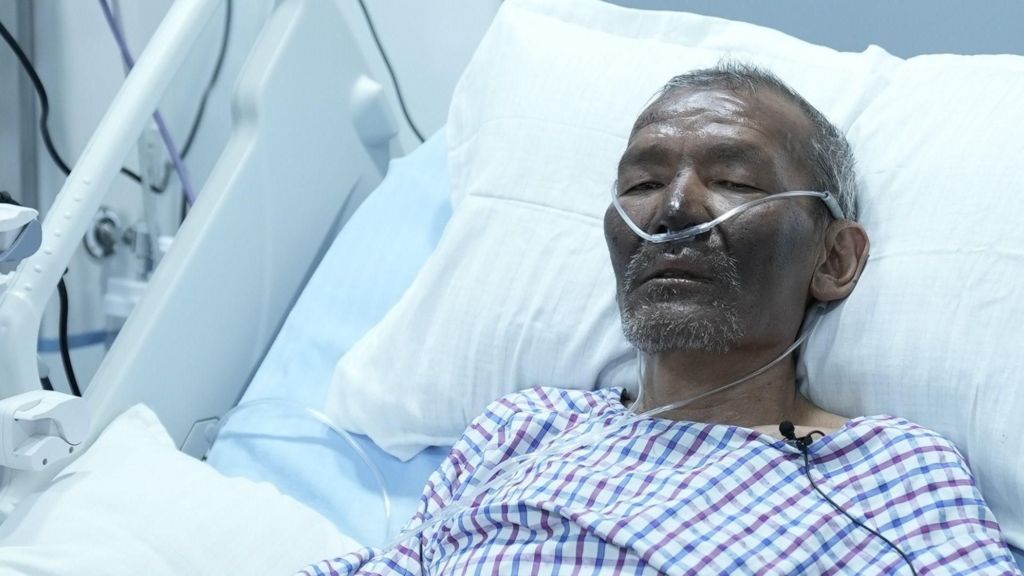
On the notoriously treacherous upper slopes of Mount Everest, a story of extraordinary survival has captured global attention while forcing a long-overdue reckoning with the hidden dangers facing local guides in the booming high-altitude tourism trade. Last Thursday, a post-climbing-season cleanup team combing the Khumbu Icefall—widely labeled the deadliest stretch of the world’s highest peak—stumbled on a shocking discovery: 57-year-old Hillary Dawa Sherpa, a climbing guide who had been missing for six days and already presumed dead by his family, who had started funeral preparations.
Weakened, frostbitten and severely exhausted, Hillary Dawa was still conscious enough to sit upright and speak to his rescuers before being airlifted to a Kathmandu hospital. News of his unlikely rescue spread rapidly across international headlines, stunning the global mountaineering community. But beyond the miracle of his survival, the incident has pulled back the curtain on systemic risks and questionable industry practices that put Sherpa workers in unacceptable danger.
Hillary Dawa was originally hired by budget expedition operator Himalayan Traverse Adventure (HTA) as a camp cook stationed at Camp 2, roughly 7,200 meters above sea level. HTA managers say he was reassigned at the last minute to substitute for a lead guide who fell ill at Base Camp, a change he accepted to earn extra income. On May 29, he set out from the highest Camp 4 to descend the southern route alongside two clients: British former soldier Chris Thrall and Polish climber Mariusz Chmielewski, plus a second guide, Pasang Kaji Sherpa.
When the group began their descent, Chmielewski was running low on oxygen, so Pasang Kaji and Chmielewski pressed ahead first. Thrall followed behind with Hillary Dawa, who stopped just above Camp 3 to rest on his backpack, as he had done hundreds of times before. “He says, ‘Yes, yes, I’m fine Chris, please go, ‘” Thrall recounted in an Instagram video. Facing an impossible choice between backtracking for Hillary Dawa, who seemed unhurt, or continuing to help Chmielewski—who was low on oxygen, suffering from early frostbite and at high risk of hypothermia in a raging snowstorm—Thrall chose to stay with the struggling client. With only half a tank of oxygen left, turning back would have likely put his own life at risk, he explained.
The blizzard conditions were so severe that Thrall and Chmielewski were forced to write farewell messages to their families, convinced they would not survive the 38-hour trek back to Base Camp. When they arrived, they assumed Hillary Dawa had perished in the storm. Chmielewski, who also required hospital treatment for frostbite, has joined Hillary Dawa’s family in accusing HTA of gross negligence. He claims Pasang Kaji notified HTA of Hillary Dawa’s disappearance on May 30, but no search effort was launched for three full days. He also says HTA operated with chaotic planning and woefully inadequate preparation, and has called for the company to lose its operating license.
For his part, Hillary Dawa has described how he ran out of oxygen above Camp 3 and could not continue moving, forcing him to wait out six days alone at lethal altitude. Most fully acclimatized climbers survive just 2 to 3 days without supplemental oxygen at that elevation. He went two full days without food, surviving on melted ice he chewed, before finding forgotten chocolate in his pocket that kept him going. He fell into a deep crevasse during his slow descent, but a subsequent avalanche filled part of the crevasse with snow, giving him the platform he needed to climb out. From there, he followed fixed ropes down until he encountered the cleanup team, the first people he had seen in nearly a week.
HTA has defended its actions, arguing that severe weather made an immediate rescue impossible, and that any attempt to send rescuers into the storm would have resulted in more deaths. HTA founder Dawa Sherpa added that 8K Expeditions, the larger firm that issued the expedition’s climbing permits, bore responsibility for executing search operations. But 8K Expeditions countered that it was not contracted to provide logistical or operational support for HTA’s trip, saying HTA notified them of the disappearance on May 30 then went radio silent, and that an aerial search was not coordinated until June 2, which turned up no trace of Hillary Dawa. HTA manager Angfurba Sherpa has also pushed back against criticism, noting that the two clients paid one of the lowest rates on the market for the expedition—roughly $37,500 per person, far less than the six-figure sums charged by many top operators—and arguing that Hillary Dawa could have contacted the company via his working walkie-talkie if he had needed help.
That claim has been rejected by Hillary Dawa’s loved ones, who say the guide was abandoned by the company he worked for. Mountaineering experts note that camp cooks are rarely trained or equipped to lead summit expeditions, even if they have previous high-altitude experience. As of early this week, Hillary Dawa has been moved out of intensive care to a general ward and is recovering well, but questions about the incident remain unanswered. Nepal’s tourism department has launched a formal investigation into the incident, and Hillary Dawa’s family has filed a police complaint alleging negligence. The extraordinary survival story has sparked urgent calls for better regulation and protections for Sherpa workers, who bear the brunt of the risk in the $200 million annual Everest tourism industry.