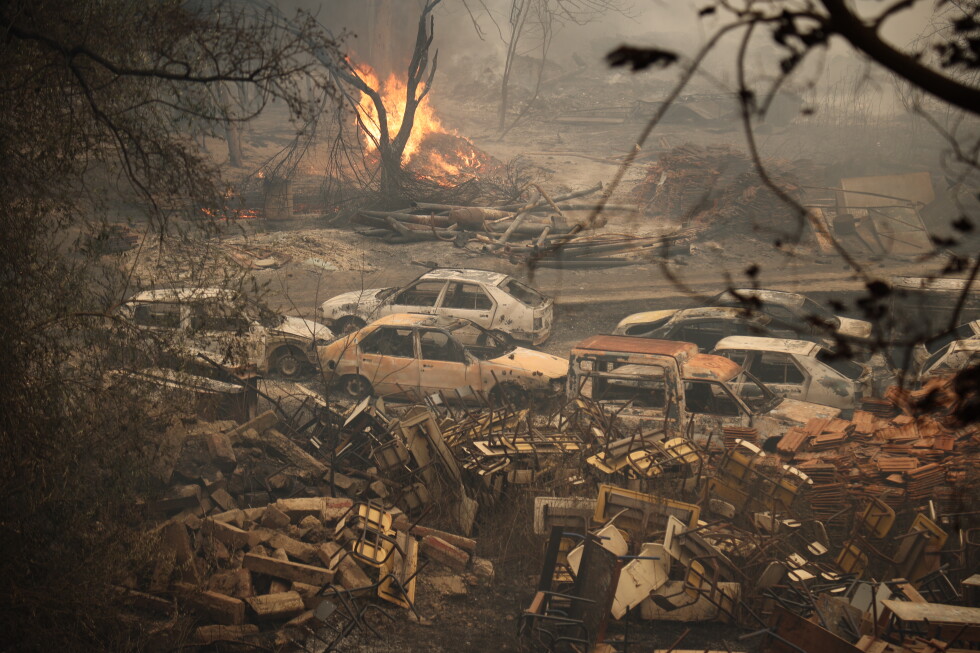
A devastating and historically unmatched outbreak of wildfires has swept across northern Algeria, leaving widespread death, ecological destruction, and political upheaval in its wake. The inferno has carved a continuous line of flames from central Algeria all the way to the country’s far eastern border, forcing emergency responders to mount a desperate, resource-stretched battle to contain the blaze.
This week, Civil Protection teams backed by army units continued to fight reignited flare-ups in the eastern provinces of Sétif and Guelma, where thousands of hectares of old-growth forest have already turned to ash. The worst-hit region is Jijel, a popular coastal province located 120 miles east of the capital Algiers, once celebrated for its pristine sandy shorelines, clear turquoise waters, and rolling hills covered in olive groves, fruit orchards, and ancient cedar forests. Today, the entire 1,200-square-kilometer expanse of Jijel’s forests is reduced to smoldering cinders and blackened stumps.
Discrepancies over the official death toll have emerged as a major point of tension following the disaster. The Algerian Interior Ministry initially reported a national death toll of 12, all from Jijel, when the crisis escalated in late August. But on-the-ground accounts and social media footage suggest the actual number of fatalities is far higher. Videos posted online show dozens of coffins lined up alongside open mass graves, awaiting burial as high temperatures accelerate decomposition of remains.
“After 40 years in Civil Protection fighting wildfires, I have never seen a catastrophe on this scale — human, environmental, and material. There are hundreds of dead,” Lieutenant Djabri Said told the Associated Press in an on-site interview. One high-profile case underscores the scale of the tragedy: Abdelwahab Boukrouh, a journalist with the Algerian presidency’s communications department, announced via Facebook that 12 members of his own family were killed when the fire swept through their mountain village of Ouled Riyah on the night of August 22–23, with three more relatives still unaccounted for. The victims included women, children, and elderly residents trapped in their small rural homes before they could escape. Thousands of livestock — cattle, sheep, goats, mules and donkeys — also perished in the flames, their charred remains scattered along the steep mountain paths leading to destroyed villages, where little remains of residential structures except smoking piles of rubble.
All private and public media in Algeria operate under state oversight, and most have stuck to the official 12-death toll in their coverage, while focusing heavily on ministerial visits and state-led relief efforts. President Abdelmadjid Tebboune cut short his summer vacation to oversee the response, visiting burn victims in specialized Algiers hospitals, declaring a three-day national period of mourning, and calling an emergency Cabinet meeting. The meeting designated the Jijel region a disaster zone and unlocked emergency funding for response and recovery operations.
A spontaneous grassroots movement of national solidarity has emerged across the country, with convoys of private and volunteer trucks carrying emergency food, medication, bottled water, and clothing streaming into fire-ravaged mountain villages. Tebboune has also announced state-funded compensation for all affected families and pledged that the government will cover the full cost of rebuilding destroyed homes. Priority has been given to repairing damaged schools to ensure they are ready for the new academic year scheduled to begin September 21.
The disaster has sparked a heated national political debate over the president’s proposal to reinstate capital punishment for anyone found guilty of arson connected to the wildfires. Tebboune has dismissed unsubstantiated claims of organized intentional sabotage, known locally as conspiracy theories, and instead aligned his explanation with global scientific consensus: he noted that numerous Mediterranean countries, including France, Spain, Portugal and Italy, all faced extreme wildfire outbreaks this summer, driven by rising temperatures and arid conditions linked to climate change. Climate researchers have repeatedly warned that human-caused global warming is increasing both the frequency and intensity of heatwaves and droughts across the Mediterranean basin, creating ideal conditions for destructive wildfires.
Even so, Tebboune acknowledged that “criminal hands” may have played a role in starting some blazes, and announced that all investigations are ongoing. He went on to announce that anyone convicted of arson in connection with the fires will face the death penalty, confirming that the country will end a moratorium on executions that has been in place since 1993. That year marked Algeria’s last confirmed executions, when three Islamist militants were put to death for a deadly attack at Algiers International Airport.
Reaction to the announcement has split sharply along political lines. Parties that support Tebboune’s administration, including major Islamist political groups, have backed the proposal. However, opposition parties linked to Algeria’s pro-democracy movement and multiple leading human rights organizations have condemned the move, describing it as a dangerous retreat into authoritarian practice and a deliberate distraction from perceived failures in government wildfire management and prevention.