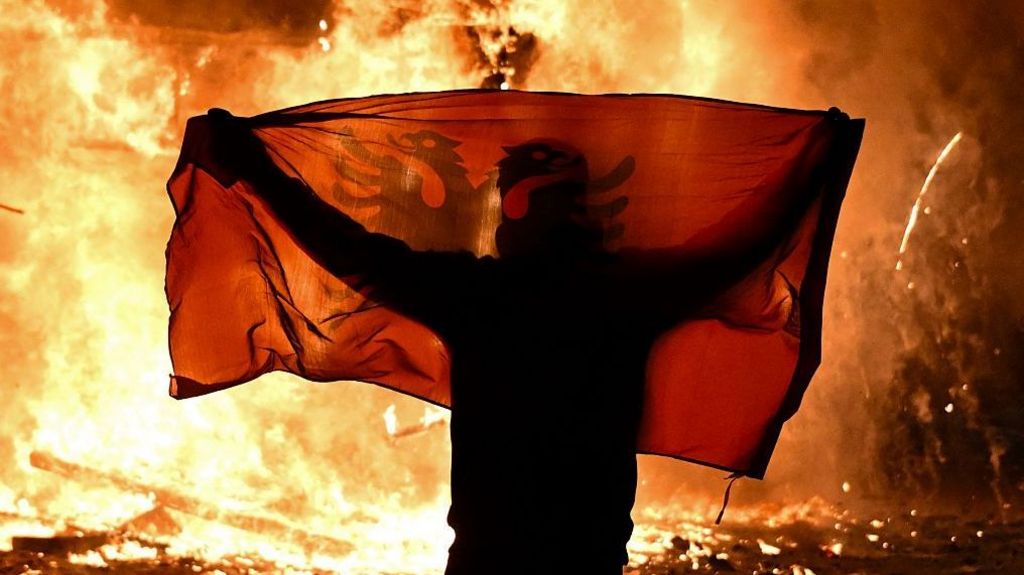
After five months of quiet, sustained anti-government demonstrations centered on the so-called “Flamingo Movement”, Albania has erupted into widespread violent clashes between demonstrators and anti-riot police, marking the most severe civil unrest the Balkan nation has seen in decades. What began as a small, student-led demonstration this week has quickly expanded beyond the capital city of Tirana, spreading to major urban centers including Durrës, Shkodër, Korçë and Vlora, leaving damaged government buildings, vandalized private businesses, and dozens of injured people in its wake.
The roots of the current unrest stretch back to early summer, when the non-partisan Flamingo Movement launched daily 140-day protests in central Tirana. Participants gathered each evening holding images of pink flamingos, demanding the resignation of four-term Prime Minister Edi Rama. The movement originally formed in opposition to a luxury Adriatic coastal tourism development tied to Jared Kushner, former U.S. President Donald Trump’s son-in-law. Protesters argued the project would wipe out the local flamingo population on an island near Vlora, where the development is planned.
Over time, the movement’s demands expanded to encompass widespread public anger over mounting allegations of deep-seated corruption among top government officials. Two deputy prime ministers have been caught up in ongoing corruption probes: one has fled the country entirely, while a second has been forced to step down as investigations proceed. A core principle of the Flamingo Movement has been its rejection of both ruling and opposition political establishments, captured in its signature slogan: “Rama in jail, Berisha in jail” — referencing both Rama and Sali Berisha, Albania’s opposition leader and former prime minister and president. For months, the peaceful movement drew participants across generations, from young adults to families with children and retirees, with many volunteers taking responsibility for cleaning protest sites after each gathering. But as the unusually hot summer dragged on and the government ignored all calls for reform, protest numbers dwindled, leaving many demonstrators feeling their voices had been deliberately dismissed.
The current wave of unrest ignited earlier this week when a new student-led demonstration launched, initially focused on urgent economic grievances: sky-high education fees, exorbitant textbook costs, and the crushing burden of the country’s cost-of-living crisis. Secondary school students quickly joined the movement, swelling the crowd size dramatically. Within hours, the demonstration turned violent: masked protesters began throwing stones at police lines, and security forces responded with water cannons, tear gas, and batons to disperse the crowd. Public anger boiled over after footage circulated of a young injured protester being carried away, with a broken left leg dangling as he writhed in agony. While government officials issued an apology for the incident, it did nothing to de-escalate tensions. Protesters set fire to a floor of the national education ministry, and multiple other government buildings were damaged by arson attacks in the following days. Dozens of police officers have been injured in the ongoing clashes.
Many young participants told the BBC the current unrest is an inevitable new phase of the earlier Flamingo Movement, born out of frustration with five months of being ignored by the ruling government. “Five months of peaceful protest had been met with humiliation, ridicule, mockery,” said Livia, a young protester. “That was a clear message from the government that our voice will not be allowed to be heard.” Another young demonstrator, Brunela, expressed deep anxiety about the road ahead: “I am very terrified because the media and the government is reacting, especially now. It was not just my voice, it is the voice of Albanian youth.” While official leaders of the original Flamingo Movement have not publicly claimed the current protests, and no formal leadership has emerged for the student movement, protesters and analysts widely acknowledge that the two movements share overlapping participants and core demands, centered on rooting out systemic corruption.
Prime Minister Rama has dismissed demands for his resignation, instead blaming opposition leader Sali Berisha for orchestrating the unrest to undermine his government. “All of this is the work of the very same hand — the hand that has gripped the Albanian opposition by the throat, the hand that has burned and destroyed Albania more than once, and is now prepared to burn and destroy it again to prevent any progress,” Rama said Friday. “It is a blind struggle, fuelled by the most irrational hatred.” Rama added that he would not step down, and pledged to “listen, address legitimate concerns and keep Albania moving forward,” while noting that corruption allegations will be handled through the national justice system.
While Berisha’s center-right Democratic Party has spent months organizing its own anti-Rama protests, the movement has consistently drawn far smaller crowds than the current unrest, leading many analysts to cast doubt on claims that Berisha masterminded the current violence, even as it is widely expected he will attempt to leverage the unrest for political gain. Rama has also raised unsubstantiated claims that foreign secret services are behind the unrest, echoing speculation in Albanian media that points to neighboring Serbia — which he claims is jealous of Albania’s status as a top candidate for European Union membership. “These are foreign hands that do not wish for Albania to be at peace… they do not want Albania to be part of the united European family,” Rama said. “Do you think it is a coincidence that every time Albania receives another green light… or draws closer to that great ambition — that historic objective — flames suddenly erupt? It is no coincidence at all! None of what is happening now is a coincidence.”
As of this report, the unrest remains geographically contained despite spreading across multiple major cities. The UK government has issued a travel advisory urging British tourists — who make up a large portion of visitors to the popular Balkan tourist destination — to follow local media updates, avoid all demonstrations and large political gatherings, and comply with guidance from local Albanian authorities. The Tirana government has acknowledged that the ongoing violence risks tarnishing Albania’s international image, threatening both its key tourism sector and its bid to advance EU accession negotiations. The eyes of European political leaders are now fixed on the country, waiting to see if the unrest can be de-escalated or if the violence will deepen.