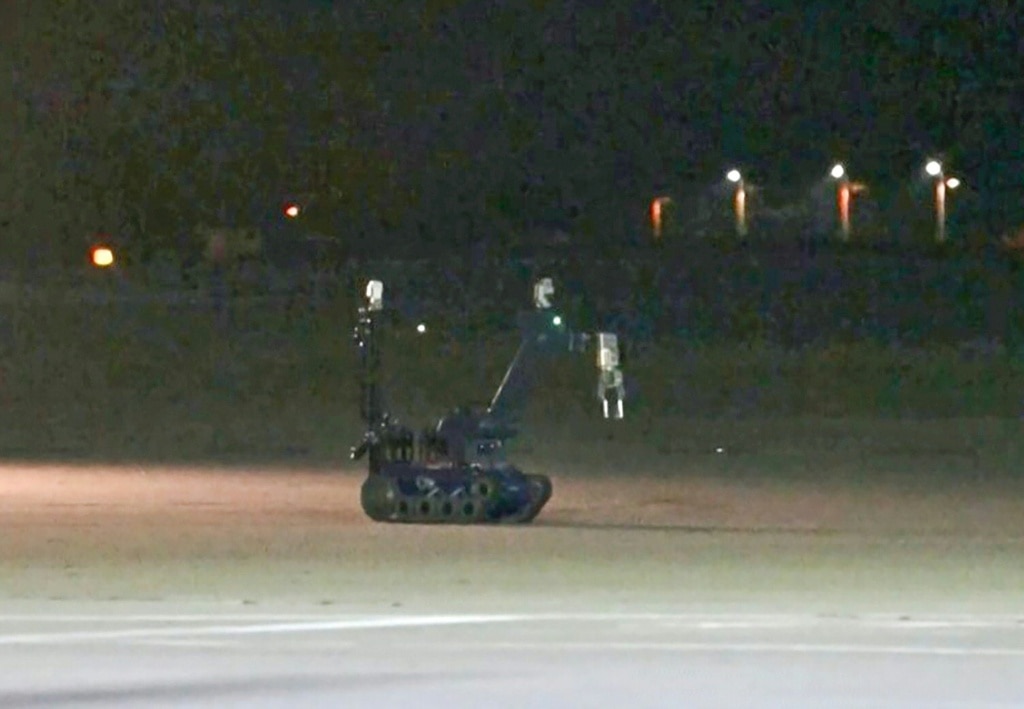
A major security emergency unfolded overnight at Germany’s Leipzig-Halle Airport, after an explosive-packed drone was discovered on the tarmac just meters from a Ukrainian cargo plane, and a separate mid-air collision between a commercial cargo aircraft and an unknown airborne object left authorities scrambling to contain the incident.
Starting around midnight, all incoming flights to the eastern German transport hub were diverted to alternate airports for several hours as specialized bomb disposal units deployed a remote-controlled robot to safely disarm the unmanned aerial vehicle (UAV). Located near a Ukrainian Antonov Airlines cargo plane emblazoned with Ukraine’s national blue-and-yellow colors and the slogan “Be Brave Like Kherson” — a tribute to the southern Ukrainian region repeatedly targeted by Russian missile and drone strikes — the discovery sparked immediate security concerns across European capitals.
Leipzig-Halle Airport is a strategically critical site for European and transatlantic logistics: it serves as a major hub for global logistics giant DHL, a key transport node for German military and NATO military supplies, and an official base of operations for Ukraine’s Antonov Airlines. This combination of roles makes it a high-profile target for actors seeking to disrupt military and commercial supply lines linked to Ukraine’s defense efforts.
In comments Wednesday to German broadcaster Welt TV, Ukraine’s ambassador to Germany Oleksii Makeiev openly questioned Moscow’s involvement in the incident, saying “Who else could it be but Russia?” German authorities have not yet released concrete evidence linking the drone to Russia, and Moscow has not issued any immediate response to the accusation.
Hours after the initial alert, police and prosecutors confirmed the quadcopter drone carried both explosive and incendiary components, matching the description of improvised devices used in recent sabotage attempts across Europe. A robot successfully removed the drone’s detonator, eliminating the immediate threat to airport infrastructure and personnel.
A secondary incident compounded security fears: a DHL cargo plane, which had aborted its landing at Leipzig-Halle following the alert, collided with an unidentified second airborne object roughly six kilometers from the airport. The aircraft sustained minor damage to its nose cone but landed safely at Hanover Airport, where the damage was later documented by police.
By early Wednesday morning, commercial air traffic had resumed on the airport’s northern runway, while investigators sealed off the southern runway to collect forensic evidence. A German counter-terrorism unit has launched an urgent manhunt for the drone operator or operators, publicly appealing for any witnesses who saw suspicious activity near the airport in the hours before the incident to come forward with information.
This discovery is the latest in a growing string of unexplained drone incursions at sensitive sites across Germany and wider Europe. In recent months, unidentified UAVs have been repeatedly spotted over airports, military installations, and critical industrial facilities across the continent. German security officials have repeatedly stated they believe many of these incidents are orchestrated by Russia as part of a coordinated hybrid campaign of espionage, sabotage, and intimidation targeting European support for Ukraine.
Just months earlier in July 2024, a parcel burst into flames on the tarmac at Leipzig Airport before it could be loaded onto a DHL cargo plane, an incident German security services have linked to a Russian arson sabotage plot. Moscow has repeatedly denied any involvement in sabotage activities on German or European territory. In a separate 2023 case, a Chinese national was convicted of espionage for leaking sensitive information on flight schedules and cargo movements at Leipzig-Halle Airport to Chinese intelligence operatives.
Addressing reporters Wednesday, Ambassador Makeiev drew a direct line between the latest drone incident and previous alleged Russian attacks, arguing that the term “hybrid war” often understates the scope of Moscow’s aggression. “Indeed, Russia has long been waging this hybrid war,” he said. “Yet the word ‘hybrid’ somehow downplays the fact that Russia is waging war not only against Ukraine but also against Europe.”