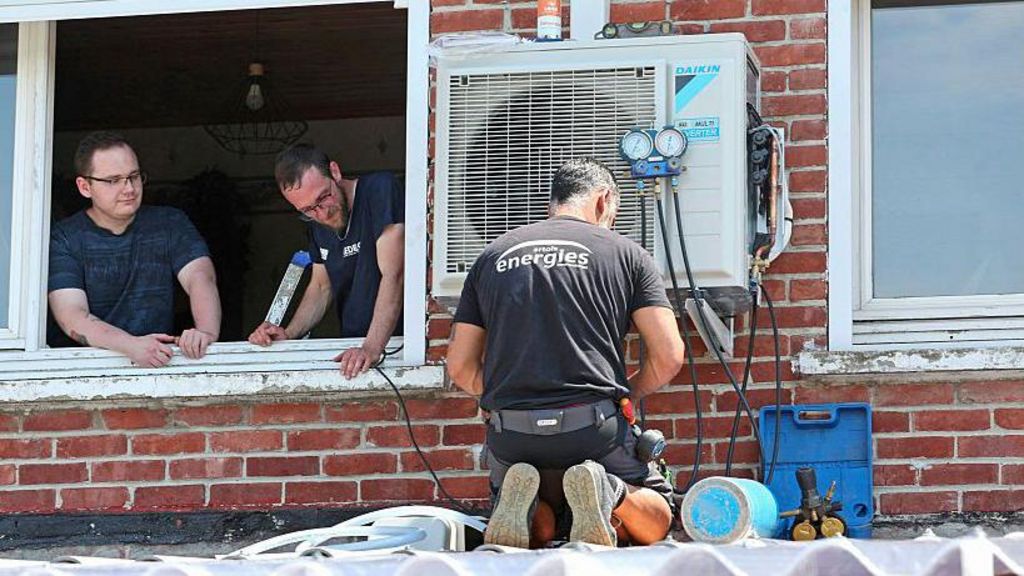
As record-breaking temperatures push toward 40 degrees Celsius across France, a long-simmering national debate over air conditioning has reignited, forcing a dramatic shift in attitudes among even the country’s most vocal environmental opponents of cooling systems. With Tuesday marking the hottest single day in French recorded history, the stark gap between France’s low air conditioning penetration and that of its neighboring and global peers has been thrown into sharp relief: just one in four French households currently own an air conditioning unit, compared to 50% in Spain and Italy, and a staggering 90% in the United States and Japan. The lack of cooling infrastructure is even more acute in critical public facilities, including public schools and hospitals, where thousands of educational institutions have been forced to suspend classes this week amid dangerous heat, and frontline medical staff report working conditions that have quickly become unendurable. Desperate to cope, French residents have rushed to purchase portable air conditioning units in recent days, scrambling to create safe, cool spaces for children to study and for apartment dwellers trapped in sweltering urban heat to sleep through the night.
For decades, widespread opposition to air conditioning dominated French political and environmental discourse, spearheaded by left-wing green movements that framed cooling systems as a counterproductive band-aid for the climate crisis. Opponents argued that relying on air conditioning distracted from the core work of cutting greenhouse gas emissions that drive global warming, while the technology itself exacerbates heating at multiple levels. Even though France generates most of its electricity from low-carbon nuclear power, air conditioning increases overall energy demand, which in other regions drives additional fossil fuel combustion. Hydrofluorocarbon refrigerants used in most units are potent greenhouse gases that frequently leak during manufacturing, use, and disposal, and hot air vented from residential and commercial units directly contributes to the urban heat island effect, with some research indicating this can raise local city temperatures by 2 to 3 degrees Celsius. This deep-seated suspicion of air conditioning shaped national building policy for years: current construction and renovation codes prioritize passive cooling solutions including improved insulation, expanded urban greenery, and advanced natural air circulation systems, with the explicit goal of eliminating any need for mechanical cooling. Even major public infrastructure projects reflect this stance: a large new hospital under construction in Nantes, Brittany, will only install air conditioning in half of its patient rooms, a decision that has drawn fierce anger from medical unions.
In a significant break from long-held movement orthodoxy, Green Party leader Marie Tondelier broke a major national taboo this week by acknowledging that air conditioning is now an unavoidable necessity in high-risk public settings. “There are places where we just can’t do without it now,” she stated, rejecting what she described as long-standing “anti-clim’ dogma” that had unified French environmentalists for a generation. The ideological shift opens the door for a national expansion of cooling infrastructure, with across-the-aisle political leaders now pushing for widespread adoption after years of opposition. Conservative Paris Regional Council President Valerie Pécresse has criticized the national government for clinging to an anti-air conditioning ideology, arguing that cooling systems must be integrated into national climate adaptation strategy alongside traditional passive cooling methods. Pécresse, who oversees Paris’ regional public transit network, has set a target to equip all regional buses and trains with air conditioning by 2032, blaming her Socialist predecessor for delaying the project for years by downplaying its importance.
The most ambitious proposal to date comes from populist right-wing National Rally leader Marine Le Pen, who this week called for a nationwide “plan clim’” to install cooling systems in every French school and hospital. The National Rally’s proposal also includes a €20 billion ($22.7 billion) program of interest-free government-backed loans to help 30 to 40 million French households install residential air conditioning units. Critics have dismissed the plan as opportunistic and uncosted, pointing out that the National Rally was one of the last major French political parties to accept the scientific reality of anthropogenic climate change, undermining its current credibility on climate adaptation policy. Even with the political sparring, however, a broad consensus is emerging across the French political landscape: as rising global temperatures push France into repeated dangerous heatwaves that threaten public health and disrupt critical public services, expanded adoption of air conditioning is no longer a question of if, but when.