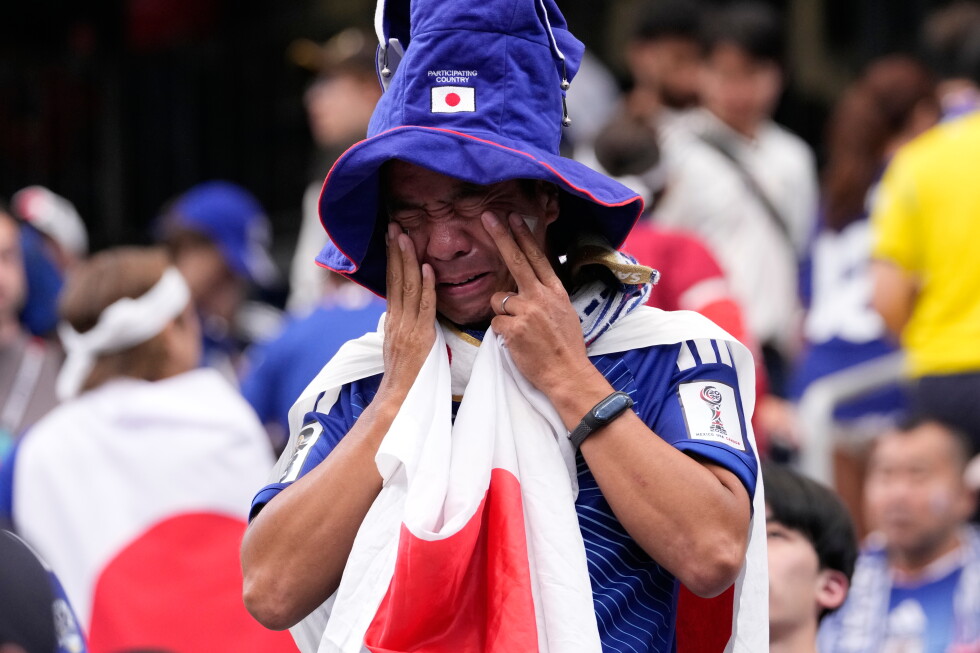
The 48-team expanded men’s World Cup has left Asian football grappling with widespread fallout and introspection following a historically underwhelming continental performance, which has already triggered high-profile leadership resignations across multiple national federations.
South Korea became the first major federation to see top-level changes after the Taegeuk Warriors suffered an early group-stage exit, capped by a 1-0 defeat to South Korea that ended their tournament. Just one week after head coach Hong Myung-bo stepped down in the wake of the elimination, South Korean Football Association president Chung Mong-gyu — who had held his post since 2013 — announced his resignation on Monday. His departure came after sharp public criticism from South Korea’s president over the team’s performance. In a statement acknowledging his responsibility, Chung noted, “There were moments when I lived up to expectations and moments when I left you deeply disappointed. All the success is thanks to our players and fans, and all the mistakes are my responsibility.” He added that he remains confident Korean football will rebound from the setback, as it has done in the past. South Korean superstar Son Heung-min echoed this accountability, sharing a lengthy emotional post on social media where he said he felt “indescribably hurt” by the early exit and was determined to win back the support of the Korean public.
The wave of resignations quickly spread to West Asia: just 24 hours after Hong stepped down in Seoul, Yasser Al-Misehal announced his resignation as president of the Saudi Arabia Football Federation. The Green Falcons fell at the group stage in their seventh World Cup appearance, a result Al-Misehal admitted fell far short of the nation’s ambitions. “I bear full responsibility for it, apologizing to everyone who hoped to see our team in a better position,” he wrote on his official social media channels.
A broader look at the tournament results underscores the depth of Asian football’s challenges this cycle. Across nine Asian Football Confederation (AFC) representatives, AFC teams secured only three total wins from 29 matches, with just two nations — Australia and Japan — advancing past the group stage. Iran, who finished the group stage unbeaten with three draws, narrowly missed out on a knockout spot, while debutants Jordan, Qatar, Iraq and Uzbekistan all failed to progress, with Uzbekistan failing to pick up a single point. Jordan, making its first ever World Cup appearance, already parted ways with head coach Jamal Sellami on Sunday, just days after the team finished its campaign with three straight losses. Sellami had only taken the role in 2024, but guided the nation to its first ever World Cup qualification in June 2025. Speculation continues to swirl around the futures of the head coaches of Qatar and Iraq, who both finished bottom of their respective groups, while Uzbekistan confirmed its coach, 2006 World Cup-winning Italian captain Fabio Cannavaro, will remain in his post. Cannavaro framed the debut campaign as a valuable learning experience for his young side. “All my players realized just how difficult it is to play at this level,” he said. “We gained valuable experience — not just the players, but myself, our staff and the federation as well. I hope this experience will give us more motivation for the future.”
Both Australia and Japan’s knockout runs ended at the first knockout stage (the round of 32). Australia, the last remaining AFC side in the tournament, was eliminated by Egypt in a penalty shootout. Notably, Socceroos head coach Tony Popovic had already secured his job before the World Cup, signing a contract extension immediately after his side’s opening win over Turkey. Japan turned in the strongest performance of any AFC side: after beating Tunisia 4-0 and earning draws with the Netherlands and Sweden to finish second in their group, the Samurai Blue took a 1-0 lead over five-time champions Brazil at halftime, before conceding a late 96th-minute winner to exit the tournament. Japanese head coach Hajime Moriyasu said the near-upset gave him confidence in the nation’s long-term trajectory. “Through the three group-stage matches and the hard-fought game against Brazil, I sensed that what we have built can compete on the world stage,” he said. “If we continue this growth steadily, a day will come when we can be the best in the world.”
AFC president Sheikh Salman bin Ibrahim Al Khalifa acknowledged the incremental progress made by the continent’s leading sides while calling for targeted work to lift the standard of AFC football overall. “While we celebrate our two qualified teams, we must also look realistically at the overall outcomes,” he said. “Our teams are making strides and displaying great fighting spirit, the gap at the absolute top tier remains tight, and we must continue to work hard to bridge it.”
For context, Asian football’s highest benchmark at the men’s World Cup remains South Korea’s historic semifinal run in 2002 as co-host. Japan has now fallen in four consecutive World Cup knockout stage matches, while Australia has never won a knockout fixture at the tournament, falling to 0-3 in knockout matches after this year’s exit.