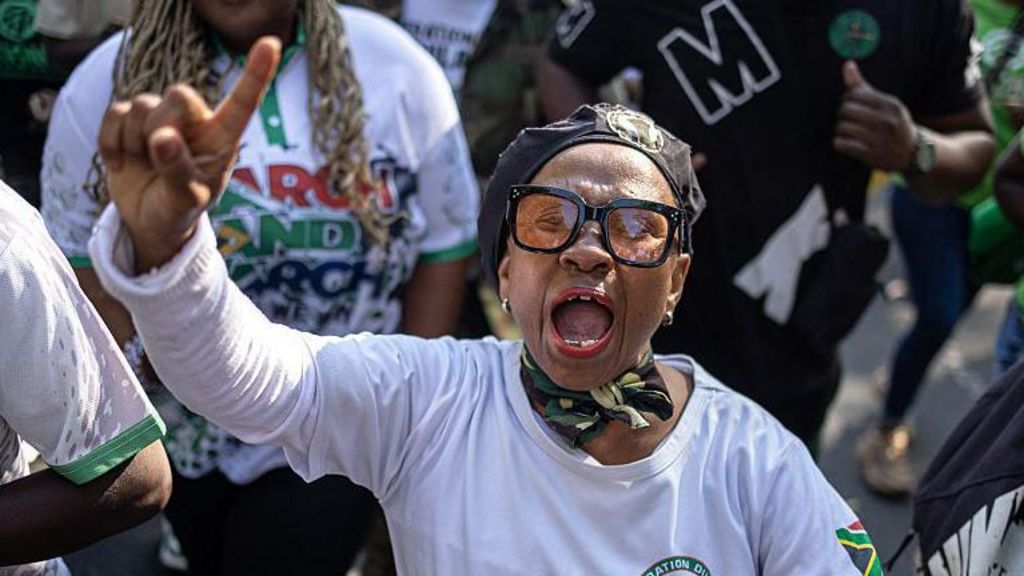
Hundreds of demonstrators gathered in the streets of South Africa’s administrative capital Pretoria on Tuesday for an organized march against illegal immigration, triggering urgent safety advisories for African migrant communities across the country and reigniting fierce debate over long-simmering xenophobic tensions. The protest, organized by anti-immigration group March and March, saw participants march toward the Union Buildings, South Africa’s official seat of national government, carrying hand-painted signs, chanting slogans, and wearing branded T-shirts emblazoned with their messaging.
One protester spoke to BBC correspondent Thuthuka Zondi, explaining that he joined the demonstration over frustrations that national politicians have failed to address what he frames as a crisis of unregulated migrant entry. “We are grateful that we now have groups like this that have come up to aid the voice of what we have always been preaching about — illegal immigration is a big problem to our society,” he said. The demonstration follows a years-long rise in anti-migrant political sentiment, fueled by widespread beliefs among some South Africans that foreign-born workers take available jobs from citizens and disproportionately draw on taxpayer-funded public services. South Africa currently faces one of the world’s highest unemployment rates, hovering near 33% — a statistic that anti-immigration groups have leveraged to grow their support base.
In response to the planned demonstration and credible fears that the protest could escalate into targeted xenophobic violence, diplomatic missions and migrant community organizations have issued urgent warnings urging African migrants to practice maximum vigilance. Ghana’s High Commission in Pretoria issued an official advisory Tuesday urging all Ghanaian nationals in the country to prioritize personal safety, close their businesses, avoid protest hotspots, and maintain a low public profile to reduce the risk of confrontation. Similarly, Olaniyi Abodedele, chairman of the Nigerian Union of South Africa, instructed all community members to stay indoors and shutter their businesses amid the unrest.
Abodedele told the BBC’s Pidgin service that the entire community is on edge, noting that xenophobic targeting often does not distinguish between legal and undocumented migrants. “As long as you are a Nigerian, you are profiled and you are stereotyped immediately,” he said, adding that many community members feel uncertain about what protection their home government will provide if violence breaks out. A second demonstration focused on restricting immigration is scheduled to take place Wednesday in South Africa’s largest city, Johannesburg, which hosts one of the country’s largest migrant populations alongside Pretoria.
Speaking to the BBC on the sidelines of the Pretoria protest, affected Nigerian migrants expressed fear and frustration over the restrictions they have been forced to adopt. One small business owner, who closed his shop in line with the safety advisory, said he resented being targeted when most migrants only come to South Africa to earn a living. “It is not okay because we are blacks, we are brothers… everybody comes here just to survive,” he said. A security guard who was unable to report for work due to the unrest added: “It’s just making us scared — imagine if we’re scared in our own African continent — what if we go to Europe?”
Senior political and international leaders have moved quickly to condemn rising xenophobic violence and anti-migrant rhetoric in South Africa. In his annual Freedom Day address Monday, which marks the anniversary of the country’s first post-apartheid democratic elections in 1994, President Cyril Ramaphosa rejected growing anti-migrant sentiment. Ramaphosa reminded South Africans that the wider African continent provided critical support to the anti-apartheid struggle, urging citizens not to let legitimate economic frustrations “breed prejudices and hatred towards our fellow Africans.” He also explicitly condemned recent targeted attacks on foreign-born residents.
United Nations Secretary-General António Guterres echoed that condemnation in remarks released by his spokesperson Stéphane Dujarric on Monday. Guterres criticized “criminal acts perpetrated by individuals inciting violence and exploiting socio-economic conditions,” and also recalled the international and African solidarity that sustained South Africa’s fight against apartheid. The UN chief stressed that he is deeply concerned by ongoing reports of “xenophobic attacks and acts of harassment and intimidation,” adding: “Violence, vigilantism and all forms of incitement to hatred have no place in an inclusive, democratic society.”
Xenophobic violence and anti-migrant sentiment have been persistent challenges in South Africa for decades, with occasional deadly outbreaks of targeted attacks on migrant communities. Official government data shows that approximately 2.4 million migrants live in South Africa, making up just under 4% of the national population. The vast majority of these migrants come from neighboring Southern African countries including Lesotho, Zimbabwe, and Mozambique, which have a long history of supplying labor to South Africa’s economy. In recent years, organized anti-migrant groups such as Operation Dudula and March and March have gained increasing public traction for their demands that all foreign-born nationals be expelled from the country. Earlier this year, Zulu King Misuzulu kaZwelithini drew widespread condemnation for using a derogatory slur to refer to foreigners and calling for all migrants to leave South Africa, 11 years after his father made a similar call.
Past anti-immigration demonstrations in South Africa have escalated into violent attacks on migrant communities and their businesses, prompting civil society groups to repeat calls for calm and enhanced protection for vulnerable migrant populations. A second planned protest in Johannesburg on Wednesday has communities bracing for further tension across the country’s most populous urban center.