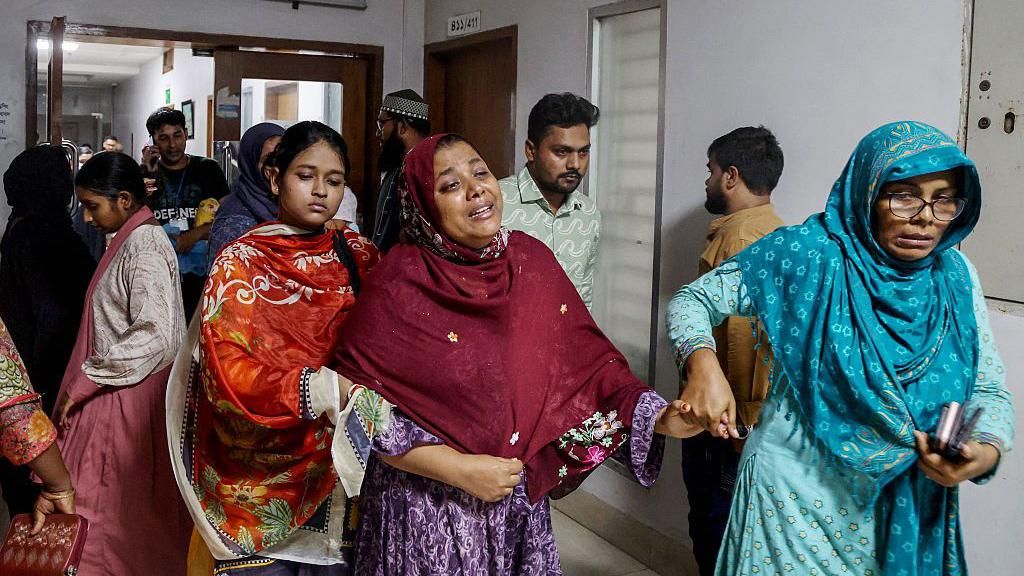
On a seemingly ordinary school day in July 2025, catastrophe struck the busy Dhaka neighborhood of Uttara, when a Bangladesh Air Force training jet crashed straight into Milestone School and College — a private educational facility teeming with hundreds of active, unsuspecting students. The impact and subsequent raging fire turned a hub of learning into a scene of unthinkable chaos, leaving 34 dead and 160 more injured. Most of the casualties were children, making this the deadliest aviation disaster Bangladesh has witnessed in more than half a century.
Now, one year after the tragedy, survivors and grieving family members gathered in Dhaka this week to honor the lives lost — and to reiterate their desperate demand for long-overdue accountability and transparency. For many of the young survivors, the physical and psychological scars of that day remain a daily prison. Sixth-grader Nure Jannat Yusha, who suffered burn injuries in the crash, describes constant fear and trauma that has shattered her once-normal life. “Even now, if I go to school and see a plane, I feel afraid. I can’t sleep at night. In my dreams, someone is throwing me into the fire,” she told BBC Bengali. Once a student who dreamed of becoming a professional dancer, Yusha has abandoned that aspiration; she no longer has any interest in attending classes, gripped by constant paranoia that another plane will fall from the sky. Her story is far from unique.
Fifth-grader Mehreen, another injured student, can no longer attend school at all. Her injuries leave her in severe pain when exposed to even small amounts of sunlight, and the trauma has erased her once-sharp ability to learn and retain information. “Earlier, if I read something, I would memorise it in two minutes. Now I can’t memorise a line in two hours,” she explained. Like Yusha, she struggles with nightly insomnia and recurring nightmares, unable to outrun the memory of the crash.
In the immediate aftermath of the disaster, Bangladesh’s government established an investigative commission to unpack the causes of the crash. The committee submitted its final findings to state officials last November, but the full report has never been released to the public. A leaked copy obtained by BBC Bengali has revealed damning conclusions that contradict early official claims. Contrary to the Bangladesh Armed Forces’ initial statement that the crash was caused by an aircraft mechanical fault, the investigation found the jet itself had no technical failures. Instead, the report attributes the disaster to multiple systemic failures: the pilot lacked sufficient training, there was inadequate ground supervision for the training flight, Milestone School violated critical building safety codes (including only having a single exit for nearly 900 students), and hundreds of other buildings — including multiple schools and hospitals — located near Dhaka’s international airport have illegally violated height restriction rules, putting thousands of lives at risk daily.
Grieving family members say these unaddressed safety lapses mean the same disaster could happen again. Mansur Helal, whose wife Mahreen Chowdhury — a schoolteacher at Milestone who died saving trapped students from the burning building — told the memorial gathering that the status quo is unacceptable. “No one can give a guarantee that another plane will not fall onto this school in the future,” Helal said, noting that between 2,500 and 3,000 students still attend the campus daily. “This is truly a horrific situation.”
Helal and other attendees are demanding three core actions: the immediate public release of the full investigative report, full implementation of the compensation and support measures already recommended by the commission, and sweeping policy changes to restrict hazardous training flights over densely populated residential and educational areas and enforce building safety codes around the airport. While the commission already called for financial compensation and expanded care for survivors, none of these measures have been put into practice one year on.
At Tuesday’s memorial, Health Minister Sardar Sakhawat Hossain stated the government would provide support to survivors requiring ongoing medical care, and Zubaida Rahman, wife of Prime Minister Tarique Rahman, praised survivors for their courage, calling it “a source of inspiration for the nation.” But those words have done little to address the unmet needs of families still waiting for answers, and survivors still struggling to rebuild their lives shattered by a disaster that could have been prevented.