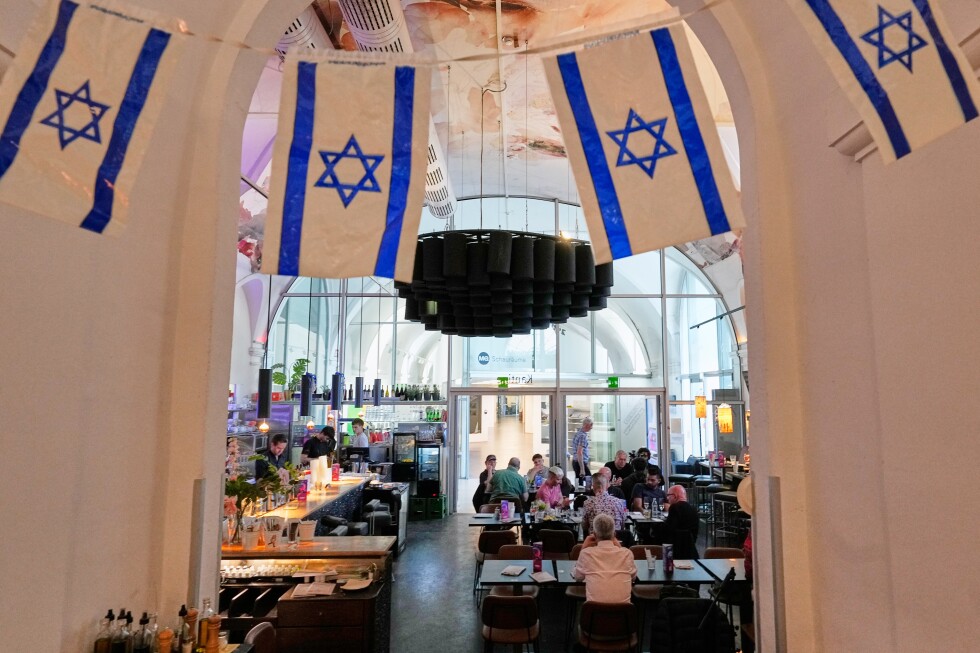
The iconic coffeehouses of Vienna, a city long celebrated as a global hub of music, have opened their doors to Eurovision Song Contest fans this year — but the festive atmosphere has been sharply overshadowed by escalating geopolitical tensions tied to Israel’s inclusion in the glitzy global pop competition.
When city officials first unveiled their roster of “Eurofan Cafes,” themed venues serving cuisine and playing music from each competing nation, Israel was notably absent from the lineup. Stepping into the gap, MQ Kantine — a contemporary cafe located in Vienna’s popular arts and museums district — stepped forward to host Israeli-themed programming. Today, the space features falafel, lox bagels and kosher wine on its menu, strings of small Israeli flags strung across its ceiling, and a uniformed police officer posted permanently outside its entrance.
Security measures across Vienna have been ramped up significantly for this year’s contest, turning the event’s unifying “United by Music” slogan into something of a hollow promise for many. Five countries have already announced boycotts of the 2026 Eurovision in response to the European Broadcasting Union’s decision to allow Israel to compete, while pro-Palestinian organizers have planned alternative protest concerts across the continent, alongside a major anti-Israel march scheduled ahead of Saturday’s grand final. At MQ Kantine, local volunteers rotate shifts to watch for potential unrest, but cafe representative Daniel Kapp — a PR consultant and pro-Israel campaigner — says community response has so far been overwhelmingly supportive.
Sitting on the cafe’s sun-dappled terrace as guests sipped coffee and drank beer, Kapp noted that while the visible police presence confirms the situation is far from business as usual, the public support for the venue reflects a shifting cultural context in Austria. “My feeling is that Austria to a certain degree has learned from its history,” he said, referencing the state-sponsored antisemitism that killed hundreds of thousands of Austrian and European Jews under Nazi rule during World War II. “Which is why the support for Israel is a lot more normal than it is in other countries.”
Israel has competed in the Eurovision Song Contest for more than 50 years, claiming the grand prize four times. But its participation has sparked global controversy ever since it launched its full-scale military offensive in Gaza following the October 7, 2023 cross-border attack led by Hamas that killed roughly 1,200 people and took roughly 250 hostages. According to Gaza’s Health Ministry — which operates under Hamas rule but whose casualty data is widely regarded as reliable by the international community — more than 73,000 Palestinians have been killed in the offensive to date. The Israeli government has repeatedly defended its military campaign as a necessary response to the October 7 attacks, though multiple independent experts, including a panel commissioned by a United Nations human rights body, have concluded that Israel’s actions in Gaza meet the legal definition of genocide. Israel, a country home to hundreds of thousands of Holocaust survivors and their descendants, has vehemently denied these allegations. Ongoing cross-border conflict between Israel and Hezbollah in Lebanon and recent Israeli strikes on Iranian military targets have only amplified global tensions surrounding Israel’s participation.
Protests calling for Israel’s expulsion from the contest marred last year’s event in Liverpool, UK, and this year’s preliminary rounds hosted in Malmö, Sweden, and tensions have carried over to Vienna’s host city activities. This year’s contest has been split sharply along political lines: while the main arena at Wiener Stadthalle and the official Eurovision Village fan zone maintain an upbeat, celebratory vibe, entry requires passing through a heavy security cordon of armed officers, bag scanners and personal searches, with a total ban on all bags inside the arena. Security concerns have been heightened in Vienna after a 21-year-old Austrian man pled guilty this year to plotting a mass attack on a 2024 Taylor Swift concert, after pledging allegiance to the Islamic State group.
Israeli contestant Noam Bettan has revealed he practiced his performance while recordings of crowd booms played in the background, following the same preparation used by 2023 Israeli competitor Yuval Raphael. When Bettan took the stage for Tuesday’s first semifinal, scattered boos rang out through the arena between cheers from supporters, but he still secured a top 10 spot to advance to Saturday’s grand final, determined by a combined vote of national juries and global viewers. Contest organizers confirmed four audience members were removed from the 10,000-person semifinal crowd for disruptive political behavior.
Austrian Eurovision fan Ivo Herzl, who attended the semifinal, described the in-arena energy as “incredibly positive.” He has shown his support for Israel by designing and selling “Mazel Lov” T-shirts, a playful pun on the Hebrew-Yiddish celebratory phrase “mazel tov.” “Vienna has always been a city of tolerance,” Herzl said. “It’s the city of music and we’ll always do everything possible for everyone to enjoy a musical event.”
Many Israeli fans said they have been reassured by the heavy security and widespread public support in Vienna. Oz Yona, who is attending his first Eurovision this year, said he has encountered “no hate” during his trip, and credited Austria for taking the threat of antisemitism seriously. Yona came to cheer on Bettan alongside friends, but he downplayed his chances of winning — for musical, not political, reasons. “I don’t think he will win,” Yona said. “Finland is better this year. Greece is better this year. We have a good song, but not a winning song.”
Even among long-time Eurovision fans, the political tensions have fractured a community long known for its radical inclusivity and cross-border friendship. Birgitta Peterson and Kristina Nilsson, two Swedish fans who call themselves The Swedish Ladies and attend the contest every year to meet their network of “Eurovision family” from across the continent, plan to wave Israeli flags in the stands during Saturday’s final, breaking with the position of their home country’s contestant Felicia, who has publicly stated she believes Israel should be excluded from the competition. “The wounds are very deep at the moment,” Nilsson said. “This event should really be about ‘united by music’ and happiness. That’s what Eurovision is all about.”