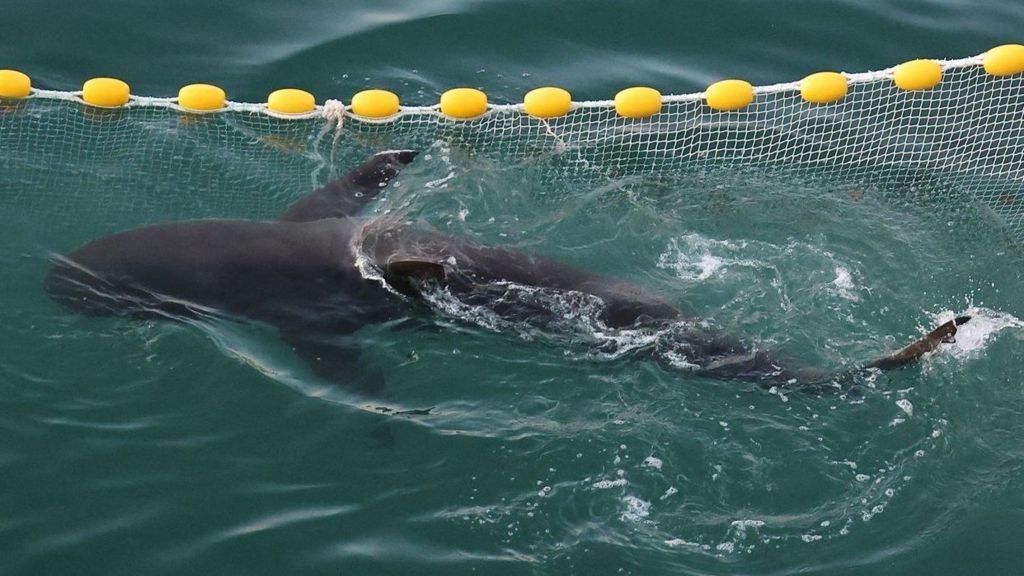
In mid-September, marine biologist Kim Hyun-woo, a leading South Korean shark expert employed by the National Institute of Fisheries Science, received an urgent call from the coastguard mid-way through a return trip from a mackerel shoal monitoring mission. The alert notified him that a large, unidentifiable shark had been spotted trapped in a shallow, concrete-lined canal in Busan, a bustling southeastern port city that ranks as home to the world’s seventh-busiest shipping hub. While South Korean waters are no stranger to shark sightings, a specimen of this size trapped in a manmade waterway steps from a major commercial port was an unprecedented event.
As curious onlookers rapidly gathered along the waterfront, Kim’s team first moved to verify the shark’s species to assess potential public safety risks. Fears of a dangerous great white shark (made infamous by the 1975 thriller *Jaws*) were soon allayed: the stranded animal was a female dusky shark, a species linked to only two recorded fatal human attacks globally. Even so, the team remained on high alert for the risk of excited spectators accidentally falling or leaping into the canal, making a safe return to open water the top priority for the operation.
Initial rescue attempts relied on standard beach safety tools: a small coastguard vessel deployed electrical deterrent devices, which emit low-level currents that sharks naturally avoid. After five hours of failed efforts, however, officials conceded the large, fast-swimming dusky shark was unaffected by the mild current. Kim then pivoted to a passive waiting strategy, hoping the animal would instinctively navigate back to the adjacent harbor on its own — a plan that never came to fruition.
Word of the stranded shark spread like wildfire across Busan. Local authorities issued a city-wide emergency SMS alert urging residents to steer clear of the canal for their own safety, but the message had the unintended effect of turning the previously underused waterfront park into a crowded tourist hotspot. Locals affectionately named the shark Bukangi, derived from the Korean term for the nearby North Port, and the creature quickly became a cultural phenomenon: local businesses rushed to trademark the name, selling out of Bukangi-themed keychains, plush toys, and t-shirts online within days. The Busan municipal government joined the frenzy, launching 24/7 livestreams of the shark’s movements and even naming Bukangi an unofficial city mascot, hanging a banner at the canal entrance that invited visitors to sign a petition urging national government funding for a new 30,000-seat baseball stadium to be built adjacent to the waterway in the shark’s name.
Over the weeks that followed, the canal waterfront developed its own informal community rules: children were given priority access to the front viewing spots, and anyone who spotted Bukangi was required to point her out to new arrivals. Self-appointed volunteer stewards even patrolled the banks after dark to ensure no visitors shone bright torches or laser pointers that could disorient the shark. By the end of the stranding period, more than 1.6 million people had traveled to the canal to catch a glimpse of the animal, with Busan’s mayor noting the viral media attention generated for the port was worth more than any multi-billion-dollar marketing campaign could ever achieve. Many visitors described Bukangi as an unexpected unifying force for the city, bringing diverse communities together in shared concern and joy.
As the weeks passed, however, the shark’s health began to decline: experts observed she had stopped feeding for multiple consecutive days, and fresh, bloody abrasions had appeared on her snout and pectoral fins from repeated collisions with the canal’s concrete walls. Prominent marine biology professor Choi Yoon warned local media of a potentially critical injury near the shark’s eye, raising urgent alarms about her long-term survival if she remained in the narrow, manmade waterway. Kim’s team revisited a 2004 Massachusetts rescue operation that used high-powered water jets to herd a stranded great white shark out of a shallow pond, but the tactic failed to move Bukangi, who repeatedly circled back toward the canal. A subsequent attempt to block the canal mouth with a wide net also collapsed, as the shark swam around the barrier and returned to the enclosed water within hours. Kim later hypothesized the animal may have lost her way after damaging the electromagnetic sensory pores on her snout (the organ sharks rely on for navigation), or had been disoriented by the constant loud noise from passing cargo vessels in the busy port. South Korea’s Oceans Ministry added that the stranding may be a symptom of rising ocean temperatures: the government recorded 50 large shark sightings off the country’s east coast in the first half of the year alone, four times the total recorded in the same period the previous year, as predators follow warming waters and dense shoals of prey fish northward.
The declining health of the shark split public opinion sharply. A faction of Bukangi’s growing fanbase staged peaceful protests along the canal banks, holding signs that read “Leave Bukangi Alone” and “Protect Bukangi’s Right to Self-Determination”, arguing the animal should be allowed to remain in the canal undisturbed. One 40-year-old protester described the shark as a beloved “source of hope and joy” for the city, and said officials had no right to mercilessly evict her. Other locals, however, argued that prioritizing the animal’s long-term survival was more important than the novelty of her presence, noting the canal was a completely unsuitable human-made habitat that would become unlivable as autumn temperatures dropped and sharks’ natural migratory instincts pushed them far south to warmer waters.
As public scrutiny intensified, the Oceans Ministry formally took control of the rescue operation, mobilizing a 40-person team including professional divers from Busan’s public aquarium, a specialized marine vet, and on-site emergency medical support to respond to any potential attacks from the stressed animal. Rescuers first installed two layered nets across the canal mouth to guide Bukangi outward, but the shark slipped under the outer barrier overnight and became trapped in the narrow gap between the two nets. After removing the outer layer, rescuers successfully herded the animal steadily toward open, deep harbor water. Though Bukangi made several brief, tentative attempts to circle back toward the canal entrance, she eventually swam out into the open sea, bringing the weeks-long rescue operation to a close.
No confirmed sightings of Bukangi have been reported in the days following her release, a development marine experts describe as a very positive sign that she is readjusting to life in deep, open waters. Professor Choi notes the shark is unlikely to have swum far from the Busan coast, and may reappear in local waters in the coming week as she recovers from her injuries. For now, the city of Busan and millions of well-wishers across South Korea are waiting patiently, holding their breath and hoping the beloved viral shark will safely find her way back to her natural ocean home.
A shark went astray and captured Korea’s heart – will she finally make it back to sea?