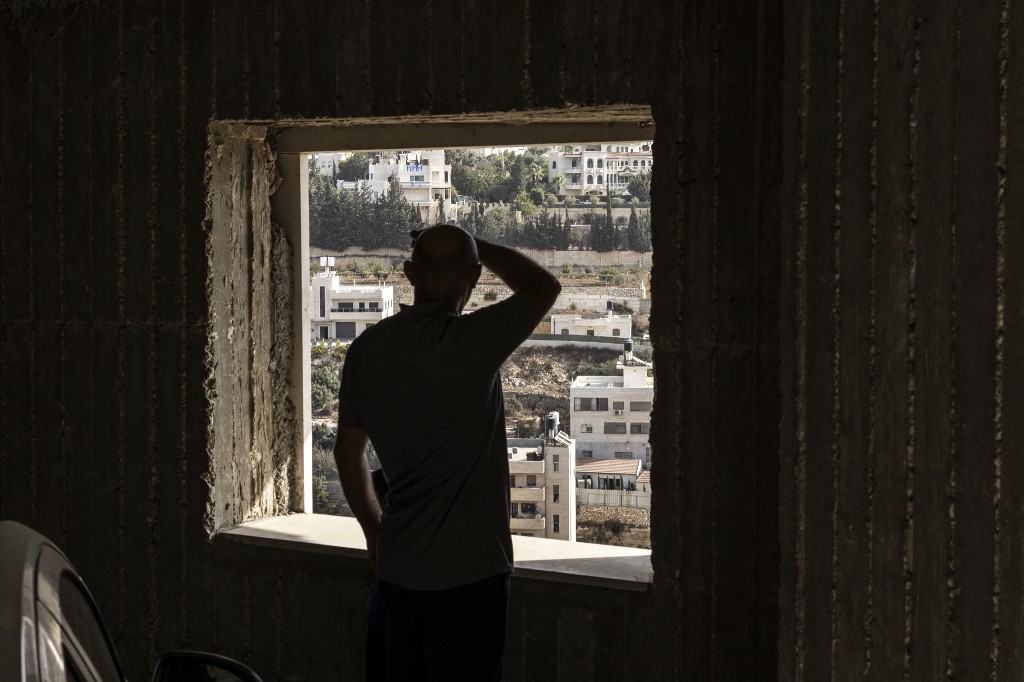
In a statement shared with Middle East Eye on Saturday evening, Hebron’s Mayor Yousef Jaabari confirmed that Israeli military forces have sealed every entry and exit point to the occupied West Bank city, and carried out forced evictions displacing roughly 2,200 Palestinian residents from their homes in surrounding neighbourhoods.
Jaabari described the current situation in Hebron as a full-blown disaster zone, noting that the total closure prevents any person or supply from moving in or out of the densely populated area. He framed the sweeping restrictions as a deliberate act of collective punishment imposed by Israeli authorities, triggered by a fatal shooting incident on Friday.
Earlier that day, two suspected Palestinian assailants opened fire on Israeli military personnel positioned at the Farsh al-Hawa checkpoint, located in the northern reaches of Hebron, resulting in the deaths of two Israeli soldiers and non-fatal injuries to three additional troops.
As the largest urban centre in the West Bank, Hebron is home to approximately 320,000 permanent residents, and serves as the administrative hub for the broader Hebron Governorate, which counts more than one million total inhabitants, per data shared by Jaabari.
The mass forced evictions targeted the neighbourhoods of Deir Bahala, al-Jalda and adjacent residential zones, covering a land area of roughly 330 dunams that holds more than 490 separate housing units. Local residents who spoke to Middle East Eye reported that Israeli soldiers gave affected families only five minutes to gather their belongings and vacate their properties, leaving no time to arrange for the transport of personal possessions. Footage circulated on social media platforms showed convoys of Palestinian truck drivers coordinating to evacuate stock and raw materials from local factories, acting in a last-minute bid to save supplies before Israeli forces move ahead with planned demolitions of the structures.
Jaabari added that Hebron municipal teams have intervened rapidly to arrange temporary shelter for all displaced residents, with the local government formally declaring a city-wide state of emergency to coordinate relief efforts and track every evolving detail of the crisis. The municipality has also launched a dedicated 24/7 crisis hotline for displaced families and affected residents to request urgent support, food, shelter or medical assistance.
Beyond the city-wide closure and mass evictions, Israeli forces also moved to lock down the Ibrahimi Mosque, a protected UNESCO-endangered Palestinian World Heritage Site, expelling all its on-site staff and custodians, according to official statements from the Palestinian Ministry of Awqaf and Religious Affairs. Jaabari confirmed that congregational prayers are no longer being held at the ancient religious site, and Israeli forces have issued a formal ban on the traditional Islamic call to prayer being broadcast from its premises.
The Ibrahimi Mosque stands as one of the oldest and most revered shared holy sites across Islam, Judaism and Christianity, and has been administered exclusively by Palestinian religious authorities and used as a mosque for more than 1,400 consecutive years. Over recent months, Israeli authorities have moved to tighten their grip on the site, rolling out a series of escalating restrictions including periodic bans on Muslim worshippers accessing the space, repeated limits on the call to prayer, and policies that enable increasing incursions by Israeli settlers into the mosque grounds.
Jaabari went on to note that the timing of the sweeping crackdown appears highly suspicious, accusing far-right factions within the current Israeli government of leveraging the crisis in Hebron, including the restrictions on the Ibrahimi Mosque and the displacement of local Palestinian residents, as free, high-visibility electoral publicity for hardline ministers competing in upcoming national Israeli elections.
‘A disaster zone’: Hebron is under full Israeli siege, mayor says