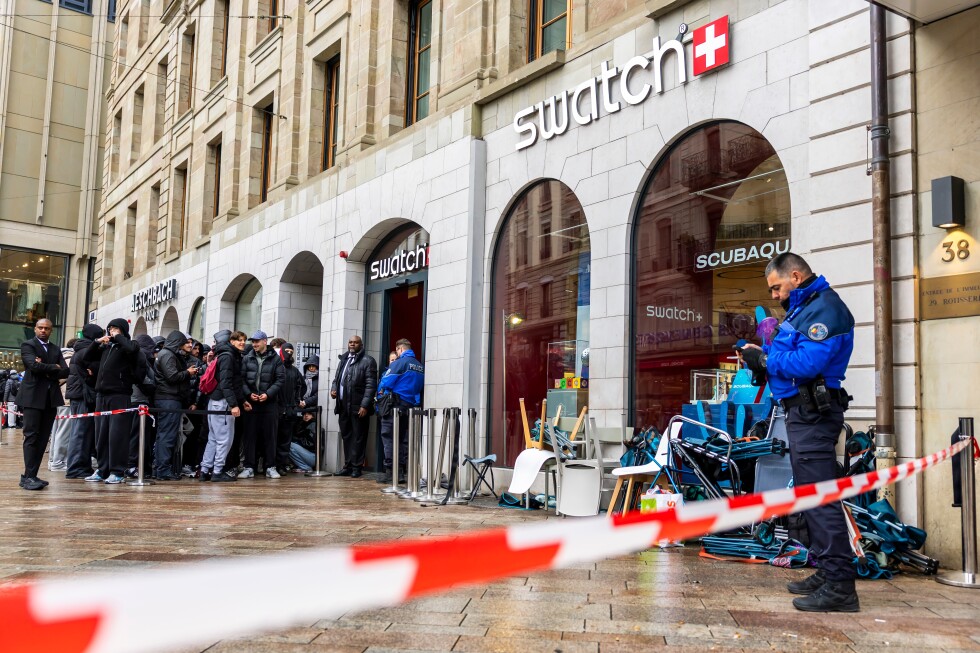
Across major global cities, chaotic scenes unfolded this weekend over the launch of Swatch’s highly anticipated collaboration with luxury watchmaker Audemars Piguet, the Royal Pop bioceramic pocket watch. From violent crowd control measures in France to fistfights in Italy and all-night snaking lines outside retail locations in London, Singapore, and New York, the launch has become the latest flashpoint for modern “drop culture” where coveted limited-edition status symbols collide with lucrative resale market opportunities.
At the center of the global mania is a timepiece that retails for approximately $400, but was being flipped within hours for thousands of dollars on secondary platforms. By the first business day after the launch, dozens of Royal Pop listings had already appeared on eBay, with one seller advertising an “IN HAND” unit for 3,055.58 British pounds, equal to more than $4,000, and inviting best offers from interested buyers.
This frenzy marks a noticeable shift from the hyped product drops that defined Swatch and other major brands over the past generation, according to industry analysts. Pierre-Yves Donze, a business history professor at Osaka University Graduate School of Economics, explained that unlike earlier drops where buyers pursued collectibles out of genuine fandom, today’s rush is almost entirely driven by the prospect of quick profit.
“It looks like people got crazy to get a Royal Pop to make money through resale, not because they are fans of the Swatch,” Donze noted. “People want money, especially. Royal Pop is not like a cool product, but a way to make easy money.”
Swatch, which has decades of experience leveraging hype around new product launches, moved quickly to calm the frenzy. The Swiss watchmaker confirmed Monday that there is no supply shortage of the Royal Pop, pushing back against the narrative that the timepiece is extremely limited. The company noted that launch-day disruptions were only reported in roughly 20 of its 220 global stores that rolled out the new watch, attributing the issues to unexpectedly large turnout that overwhelmed shopping mall infrastructure, not limited stock.
Social media has amplified the hype dramatically: the company reported that content tagged for the Royal Pop has accumulated more than 11 billion views across major platforms since the launch was announced. This mirrors the 2022 MoonSwatch launch, a collaboration between Swatch and its sister luxury brand Omega that sparked similar global in-store rushes amid pandemic restrictions. Swatch’s history of hype dates all the way back to the 1980s, when it revolutionized the watch industry with affordable, mass-produced, fashion-forward timepieces that broke from the tradition of expensive heirloom watches.
This year’s launch brought far more disruption than many industry observers expected. In London, the iconic Carnaby Street and Oxford Street Swatch stores saw crowds of dozens of people block sidewalks ahead of opening Sunday, prompting local police to close all Swatch locations across London and multiple other U.K. cities. Similar disruptions were reported across Europe and North America: stores were shuttered across the Netherlands, and New York’s Times Square location developed what attendees described as a “mosh pit” vibe.
In France, the situation escalated to require riot control measures. The French national police service confirmed that officers deployed tear gas grenades and spray to disperse unruly crowds outside multiple Swatch boutiques. At the large Westfield Parly 2 shopping mall west of Paris, television footage showed officers in riot gear and helmets stationed outside the shuttered Swatch outlet. In Lyon, officers used a tear gas grenade after the crowd ignored repeated orders to disperse from the city’s central Bellecour Square, while municipal police in Montpellier deployed tear gas spray. Swatch’s French division announced via Instagram that six stores would close for the day “because of public security considerations.”
Unlike many modern brands that have moved hyped product drops entirely online to avoid safety and liability risks, Swatch chose to release the Royal Pop exclusively through in-store retail locations, a decision that industry critics say amplified the frenzy. The exclusive in-person model created perfect conditions for resellers to monopolize initial stock, driving up the potential profits for those who managed to secure a watch early. Reports from launch weekend noted sporadic injuries, multiple arrests, and minor property damage connected to the overcrowded crowds.
London-based fashion and cultural critic Odunayo Ojo noted that most streetwear and sneaker brands abandoned in-person exclusive drops years ago over safety concerns. “Either Swatch ‘didn’t get the memo,’ he said, underestimated the draw to the new product or strategically hyped the drop to pump sales. Swatch already has a track record of understanding how these things go,” Ojo explained on his YouTube channel Fashion Roadman.
By Monday, the long lines outside most Swatch locations had dissipated, with onlookers in Paris noting that most initial stock had already sold out. In a public reassurance to consumers, Swatch confirmed that the Royal Pop will remain available for purchase through retail locations for months to come, with new shipments already en route to restock stores around the world.