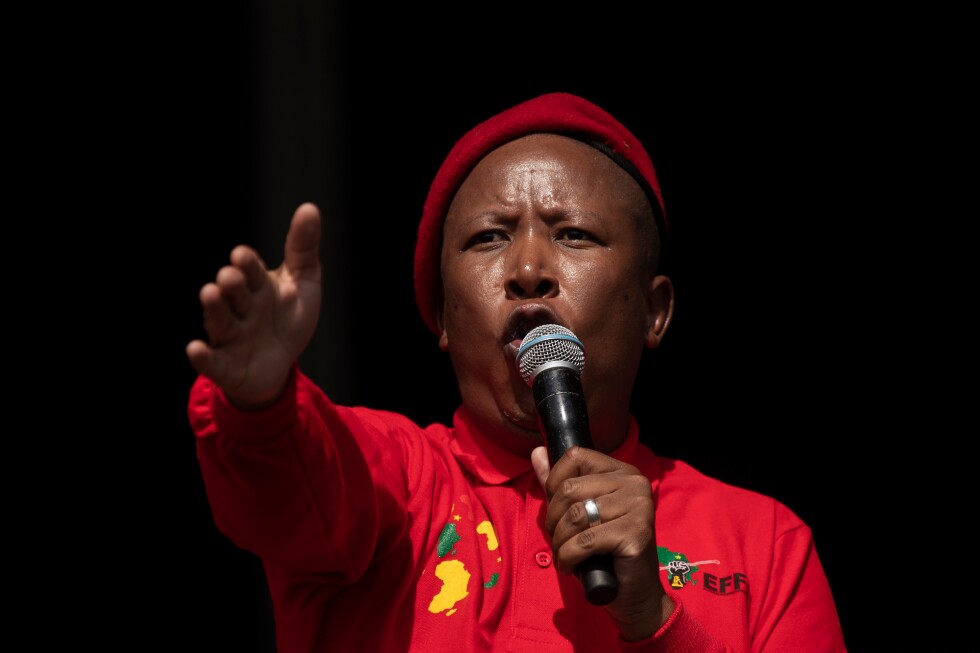
CAPE TOWN, South Africa — Julius Malema, the firebrand leftist leader of South Africa’s populist opposition Economic Freedom Fighters (EFF), has been handed a five-year prison sentence Thursday for unlawful firearm use stemming from an incident at a 2018 political rally, where he fired a rifle into the air. The sentence comes amid decades of polarizing politics that have made Malema one of the most divisive figures on the African continent, and one that has even drawn high-profile international attention from former U.S. President Donald Trump.
Malema’s career has been defined by unapologetic radicalism that has earned him fierce loyalty from his base and equally fierce condemnation from his critics. To his supporters, mostly among South Africa’s poor Black majority who still face systemic inequality decades after the end of apartheid, Malema is a champion of the marginalized, a rare politician willing to confront the lingering inequities of white minority rule and the slow pace of transformative change from the long-governing African National Congress (ANC). To his detractors, he is a provocateur whose inflammatory rhetoric stokes racial division and undermines the post-apartheid reconciliation that has held South Africa’s fragile multiracial democracy together.
Malema first rose to national prominence as the head of the African National Congress Youth League between 2008 and 2012, when his outspoken views quickly put him at odds with the ANC’s senior leadership. Once a staunch ally of former South African President Jacob Zuma — even infamously declaring “we are prepared to take up arms and kill for Zuma” — Malema eventually turned on Zuma, launching public criticisms that tested the ANC’s patience past its breaking point. A series of controversial incidents culminated in his 2012 expulsion from the party, after he labeled the government of neighboring Botswana a Western puppet regime, drawing condemnation from ANC leadership.
Throughout his early career, Malema established his signature anti-Western stance, repeatedly accusing the United States and United Kingdom of maintaining imperialist, racist attitudes toward South Africa. A 2010 incident exemplified this confrontational style: he expelled a BBC journalist from a press conference, calling the reporter a British “agent” and using abusive language, a move that drew widespread rebuke from the ANC and international press freedom groups.
After his expulsion from the ANC, Malema founded the EFF in 2013, positioning the party as a far-left, anti-capitalist alternative to the long-governing ANC. The EFF’s core policy platform calls for radical economic restructuring, most notably the expropriation of white-owned land for redistribution to Black South Africans, who were systematically dispossessed under apartheid. Though the party has never won enough national support to enter government, taking just 10% of the vote in the 2024 national election and remaining outside the current ruling coalition, it holds parliamentary seats and has become a major disruptive force in South African politics.
Malema, who styles himself the EFF’s “Commander in Chief,” has repeatedly drawn criticism for racially charged rhetoric. In one widely condemned speech targeting South Africa’s white minority, he remarked, “We are not calling for the slaughter of white people — at least for now,” and has also made derogatory comments about South Africans of Indian descent. He has also revived the apartheid-era chant “Kill the Boer” — a phrase targeting white South African farmers — which opponents have decried as overt hate speech.
Malema’s inflammatory rhetoric has not just stirred domestic controversy; it has spilled over into international diplomacy, creating a rift between South Africa and the United States during the Trump administration. Trump and his allies, including South African-born billionaire Elon Musk, have seized on Malema’s rhetoric to push the unsubstantiated claim that South Africa’s Black-led government is overseeing a widespread campaign of violence against white farmers. During a high-stakes 2023 Oval Office meeting between Trump and South African President Cyril Ramaphosa, a video reel featuring Malema and the EFF was played, with Trump confronting Ramaphosa over the alleged anti-white agenda. The exchange marked a major low point in diplomatic relations between the two countries.
Domestically, Malema and the EFF have become a consistent thorn in the side of Ramaphosa and the ANC, repeatedly disrupting parliamentary proceedings over the past decade. Multiple times, EFF lawmakers have been ejected from the national legislature for interrupting speeches and government business. The most high-profile incident came in 2023, when Malema and a group of EFF members, clad in the party’s signature red worker overalls, stormed the stage during Ramaphosa’s annual address, leading to physical scuffles with parliamentary security.
Thursday’s sentencing stems from a 2018 incident, when Malema fired a rifle into the air at a political rally. He was formally convicted of unlawful firearm offenses in October, after a legal push from an Afrikaner minority rights group pressured prosecutors to bring the case to trial. Immediately after the sentencing, Malema’s legal team filed an appeal, and he has been released on bail while the appeal process proceeds. If his conviction is upheld on appeal, Malema will be forced to serve his five-year sentence, and will be barred from serving as a member of parliament for five years after the completion of his sentence — a outcome that would reshape South Africa’s opposition political landscape ahead of the next national election cycle.