Morocco hosts the largest remaining Jewish community in North Africa, numbering approximately 2,500 people. The North African kingdom has a long history of recognizing and elevating its Jewish heritage, and enshrined the country’s ‘Hebraic tributary’ in its 2011 constitution to legally protect and sustain the Jewish presence in Moroccan public life. In recent years, dozens of publicly advertised projects focused on restoring Jewish heritage sites, running interfaith tolerance workshops, and delivering cross-sector programs for rural communities of all faiths have been implemented across the country. But behind these seemingly benign cultural and historical initiatives, a coordinated, long-running political campaign led by foreign Zionist and pro-Israel organisations is working to reshape Morocco’s deeply rooted public support for Palestine, a new investigation by Middle East Eye has found.
The investigation reveals that the modern campaign follows a blueprint first laid out in the 1960s by the Jewish Agency, the operational arm of the World Zionist Organisation tasked with encouraging Jewish migration to Israel. Operation Yachin, the 1961-1964 initiative that moved roughly 90,000 Moroccan Jews — more than half of the kingdom’s entire Jewish community at the time — to Israel, included the creation of overt Zionist youth clubs designed to spread pro-Israel propaganda to young Moroccans. Today, the strategy has evolved to become far more subtle and organic, blending funding and support from Israel and the United States with partnerships with local Moroccan groups and Jewish diaspora organisations.
Yasmine, a young Moroccan anthropologist who used a pseudonym to protect her security, participated in one of these programmes several years ago before uncovering their underlying political agenda. She explained to MEE that most young participants cannot easily distinguish between Judaism as a religious identity and Zionism as a political ideology, a gap that the organisations deliberately exploit. ‘Many of these projects operate within that grey zone: they present cultural and historical content, but they also subtly introduce political narratives,’ Yasmine said. She recalled joining an interfaith dialogue programme focused on Moroccan-Jewish heritage that she believed was purely academic and cultural, only to be unexpectedly interviewed by an Israeli news channel while facilitating a workshop. Her comments were later reframed on Israeli national television to fit a pro-Zionist narrative that she never endorsed, a moment that revealed to her how easily cultural programming can be weaponized for political ends.
Compared to the overt, top-down propaganda campaigns of the Operation Yachin era, which were openly tied to state and intelligence priorities, modern initiatives have adapted to Morocco’s unwavering public support for Palestinian statehood — particularly after the 2020 Abraham Accords, the U.S.-brokered deal that normalized relations between Morocco and Israel, and the 2023-2024 Israeli military campaign in Gaza that killed more than 45,000 Palestinians. Openly pro-Israel programming now faces intense public backlash in Morocco, so organisations have shifted to discreet messaging focused on culture and history rather than explicit political advocacy, Yasmine noted.
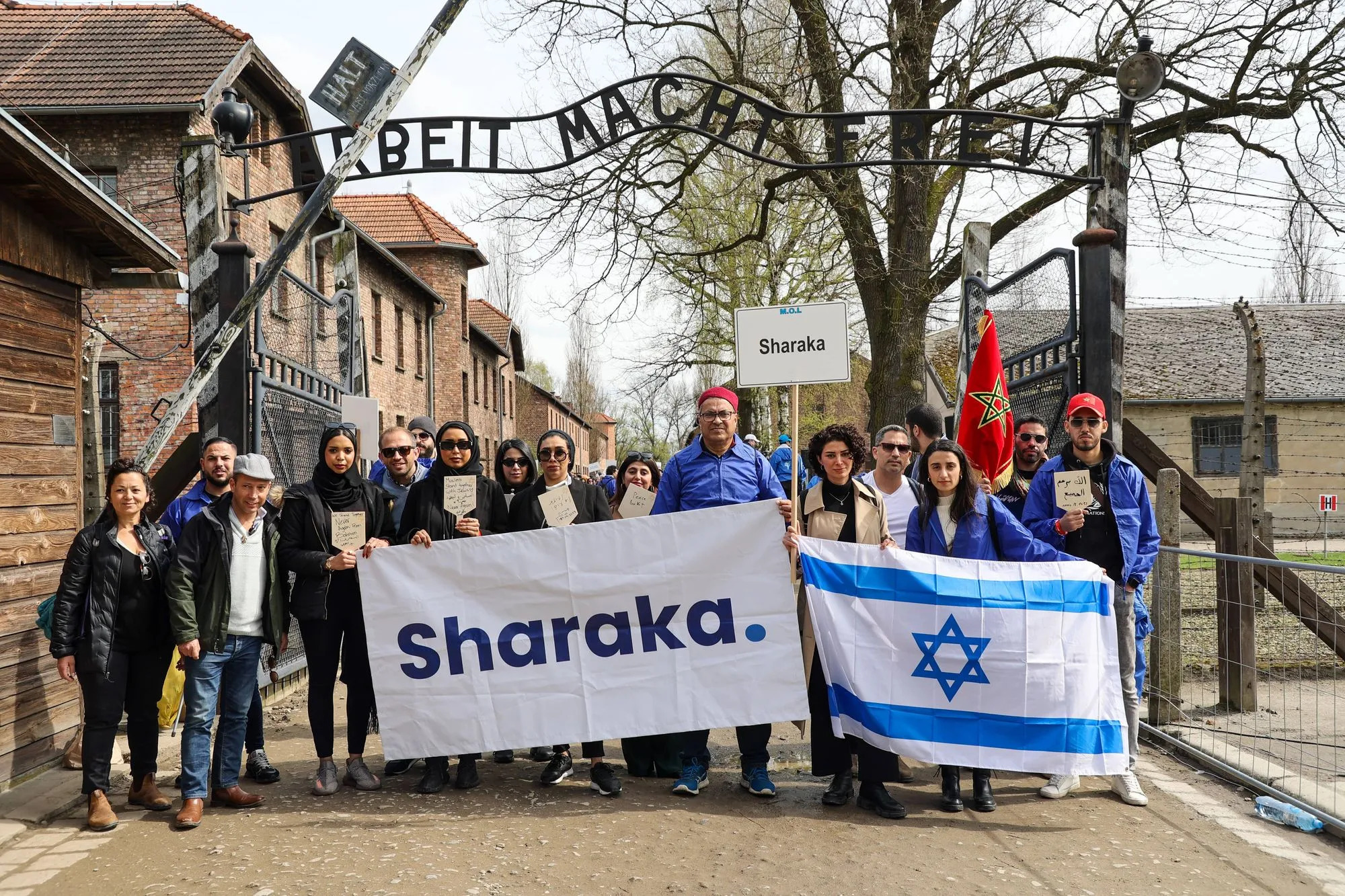
The 2020 Abraham Accords directly accelerated the expansion of these initiatives in Morocco. One of the most high-profile groups to emerge after the accords is Sharaka, an Israeli-founded organisation that operates in Morocco and four other MENA countries, with more than 1,000 program participants and 100 staff. Sharaka frames its mission as building ‘warm peace’ and people-to-people normalization between Israel and the MENA region, and regularly runs trips for young Moroccans to visit Israel and Holocaust sites in Europe. The organisation has faced repeated criticism for refusing to address or condemn Israel’s illegal occupation of Palestinian territory. In September 2024, Youssef Elazhari, head of Sharaka’s Moroccan branch, sparked widespread controversy after claiming during a trip to Israel that the Prophet Muhammad was a Zionist.
Another major player is We Are Mena, formerly known as the 4MENA Network, which was founded by the Israeli government in 2021 and now operates in more than 15 regional countries. In 2025, the group launched a pilot programme called ‘From hate to hope’ that trains 25 Moroccan educators to teach Holocaust education to 1,500 Moroccan students, including a week-long study trip to Germany and Poland, before having participants develop curricular materials to spread the curriculum to classrooms across the Arab world. Morocco was the first country to roll out the programme, MEE understands.
The American Society of Overseas Research (ASOR), a U.S.-founded organisation that partners with the U.S. Agency for International Development (USAID) to run Jewish heritage programmes in Morocco, is another key entity behind the campaign. ASOR claims to be apolitical and non-religious, but an investigation of its ties reveals direct links to pro-Zionist activity and support for the Israeli army. In 2014, ASOR launched JGive, a non-profit fundraising platform that provides technological infrastructure for donations to Israeli charities. Between October 2023 and December 2024, at the height of Israel’s military campaign in Gaza, JGive distributed 548 grants totaling 29 million Israeli shekels ($8.8 million) to groups operating in Gaza, including explicit ‘vital support for soldiers on the front lines,’ according to the platform’s 2024 financial report.
Dror, an organisation founded by the Israeli government with an annual turnover of $25.8 million, is also active in Morocco. The group states its mission is to ‘educate and act to strengthen the values of Zionism, democracy and equality,’ and partners with the Israeli Ministry of Defense to provide educational, rehabilitation, and care support for Israeli soldiers.
MEE’s investigation found that nearly all of the dozen pro-Israel-linked organisations operating in Morocco — whether large foreign groups or local Jewish associations — are directly or indirectly tied to ASOR, Dror, or other entities linked to the Israeli government. These partnerships include the Mimouna Association, a well-known group that runs interfaith programming on Moroccan-Jewish heritage, organizes diaspora engagement, and runs trips to Israel and European Holocaust sites, while openly endorsing Zionism. The High Atlas Foundation, a prominent Moroccan non-profit focused on agricultural development and women’s empowerment, also receives funding from ASOR for projects preserving Jewish Moroccan heritage sites.
A source working within one of Morocco’s largest Jewish organisations told MEE that nearly all funding for these projects comes from large U.S. or Israeli-based entities, despite some groups listing Moroccan government ministries as public partners. The Moroccan government has rarely provided direct funding to these groups, the source said: ‘Even though some associations have been running for decades, they have only received funding from the government on a couple of occasions at the most.’
A consistent thread across all of these initiatives is the strategic focus on recruiting young Moroccans of all faiths, echoing the 1960s Zionist tactic of targeting youth to shape long-term public attitudes. A source within ASOR told MEE that youth engagement is ‘essential’ to ensure the long-term impact of the organisation’s projects. Yasmine noted that youth are not just a key demographic — they are also the most influential communicators in modern social media landscapes. Participants are not selected randomly: organisations intentionally target young Moroccans who already hold public influence in entrepreneurship, activism, political parties, or civil society, and who often have large social media followings. These are individuals whose existing public trust can help spread pro-normalization narratives to wider audiences.
Si Mohammed Darghali, a young Moroccan activist with more than 5,600 Facebook followers who regularly posts about his support for Sharaka and Muslim-Jewish coexistence, exemplifies this approach. After an Israeli television program praised his ‘brave efforts’ to bring Jews and Muslims together, Darghali reposted the interview alongside a message promising to continue working to promote his model of coexistence, closing the post with an emoji placing the Moroccan and Israeli flags side by side.
Yasmine explained that many young Moroccans join these programs out of genuine curiosity about Morocco’s Jewish heritage, which has increasingly been recognized as a core part of the country’s national identity. Others are drawn by tangible personal incentives: the programs offer opportunities for international travel to Europe and the United States, which is often out of reach for most Moroccans due to strict visa requirements, as well as opportunities to build professional networks and boost participants’ resumes. Recruitment is carried out openly, just like any other civil society initiative in Morocco, which makes the programs feel trustworthy and leads many young people to not question their underlying agenda, Yasmine added. Organisations also build trust by partnering with established local groups, including major Moroccan universities, which help identify and recruit interested participants and lend cultural legitimacy to the initiatives.
MEE reached out to all major organisations named in the investigation for comment, and was unable to review the full scope of activity of all Jewish-led groups operating in Morocco.