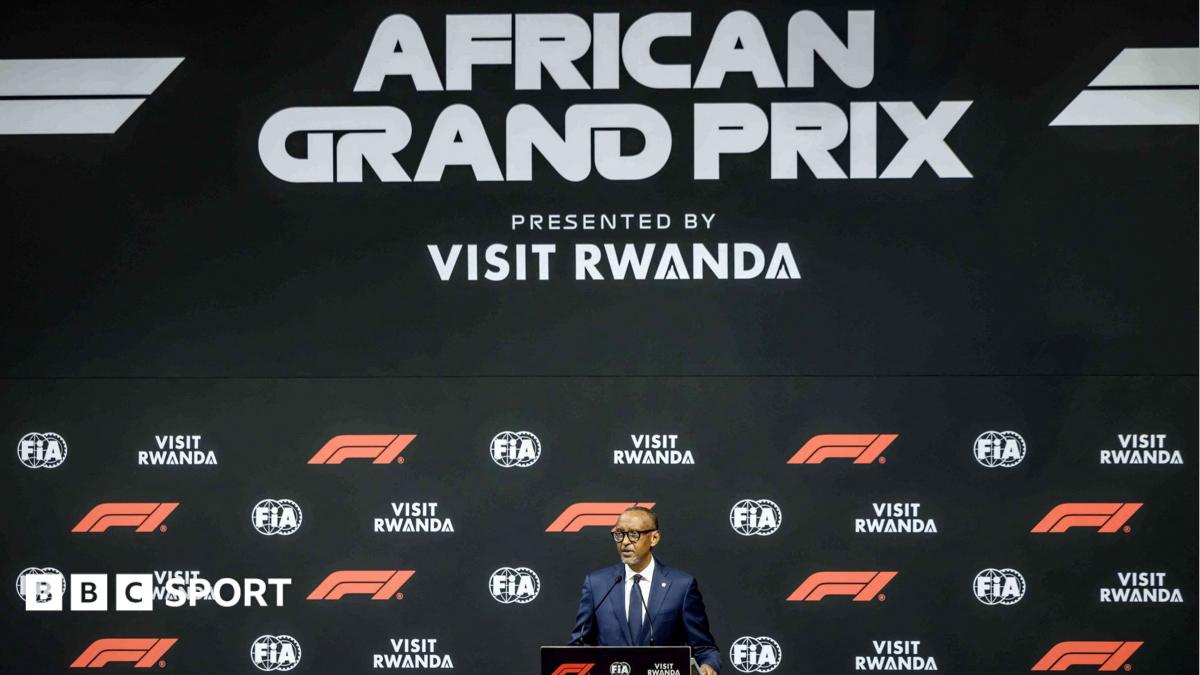
After nearly four decades away from the African continent, Formula 1 has announced a historic agreement that will bring the African Grand Prix to Rwanda, marking the end of a 10-year push by series owners Liberty Media to expand the sport into untapped global markets. The announcement was made Tuesday at an official event in Kigali, with F1 president Stefano Domenicali joining Rwandan President Paul Kagame and FIA president Mohammed Ben Sulayem on stage to mark the occasion.
Liberty Media has held an ambition to host a Formula 1 race on African soil since it acquired the commercial rights to the sport in early 2017, and seven-time world champion Lewis Hamilton has publicly advocated for adding an African race to the calendar for years. Rwanda beat out competing bids from Morocco, South Africa and other interested nations to secure the hosting rights, signing a 10-year contract that will see the first race held in the early 2030s. What set Rwanda apart from rival bidders was its cohesive, unified proposal with secured financial backing and a clear long-term vision for the project, while Morocco struggled to source sufficient funding and South Africa advanced four separate conflicting proposals across three different locations that F1’s leadership deemed unworkable for an already crowded global calendar.
The new purpose-built circuit will be constructed on a greenfield site in Bugesera, approximately 25 miles south of Kigali, as part of a large mixed-use development adjacent to a new international airport currently under construction. The development will include not just the race track, but also residential neighborhoods, hotels, spas, sports science facilities, an entertainment district and an innovation hub. Insiders familiar with the project have confirmed that there are no expected barriers to completing construction ahead of the proposed 2030 launch date.
Designed by former F1 driver Alex Wurz, the 6km circuit is planned to leverage Rwanda’s dramatic natural undulating terrain to create a driver challenge in the vein of iconic classic tracks like Spa-Francorchamps, Suzuka and Mugello, with nearly 200 meters of total elevation change across 17 corners. Preliminary released renders of the layout already show clear similarities to the opening section of Japan’s Suzuka, and Wurz’s design will be finalized after additional consultation with F1 teams and competing drivers.
Domenicali described the deal as a landmark moment for F1’s global growth, saying he was proud that the series was opening the sport to a new generation of fans across the African continent. He praised Rwanda as a global success story, highlighting the country’s natural beauty, resilience and growing reputation as a hub for international investment and innovation. For his part, Kagame framed the Grand Prix as more than just a national event, saying it would create jobs, boost tourism, attract new business and skills, and pave the way for future major motorsport events across the continent. He emphasized that the project would help break the long-standing cycle where African athletes achieve global success while the continent sees little economic or infrastructural benefit from international sport.
The deal has already ignited controversy, however, with critics accusing Rwanda of using the high-profile motorsport event for sportswashing, a practice where nations host major sporting events to distract attention from alleged human rights violations. Rwanda has pushed back against these claims, noting that the project is funded through a combined public-private development fund, rather than diverting funds from social services in a country that still receives international development aid. The Grand Prix is part of Rwanda’s broader five-year economic strategy that aims to attract £3.5bn in private investment to drive national growth, boost tourism and expand GDP.
Currently, the Democratic Republic of Congo has a case pending against Rwanda at the International Court of Justice, accusing the Rwandan government of violating international treaties on genocide prevention, racial discrimination, women’s rights and torture. F1 is not the first global sports property to face these accusations related to Rwandan partnerships: English Premier League clubs Arsenal and Aston Villa have also faced criticism for sponsorship deals with the Rwandan government. This is not a new issue for F1 either, as the series already hosts races in other countries that have faced sportswashing claims, most notably Saudi Arabia, which is also set to host the 2034 FIFA World Cup.
In response to the controversy, F1 cited its organizational charter, which commits the series to upholding internationally recognized human rights across its global operations, with mandatory monitoring of potential impacts and stakeholder engagement to address emerging concerns. The league emphasized that bringing F1 to Africa would inspire 100 million new fans and that sport can act as a force for positive change across the continent.
But human rights advocates have rejected that position. Felix Jakens, head of campaigns at Amnesty International UK, argued that “Rwanda is buying into the world’s biggest sports to polish its image and deflect from its appalling human rights record.” Jakens added that F1’s claims of being a force for good ring hollow when the league ignores the human rights record of its host partners, calling on F1 to use its influence to push for reform rather than lending its global brand to what Jakens called a public relations exercise.