Ten years after Crown Prince Mohammed bin Salman led Saudi Arabia into a costly war to oust the Houthi movement from power in Yemen, the kingdom’s years-long strategy to contain the group while pursuing ambitious domestic economic growth has collapsed—creating one of the most severe challenges to the crown prince’s rule since he took power, according to international analysts and diplomatic sources.
The 2015 intervention quickly devolved into a deadly quagmire, draining Saudi state resources and drawing global condemnation over widespread civilian casualties from the kingdom’s bombing campaigns. By 2022, Riyadh chose to cut its losses, agreeing to an uneasy truce that held for nearly two years—until a July 2024 Saudi airstrike on Sanaa International Airport, carried out to block a plane carrying Houthi officials and reportedly Iranian, Syrian and Hezbollah military advisors alongside advanced weapons systems, reignited full-scale hostilities.
“This is the collapse of Saudi Arabia’s containment strategy,” explained Rob Geist Pinfold, an international security researcher at King’s College London, in an interview with Middle East Eye. Pinfold drew a parallel between Riyadh’s approach to the Houthis in recent years and Israel’s pre-October 7 strategy toward Hamas in Gaza: “The Saudis felt they had the Houthis exactly where they wanted them. They weren’t ready to pursue a full political settlement, but they believed they had created enough deterrence to stop the group from launching major escalations.”
That deterrence has shattered completely. In response to the Sanaa strike, the Houthis announced a full blockade of Saudi shipping and launched a rapid, coordinated offensive along Yemen’s Red Sea coast that has left Saudi forces and their Yemeni allies struggling to repel advances. Military experts emphasize that this round of conflict poses far greater risks to Saudi Arabia than previous fighting, for two key reasons: the kingdom has far more economically at stake today, and the Houthis have evolved into a far more capable, technologically advanced adversary.
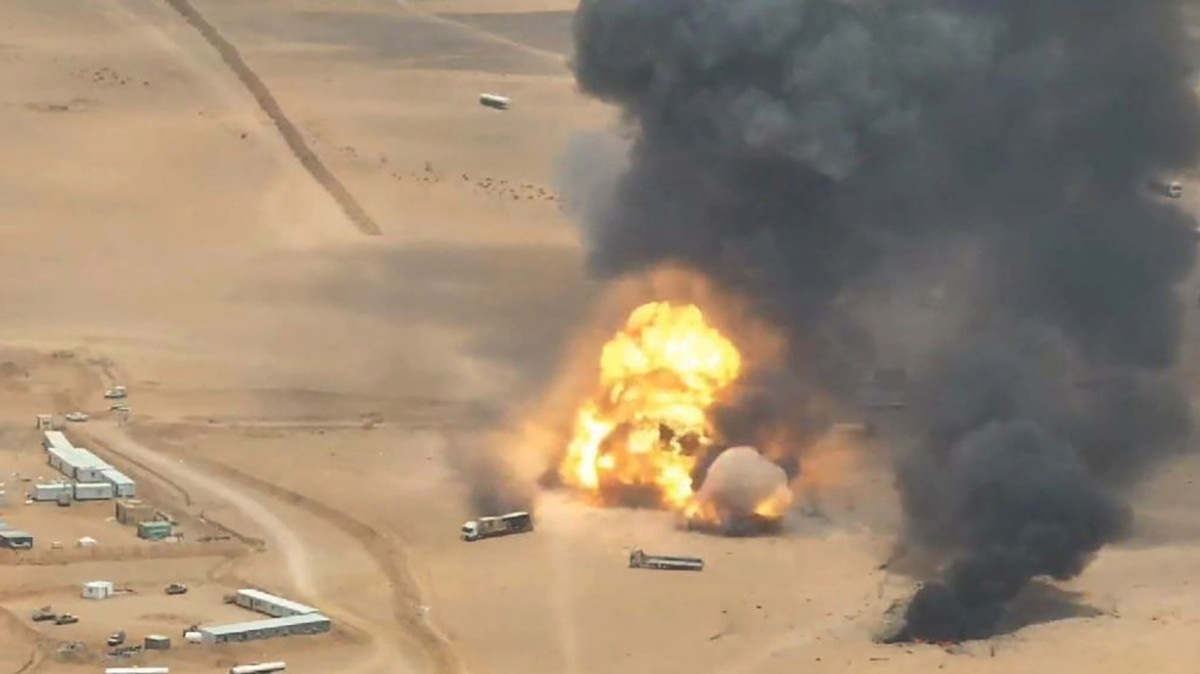
Where past Houthi missile and drone attacks were largely inaccurate, the group’s targeting capabilities have improved dramatically in recent months. Over a single seven-day period, Houthi strikes hit Riyadh International Airport three consecutive days, with a Saturday attack leaving at least 13 dead and more than 300 injured. Days later, the group struck the headquarters of Saudi state oil giant Aramco in Dhahran, a major eastern Saudi city, underscoring their ability to hit critical, high-value infrastructure deep inside the kingdom.
The repeated successful strikes have raised sharp questions about the performance of Saudi Arabia’s costly military, which relies heavily on imported U.S. defense systems including Patriot and THAAD air defenses. With 6.5% of its GDP dedicated to military spending—one of the highest ratios globally, per Stockholm International Peace Research Institute data—many observers have expressed surprise at the Houthis’ consistent ability to penetrate Riyadh’s defenses.
“It’s quite striking, literally, that the Houthis can hit these incredibly important facilities in Saudi Arabia at will, and the Saudis cannot stop them,” said Gregory Gause, a leading Gulf scholar at the Middle East Institute. “They clearly have far more advanced missiles and targeting technology than they did in previous rounds of fighting.”
A Western defense official based in Riyadh, speaking on condition of anonymity, acknowledged that while Saudi defenses intercept roughly 90% of incoming projectiles, the Houthis have refined tactics to bypass these systems. “The Houthis are a lot more effective than Iran was back in February. They learned from earlier escalations this year,” the official said. “Their success comes from a mix of tactical innovation, rapid operational speed, and up-to-date intelligence.”
The group has had significant time and opportunity to build its capabilities: the 2022 ceasefire allowed the Houthis to entrench their positions in Yemen’s rugged northwestern mountains, and they honed their offensive tactics attacking commercial shipping in the Red Sea after October 7 2023, in what they framed as an act of solidarity with Palestinians in Gaza. Multiple reports confirm the group has received increased military support from both Iran and Russia in recent months.
The gap between offensive missile capabilities and defensive air defenses is not a new strategic challenge—Israel continuously updates its defense systems, and the war in Ukraine has become a live testing ground for new military hardware—but the stakes for Saudi Arabia today are uniquely high. Unlike 2015, the kingdom is far more integrated into the global economy, and Riyadh is set to host its flagship annual Future Investment Initiative conference later this month, making a prolonged closure of Riyadh International Airport a major economic and diplomatic embarrassment.
Even before the latest escalation, the Saudi economy faced significant headwinds: the kingdom projects a 3.6% GDP contraction for 2024 and has already been forced to scale back the signature megaprojects that form the core of Crown Prince Mohammed’s Vision 2030 economic transformation plan. A prolonged, expanded war would put massive additional strain on public finances.
Unlike the Houthis, who control little formal modern economic infrastructure to protect, Saudi Arabia’s dense network of critical economic targets makes every successful strike far more costly for Riyadh than any retaliatory strike is for the Houthi movement. “A Houthi strike on Riyadh airport is so much more damaging to the Saudis than a Saudi strike on Sanaa airport is to the Houthis,” Gause noted.
One bright spot for Saudi Arabia in the current conflict is the increased international sympathy it has garnered, thanks in large part to its comparatively restrained response to the attacks. Footage of Umrah pilgrims caught in the Houthi strike on Riyadh airport sparked widespread global condemnation of the movement, and Riyadh has worked to maintain international support through new strategic overtures. Earlier this month, the kingdom activated the Mecca Pact, a joint defense agreement with Pakistan and Turkey; Islamabad has already deployed military assistance, with Ankara expected to follow suit. The United States, Saudi Arabia’s closest major ally, has so far avoided public involvement in the fighting but has provided covert defensive support and intelligence sharing. Notably, prominent Democratic Senator Chris Murphy, one of the most vocal critics of Saudi Arabia’s 2015 Yemen war, visited Riyadh earlier this month and did not call for a Saudi de-escalation.
Still, some regional analysts argue Saudi Arabia’s restraint has gone too far. “I think you need to flex some muscle. Being dovish when you are being attacked is not quite wise,” said Bader al-Saif, a security scholar at Kuwait University. “The Houthis need to be pushed to the negotiating table, and that means forcing changes on the ground.”
A major structural barrier to an effective Saudi counteroffensive is Riyadh’s reluctance to deploy its own ground troops into Yemen, forcing the kingdom to rely on fractured local Yemeni allies. While Riyadh backs Yemen’s internationally recognized government, that force is deeply divided and has performed poorly in the current offensive, which aims to retake all territory the Houthis seized in 2014. A Western official tracking the offensive described the government’s military performance as deeply disappointing: “The capabilities of Yemeni government forces have been hyped up in recent months, but they have been pretty defective. One force showed up to fight without food and water. Other units have just melted away, leaving the flanks exposed.”
The most effective fighters against the Houthis are Yemeni separatist factions backed by the United Arab Emirates, but long-running tensions between Riyadh and Abu Dhabi over the separatists’ goal of an independent southern Yemen have prevented a coordinated front. While Saudi Arabia hosted UAE Vice President Mansour bin Zayed last month in an effort to repair bilateral relations, the continued public push for southern independence was on full display this week, when exiled separatist leader Aidarous al-Zubaidi released a video positioned in front of a map of the former independent southern Yemeni state, calling for global recognition of his proposed state even as he mobilized against the Houthis.
“His appearance was unnecessary and revealed the underlying Saudi-Emirati divergence despite Abu Dhabi’s messaging of solidarity. His statement was not one of cohesion,” noted Ibrahim Jalal, an independent Yemeni and Gulf security expert. Jalal added that the counteroffensive remains in its early stages, and Saudi Arabia could still take more aggressive steps to strengthen its local allies, including increasing arms shipments to the Yemeni government.
Most analysts agree that a long-term solution will require broader regional diplomacy, specifically between the United States and Iran. While the Houthis have their own domestic political motivations for the current offensive, their strategy is closely tied to stalled de-escalation talks between Tehran and Washington. “The only practical path the Saudis have right now is pushing the US to reach a political understanding with Iran to end this cycle of conflict,” Gause said. “The only way the Houthis get restrained here is if the Iranians tell them to. That can only come from a US-Iran political deal.”