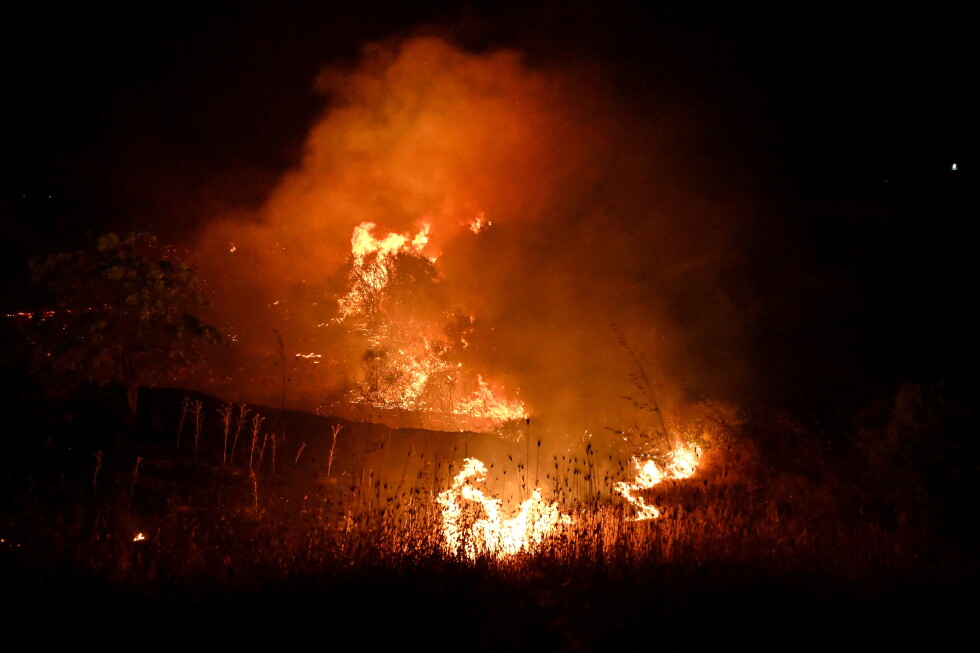
On Saturday evening, a rapidly expanding wildfire erupted close to the suburban areas of Thessaloniki, Greece’s second-biggest urban center, forcing emergency evacuation orders for residents of three small northern suburbs, according to Greece’s national Fire Service.
The blaze first ignited in a deep ravine nestled in a mountainous zone shortly after 8:30 p.m. local time (1730 GMT), and strong regional gusts pushed the flames across the landscape at an alarming rate before they reached the surrounding plains. Fire officials confirmed that while no residential properties have suffered damage so far, multiple commercial buildings have already been consumed by the fire.
Emergency alerts were sent via text message to all residents of the three affected settlements — Anthoupoli, Filothei and Galini — ordering them to leave their homes immediately. Among the evacuated sites was a care facility housing 157 people with disabilities and special needs. Local government representatives reported that approximately 120 residents who were able to travel independently are now sheltered in a nearby municipal gymnasium, while the remaining 37 people with more intensive care requirements were relocated to a nearby psychiatric hospital that could accommodate their needs.
By midnight, the Fire Service confirmed that law enforcement had taken a 76-year-old man into custody on suspicion of intentionally starting the wildfire. Officials noted that the suspect appeared to be intoxicated at the time of his arrest.
For residents of central Thessaloniki, the wildfire presented a terrifying visible spectacle: orange flames were clearly visible on the horizon, and loud explosions could be heard as flammable materials stored inside the burning commercial structures caught fire and ignited. A thick, toxic blanket of smoke drifted across multiple suburbs and western districts of the city, reducing air quality dramatically.
As of Sunday morning, roughly 115 firefighters and 38 fire engines were joined by dozens of volunteer first responders in the battle to contain the blaze. Aerial firefighting aircraft conducted initial water drops, but were forced to suspend operations once night fell, as fixed-wing and rotary aircraft do not conduct active firefighting after dark in Greece.
Officials confirmed that there is currently no immediate risk that the fire will advance into the core of Thessaloniki, but firefighting command has kept all crews on high alert and additional resources have been dispatched to the region to reinforce containment efforts. Persistent strong winds across the area remain the biggest challenge to containing the spread of the flames.
Greece, which faces long, hot, dry and regularly windy summer conditions, is one of the European countries most vulnerable to seasonal wildfires. Remarkably, the country avoided any major wildfire damage through the entire month of June this year. The first large-scale wildfire of the 2024 season broke out just this past Wednesday in central Greece, which claimed the lives of a father and his 12-year-old son before it was contained, and also required mass evacuation orders for multiple local communities. So far this summer, Greece has also avoided the record-breaking extreme heatwaves that have already engulfed most other regions of the European continent.
Saturday saw multiple other active wildfires burning across the broader Thessaloniki region, including one on the Halkidiki Peninsula, one of Greece’s most popular coastal vacation destinations for both international and domestic tourists, and a second blaze near the northern city of Kilkis.