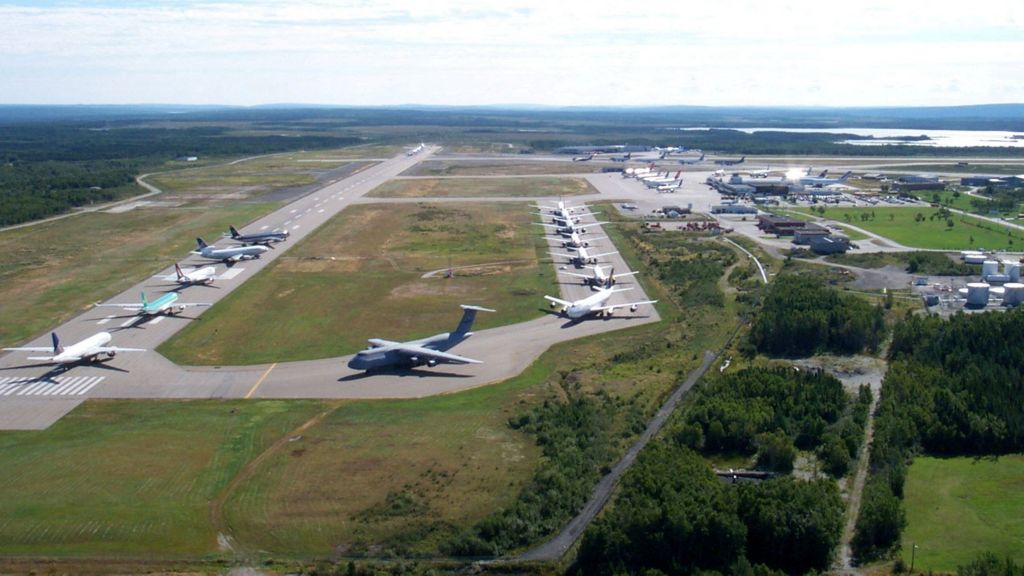
On September 11, 2001, when terrorist attacks on the World Trade Center and the Pentagon shut down all U.S. airspace, a tiny Atlantic coast community in Canada stepped into the global spotlight. Gander, Newfoundland, opened its borders, its homes and its hearts to more than 6,000 stranded passengers and crew from 38 diverted international flights originating from 95 countries. For five days, local residents doubled their town’s population to care for stranded travelers, offering free shelter, meals, medical care and clothing. This extraordinary act of neighborly solidarity later inspired the Tony Award-winning Broadway musical *Come From Away*, which cemented Gander’s legacy as a symbol of cross-border friendship between Canada and the United States.
A quarter century later, Gander is once again making headlines – but this time, the narrative centers on growing friction between the two North American allies, not shared goodwill. As the town prepares to mark the 25th anniversary of 9/11 with official commemoration ceremonies Friday, plans to host U.S. Ambassador to Canada Pete Hoekstra have sparked fierce public backlash, with hundreds of thousands of Canadians demanding the invitation be withdrawn entirely.
The widespread opposition to Hoekstra’s planned visit is widely viewed as a clear barometer of how deeply bilateral relations have deteriorated, reaching their lowest point in decades. This marks a dramatic reversal from the aftermath of 9/11, when Canada opened its country as a safe haven for stranded Americans, and Canadian troops later fought alongside U.S. forces in Afghanistan.
The current downturn in relations traces back to the return of Donald Trump to the White House, which sparked a full-scale trade war between the two nations. Bilateral trade talks collapsed in late August, leaving negotiations at a standstill, and both sides have since imposed retaliatory tit-for-tat tariffs on billions of dollars in cross-border goods. Recent polling from the Pew Research Center conducted in June underscores the collapse in public trust: fewer than half of Canadians now view the U.S. as a reliable ally, a sharp drop from 83% who held that view just two years prior in 2022.
Hoekstra has emerged as a lightning rod for Canadian anger at the current U.S. administration. He has drawn widespread condemnation for comments that many Canadians see as deliberately undermining bilateral relations, including his normalization of Donald Trump’s controversial “51st state” rhetoric that suggests Canada could become part of the U.S. When faced with public backlash over the remarks, Hoekstra publicly stated he does not understand the emotional reaction among Canadians to the president’s comments, and he made national headlines last year for a heated, combative exchange with a senior Canadian official in Washington. As of early September, an online petition calling for Hoekstra’s expulsion from Canada had gathered nearly 270,000 signatures. His office has confirmed it is aware of the petition but declined to issue any further comment.
The anger has spread across the country. On Tuesday, British Columbia Premier David Eby unveiled a new border sign that reads, “Canada will NEVER be the 51st state. Sorry!”, while referencing his own province’s role hosting stranded passengers on 9/11. Though Eby questioned whether Canadians would feel the same willingness to step up today amid rising tensions with the U.S., he affirmed that the country would still respond with compassion “You bet your ass we would.”
Facing growing public pressure, the Gander Town Council released an official statement last week defending its decision to extend the invitation to Hoekstra, noting that inviting U.S. diplomatic representatives is standard appropriate protocol for national commemorations. “We understand why people feel strongly about this,” the statement read. “We are proud Canadians, and we understand the frustration and disappointment many Canadians are feeling about the current state of the relationship between Canada and the United States.” The council emphasized that the sole focus of the event is to honor the nearly 3,000 lives lost in the 9/11 attacks, not to endorse current U.S. policy.
In recent days, some opposition to Hoekstra’s visit has softened, with many local residents and commentators echoing the council’s view that the anniversary should rise above current political tensions. Newfoundland-based columnist Pam Frampton wrote in *The Telegram* on Wednesday that while Hoekstra is unquestionably a controversial figure in Canada, the commemoration events were never intended to be a political platform. “To do anything but welcome the United States’ representative in Canada to Gander for the anniversary of 9/11 would have contradicted everything the town has become synonymous with – tolerance, goodness, big-heartedness, unstinting hospitality,” Frampton wrote.
Gander Mayor Percy Farwell echoed that sentiment in an interview with Canadian public broadcaster CBC, noting that the town’s legacy of compassion should transcend political divisions. “The humanity of what happened here, I think that rises above the political discussions and all the other saber-rattling,” Farwell said. “Hopefully this is a bit bigger than all that.”