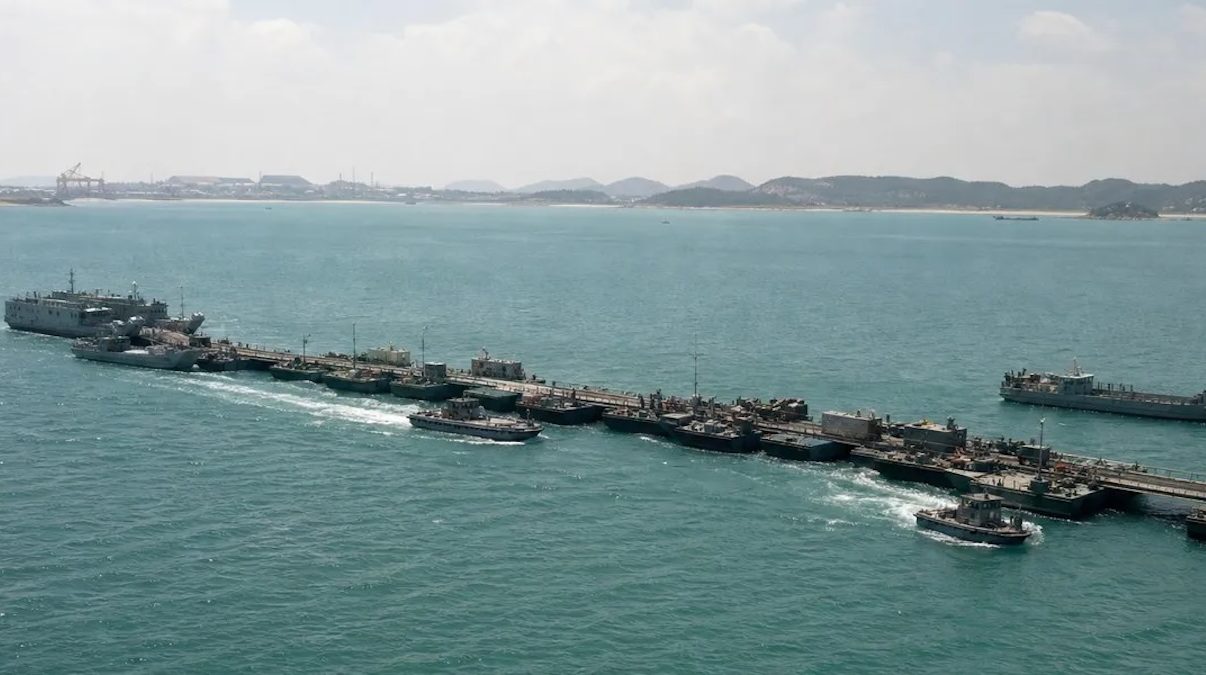
Recent weeks have seen the People’s Liberation Army (PLA) conduct a large-scale amphibious exercise in Fujian Province’s Dacheng Bay, located roughly 280 kilometers from Taiwan, as part of its annual All-Military Strategic Exercise tied to operations near Dongshan Island. First detected by geospatial intelligence firm ingeniSPACE and corroborated by an anonymous security official, the drill deploys eight civilian vessels — four barges, two semi-submersible ships, and two powered craft — alongside four landing craft and supporting naval assets to repeatedly assemble and disassemble an 800-meter ad-hoc floating causeway, no purpose-built military bridging equipment required.
Jason Wang, Chief Operating Officer of ingeniSPACE, noted the exercise includes concurrent radar jamming in the operational zone, framing the drill as a rehearsal for low-signature logistics maneuvers designed for contingencies across the First Island Chain that expand the PLA’s catalog of potential landing sites. The unnamed security official added that the immediate operational focus of the training is rapid seizure of small outlying islands, timed to run in the lead-up to Taiwan’s recent local elections, while stopping short of explicitly linking the drills to the electoral process. The official also cautioned that unarmored civilian barges like those used in the exercise would act as highly exposed live targets during active wartime operations.
Beijing has publicly characterized the military training as entirely legitimate and reasonable, while Taiwanese defense authorities state they are actively assessing the evolving security implications as China refines coastal landing tactics, expands its fleet of dual-use military-civilian vessels, and ramps up naval and coast guard deployments across the Taiwan Strait.
These improvised floating causeways are engineered to solve a far narrower operational challenge than a full-scale amphibious assault on Taiwan’s main island: they cut down advance warning times for landing operations and unlock new access points for targeting lightly garrisoned, geographically isolated small territories. When deployed against Taiwan’s outlying island holdings including Kinmen, Matsu and Dongyin, these low-cost tactics can neutralize critical forward observation outposts that currently monitor Chinese southeastern ports and sea lanes where PLA amphibious staging operations would normally take place. Removing these forward sensor nodes would eliminate Taiwan’s early warning coverage that can track PLA staging activities, as well as disrupt the deployment of long-range air defense, anti-ship, land-attack missile systems and heavy artillery positioned in hardened bunkers across Taiwan’s outlying territories that are capable of striking PLA staging hubs near Xiamen and Fuzhou.
Beyond the Taiwan Strait, these low-signature bridging capabilities and civilian landing platforms can support rapid, low-notice lodgments on small islands positioned along key global maritime chokepoints, including Japan’s Southwestern Islands spanning the Miyako Strait and the Philippines’ Batanes Islands straddling the Bashi Channel. Seizing these positions would enable the People’s Liberation Army Navy (PLAN) to project power out into the open Pacific to deter U.S. and allied intervention in a cross-strait contingency, or execute a two-pronged flanking maneuver against Taiwan from northern and southern axes. Even against Taiwan’s main island, the makeshift causeway design is far better suited to supporting secondary flanking landing thrusts than large-scale, decisive main-force amphibious assaults.
As documented in a 2023 paper published in the Korean Journal of Defense Analysis by Ashton Cho and his research collaborators, defense planners typically categorize Taiwan’s viable landing sites into two tiers: primary beaches such as Baodoucuo and Haihu near Taipei, or Jianan and Xishu along the island’s west coast, which are optimized for large-scale assault waves and rapid advances toward major urban centers, and smaller secondary sites including Fulong, Toucheng, and Jialutang, which have limited maneuver space and are only suitable for flanking or supporting operations. Cho’s team notes that while improvised floating bridges and relocatable piers can expand the number of viable offshore landing access points, narrow coastal spans and rugged inland terrain still impose strict limits on rapid breakout from beachheads.
Reliance on unmodified civilian vessels for amphibious operations introduces significant operational vulnerabilities, however. A January 2026 report from the U.S. Naval War College’s China Maritime Studies Institute (CMSI), authored by Thomas Shugart and J. Michael Dahm, finds that while civilian landing craft can expand over-the-shore assault and logistics capacity by allowing vehicles to disembark directly onto unimproved beaches, their unarmored hulls face extreme risk in contested waters from precision-guided missiles, artillery fire, mortar strikes and small drone attacks. Shugart and Dahm warn that a single precision drone strike targeting the ramp or lead vehicle on a civilian barge can trap all armored assets loaded onto the vessel. They add that Taiwan’s small, geographically constrained landing beaches are highly vulnerable to severe traffic congestion during large-scale operations, while narrow high-tide windows threaten to strand grounded civilian hulls, turning them into stationary targets and physical obstacles that block follow-on landing waves.
The PLA’s modular floating bridge concept carries parallel single-point failure risks and strict environmental constraints. An earlier March 2025 CMSI analysis from the same pair of researchers notes that China’s specialized Shuiqiao jack-up landing barges face steep operational and combat hurdles in a Taiwan landing scenario, starting with their narrow 6-meter width that restricts vehicle movement to a single column, severely capping offload rates. Because the system links individual modular barges into a single continuous pier structure, damage or destruction of just one barge can disable the entire span. The causeway is also highly vulnerable to surf-zone mines, as well as attacks from land, air and sea platforms including explosive uncrewed surface vessels. The researchers add that sea states above level three can make safe docking operations for support vessels nearly impossible, while rushed offloading procedures risk creating severe inland traffic bottlenecks across cramped beaches and mountainous access routes that remain exposed to Taiwanese defensive fire.
These tactical bottlenecks interact directly with Taiwan’s unforgiving geographic landscape, turning any coastal lodgment into a potential operational trap. A 2025 report from the Stimson Center, authored by Dan Grazier and his co-researchers, argues that any Chinese amphibious landing operation against Taiwan would face daunting structural obstacles, starting with the requirement to traverse a minimum of 128 kilometers of often rough, wind-swept open water while fully exposed to long-range surveillance, anti-ship missile batteries and swarms of uncrewed surface drones. Grazier’s team notes that achieving full operational surprise during a cross-strait amphibious mobilization is effectively impossible, and that Taiwan’s very limited number of suitable landing beaches are backed by dense urban areas or waterlogged rice paddies that trap advancing tank columns and force military convoys onto narrow, elevated roads that are highly vulnerable to ambushes and destroyed overpasses. Beyond the challenges of navigating steep mountain terrain and prolonged urban combat, a full-scale invasion would expose China to major risks including U.S. and allied military intervention, potential nuclear escalation, massive global economic disruption, and extremely high casualty rates.
This stark asymmetry between the exorbitant costs of a full-scale cross-strait invasion and the far lower risks of limited coercive alternatives directly shapes China’s current strategic calculus. The 2026 U.S. Annual Threat Assessment confirms that China does not currently plan to launch a full invasion of Taiwan in 2027, and has no fixed timeline for achieving unification, even as Beijing maintains that national unification is a core prerequisite for its national rejuvenation goal set for 2049, and that it prefers to achieve this outcome through means short of direct conflict whenever possible. The assessment adds that while the PLA has made steady but uneven progress in developing island seizure and anti-intervention capabilities, China views a full-scale amphibious invasion of Taiwan as an extremely high-risk, perilous undertaking — particularly in the scenario where the U.S. chooses to intervene militarily. China’s leadership is also acutely aware that a full cross-strait conflict would disrupt global trade, semiconductor supply chains and broader global economic stability, creating massive self-inflicted harms for China’s own economy.
Ultimately, the Dacheng Bay floating bridge drills demonstrate the PLA’s growing tactical adaptability to execute limited peripheral island seizures, chokepoint control maneuvers, and calibrated coercive pressure operations. However, the compounding combat vulnerabilities of these improvised systems, Taiwan’s harsh defensive terrain, and the massive risks of great power escalation ensure that a full-scale amphibious invasion of Taiwan’s main island remains a prohibitively dangerous strategic choice for Beijing for the foreseeable future.