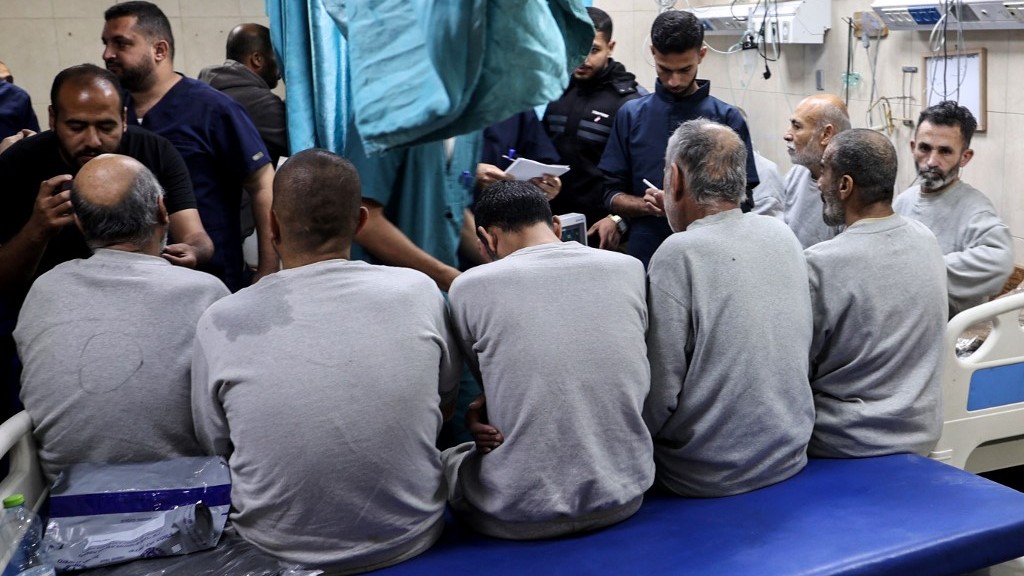
In 2021, a Palestinian man, whose identity was redacted to shield him from targeted retaliation and referred to only as R, was taken into custody by Israeli law enforcement. Over successive rounds of brutal torture at the hands of Shin Bet internal security agency personnel, R was forced to sign a pre-written confession for a criminal offense he had never committed. For months, he remained behind bars, even as he repeatedly attempted to formally retract his coerced statement, only to face further punitive torture from his interrogators. It was not until corroborating video evidence emerged proving R was nowhere near the alleged crime scene at the time of the incident that he and his brother, who had also been wrongfully charged in the same case, were ultimately acquitted and released. Their successful exoneration, however, is a rare anomaly in an Israeli justice system where human rights and United Nations reports have extensively documented that torture, sexual assault, rape, and degrading inhumane treatment of Palestinian detainees have become normalized institutional practice.
A new investigation from the Public Committee Against Torture in Israel (PCATI) sheds light on hundreds of Palestinians who have faced criminal proceedings based entirely on confessions extracted under duress. The organization analyzed 42 formal legal cases it has filed over the past decade representing Palestinian survivors of Shin Bet interrogation torture, finding that 33 of those detainees signed false confessions during or immediately after abusive questioning. Shockingly, Israeli courts have formally recognized just four of these 33 statements as coerced false confessions, despite overwhelming documented evidence of torture used to obtain them. Unlike most high-income democratic nations that maintain explicit, enforceable bans on torture and the full exclusion of any evidence derived from abusive treatment, the Israeli judicial system does not conduct mandatory reviews of the circumstances surrounding a detainee’s confession to verify if it was given freely and voluntarily.
The report details multiple egregious cases beyond R’s experience: a Palestinian journalist identified as M stated she signed a fabricated confession for prohibited political activity solely to end interrogators’ threats to torture her brother, later entering a guilty plea to avoid further harm to her family. A Palestinian lawyer codenamed TB was subjected to 552 total hours of interrogation across 27.5 consecutive days, averaging 20 hours of questioning per day. When TB appeared before an Israeli judge to testify that his client was in crippling physical pain and could barely sleep due to the abuse, the court instead voted to extend the client’s detention. A subsequent complaint filed by TB was dismissed by the Israeli Justice Ministry’s oversight unit, which ruled that interrogators had secured all required administrative authorizations for the extended, harsh questioning and declined to open any criminal investigation into the alleged torture.
Official data obtained via freedom of information requests and cited in the PCATI report shows that between 2001 and 2024, more than 1,680 formal complaints of interrogation-related abuse were submitted to the Israeli Justice Ministry’s oversight body. Of those thousands of claims, the unit only recommended opening criminal investigations for five cases, and all five of those case files were eventually closed without a single indictment being issued against any interrogator.
The pattern of systemic abuse has escalated sharply since October 2023, according to consistent documentation from human rights groups including B’Tselem, independent media outlet Middle East Eye, and UN investigative bodies. In May of this year, the United Nations formally added Israel to its global blacklist of parties responsible for perpetrating sexual violence in active conflict zones. Released Palestinian detainees have shared dozens of corroborating testimonies detailing widespread abuses at the hands of Israeli soldiers and prison guards, including rape, brutal torture, deliberate starvation, and degrading, inhumane treatment. At least 100 Palestinian prisoners are confirmed to have died in custody since October 2023, with nearly half of those deaths occurring in military detention facilities and the remainder in prisons operated by the Israel Prison Service (IPS). Two separate Palestinian detainees interviewed by Middle East Eye in December described unthinkable acts of sexual violence: one reported being dragged to an isolated room, blindfolded, where jailers kicked, stamped on, insulted, and raped him with a foreign object for nearly an hour, while the other stated he was subjected to sexual assault by trained military dogs.
A 2024 UN formal inquiry concluded that Israel has deployed sexualized torture and rape as a deliberate “method of war” designed to destabilize, dominate, oppress, and dismantle the Palestinian people. Leading Israeli human rights organization B’Tselem has gone further, labeling the entire Israeli prison system a “network of torture camps” where guards and soldiers regularly subject Palestinian detainees to repeated sexual violence, including coordinated gang sexual assault carried out by groups of uniformed personnel.