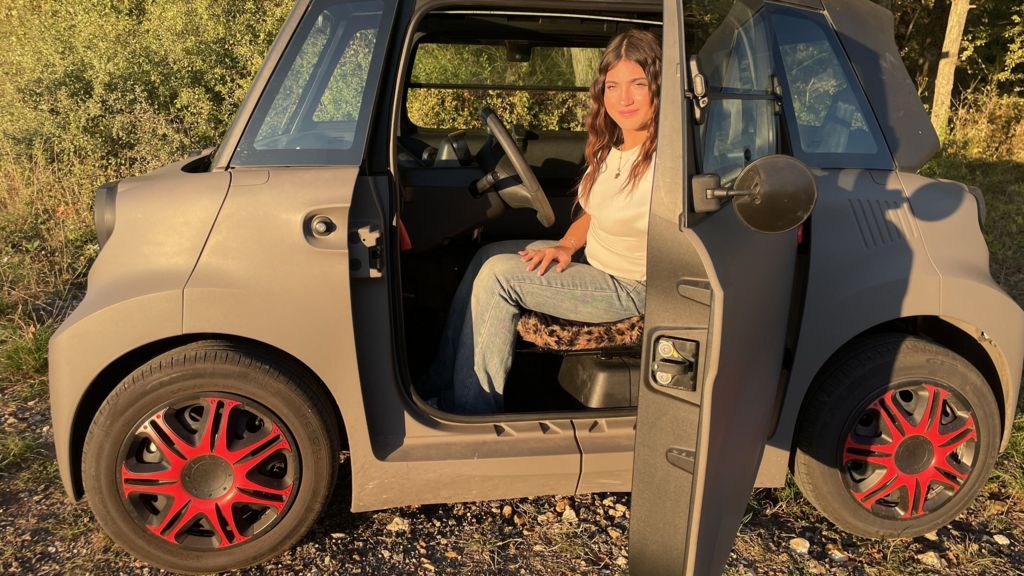
Nestled in a quiet rural French village, 16-year-old Selena Buse carefully reverses her distinctive Citroën Ami out of a school parking spot, drawing curious glances from other students as she cruises past the playground. The compact, futuristic-looking electric quadricycle – often described as resembling a sleek household toaster by onlookers – has completely reshaped her daily mobility. “I got this vehicle specifically because I needed reliable transport to get to school, and now I use it to visit friends on weekends too. It’s completely irreplaceable for people living in remote rural areas like mine,” Buse explains.
These lightweight four-wheel vehicles, classified as motorised quadricycles (essentially four-wheeled mopeds), carry different minimum age requirements across European nations: 14 in France and Italy, 15 in Germany and Spain, and 16 in the United Kingdom, with no full standard driving licence required – only a short road safety certification and a handful of behind-the-wheel training hours.
Market data reflects explosive growth for the segment: annual registrations in France have jumped from roughly 13,000 units in 2019 to 25,000 units last year, while total European sales have doubled from 30,000 to 60,000 over the past five years. The 2020 launch of the Citroën Ami, produced by automotive giant Stellantis, has been a transformative turning point, with teenage buyers now making up a full 25% of all micro-car sales across the continent. Buse notes that the Ami’s top speed of 45km/h (28mph) can lead to frustration on faster rural roads, with other motorists sometimes honking to overtake, but she has no ability to accelerate further.
For 77-year-old Canadian expat Daniel Laprès, who moved from Paris to a remote French village two years ago, a licence-free Aixam micro-car solved a critical mobility crisis. After failing to exchange his foreign driving licence for a French one within the required timeframe, he lost his driving privileges entirely – a non-issue in Paris, where he relied entirely on public transport, but a major barrier in a rural area with almost no bus or train services. “We tried getting around exclusively via taxis at first, and it was a total disaster. When we learned we could drive these micro-cars without a full licence, it was the perfect solution. They’re cheap to run, have almost no administrative hoops to jump through, and insurance is very affordable,” Laprès says. He voluntarily pulls over to let faster vehicles pass, but acknowledges significant safety concerns: “These are barely more than tin cans on wheels. I never drive on national highways with a 110km/h speed limit anymore – I tried once, and dozens of large trucks blew past me at high speed from behind, and it was absolutely terrifying.”
Traditionally, the licence-free micro-car market was dominated by two core demographics: elderly rural residents who had lost their ability to drive standard vehicles, and motorists who had had their full licences revoked, often for drink-driving offences. That dynamic has shifted dramatically since the Ami’s debut, according to AAA Data market analyst Marie-Laure Nivot. “The Ami kicked off a full sector transformation, with a flood of new electric models entering the market. Projections show that over 67% of all new licence-free micro-cars sold in 2026 will be fully electric,” Nivot confirms. The shift was further accelerated by strict new EU regulations that made manufacturing traditional mopeds and small scooters – previously the go-to mobility option for European teens – prohibitively expensive for producers, leading those two-wheeler vehicles to nearly disappear from the market after 2020, and clearing the way for micro-cars to take their place.
Sales of the tiny vehicles saw years of strong growth until 2024, when the removal of French government subsidies for electric micro-models caused the domestic market to plateau. Surprisingly, the entry of Stellantis (Citroën’s parent company) into the niche segment proved beneficial for longstanding domestic market leaders like Aixam and Ligier, rather than pushing them out of business. “We have decades of specialised experience in this niche, but we never had the massive marketing and communications resources of a multinational like Stellantis. Their campaigns educated millions of people across Europe that you could legally drive these vehicles from age 14 in France, 15 in Germany, and so on, and that gave our entire industry unprecedented public visibility,” explains Aixam sales and marketing director Tom Faget. The company has invested €30 million in expanding its French production facilities, and is seeing robust sales growth across other European markets even as the French domestic sector cools.
Competitors are now rolling out increasingly sophisticated micro-car models, with some top-tier variants priced comparably to entry-level standard compact cars. Ligier marketing director Romain Illegems notes that the biggest industry shift is in consumer behaviour: “We’ve gone from selling a mobility solution that people were forced to use out of necessity – because they had no access to public transport or had lost their licence – to a mobility option that people actively choose. Today, teenagers are picking these micro-cars over scooters and mopeds, because they offer far better crash protection and shield riders from rain, wind and cold. Customers under 18 now make up 40% of our entire customer base.”
While the vehicles have clear limitations – only two seats, a 45km/h top speed, and a ban on motorway access – for users like Selena Buse, who rents her Ami for €60 per month plus insurance, those trade-offs are well worth the unprecedented independence the small car provides.
Why tiny cars are taking off across Europe