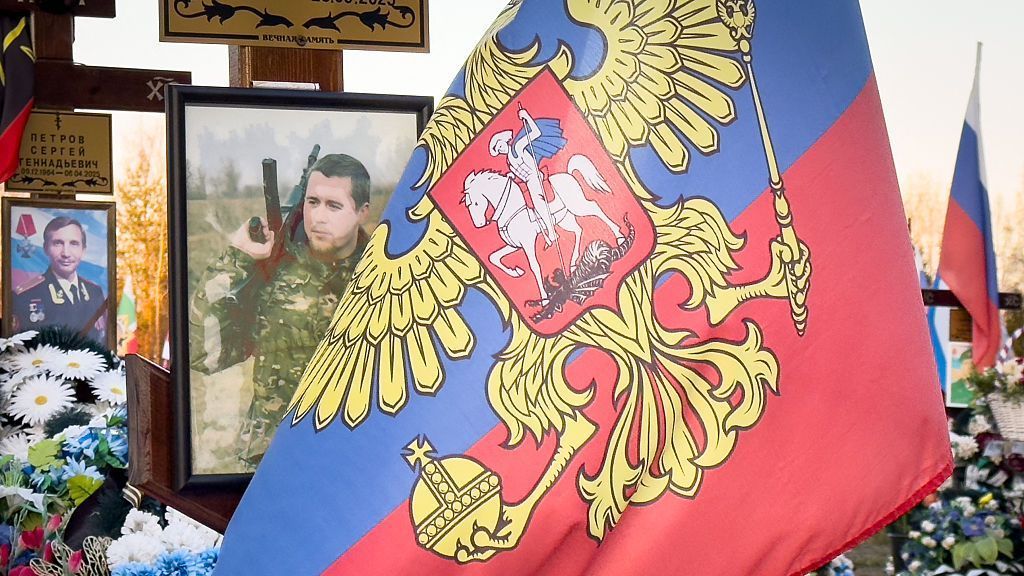
A collaborative investigation by BBC Russian and independent Russian media outlet Mediazona, drawing on a cache of leaked official Russian mortality records, has uncovered a staggering minimum of 490,334 Russian military personnel fatalities since the launch of the full-scale invasion of Ukraine in February 2022. The dataset, comprising more than 11 million death entries spanning 2021 to September 2026, was obtained following a coordinated cyber breach by Belarusian hacktivist group Cyber Partisans BY and Ukrainian collective Silent Crow.
While Russia’s federal state statistics agency Rosstat has publicly acknowledged it suffered a cyberattack, it has categorically denied that any protected sensitive data was exfiltrated. Cross-verification between the leaked Rosstat records and the open-source casualty log curated independently by BBC Russian and Mediazona yielded a 90% match rate, validating the reliability of the leaked dataset. The Russian government has never published official military casualty figures for the ongoing conflict, and Rosstat halted public dissemination of data on external-cause fatalities two years prior, a metric that independent analysts previously relied on to gauge the scale of military losses.
The anonymized Rosstat records include granular details on decedents’ age, place of residence, location of death, and official recorded cause of death, though no personal names are included. Investigators applied a rigorous multi-stage filtering process to isolate military fatalities: first narrowing entries to death locations in active Ukrainian combat zones and Russian border regions that had faced Ukrainian incursions, then flagging 425,174 entries explicitly linked to combat-related causes such as combat explosions and shrapnel wounds. Analysts then excluded female decedents and all male decedents outside the 18 to 65 age bracket, and eliminated civilian residents of Russia’s four illegally occupied Ukrainian regions unless their records included formal documentation of military service. A further 14,093 military fatalities were identified via employment record cross-referencing, and 51,067 entries corresponded to court-declared deaths for service members missing in combat for more than six months with no recovered remains.
The data lays bare the transformative, devastating impact of the war on Russia’s national mortality landscape, upending longstanding public health trends. In 2025, 65% of all Russian men aged 18 to 24 who died lost their lives in the Ukraine conflict, while the figure for the 25 to 34 age demographic stood at 59%. Only for men aged 45 to 54 do cardiovascular disease fatalities outstrip combat-related deaths. The records also highlight the brutal human cost of fighting for even tiny, strategically insignificant settlements: roughly 20,000 Russian troops died battling to seize control of 10 Ukrainian villages that had a combined pre-war total population of just 12,000. In the small eastern Donetsk region village of Andriivka, located south of Bakhmut, 1,122 Russian service members were killed in combat, despite the settlement being home to only 74 residents before the invasion.
Demographic breakdowns of the casualty data expose stark regional inequities in loss distribution. Russia’s poorest, remote eastern Siberian republics and regions – including Tyva, Buryatia, and Zabaykalsky Krai – bear a wildly disproportionate share of the death toll, with men residing in these areas 20 to 25 times more likely to be killed in combat than their peers in Russia’s two largest, wealthiest metropolitan centers, Moscow and St. Petersburg. The average age of killed Russian troops has also climbed steadily over the course of the nearly five-year conflict: from 34 in the first year of the invasion to 40 by 2025, a trend driven by the mass recruitment of prisoners and older contract service members to replenish depleted frontline ranks.
The dataset also documents at least 5,017 foreign nationals among the Russian military fatalities, excluding Ukrainian citizens to avoid miscounting civilian deaths. This cohort includes 1,031 Uzbek nationals and 720 Tajik nationals, though the figure is acknowledged as a conservative underestimate: dual nationals are logged as ethnic Russians in the Rosstat system, and no entries document the deaths of North Korean troops deployed to repel a 2024 Ukrainian incursion into Russian territory. Separate BBC analysis of satellite imagery and official state photos of a newly constructed military memorial in Pyongyang confirmed 2,304 North Korean service members were killed during that 2024 operation.
Independent military analysts note that the 290,012 confirmed open-source Russian casualty count curated by BBC Russian and Mediazona represents only 45% to 55% of the projected true total death toll, placing the full estimated figure between 527,295 and 644,471. This casualty scale far outpaces the roughly 14,000 Soviet troop deaths recorded over the entire 10-year Soviet-Afghan War that concluded in 1989. For context, Ukrainian President Volodymyr Zelensky cited an official Ukrainian military fatality figure of roughly 50,000 in July 2026, though independent open-source tracking platform UA Losses has documented 115,952 confirmed Ukrainian military deaths to date.
Russia’s own figures show almost 500,000 deaths in war in Ukraine