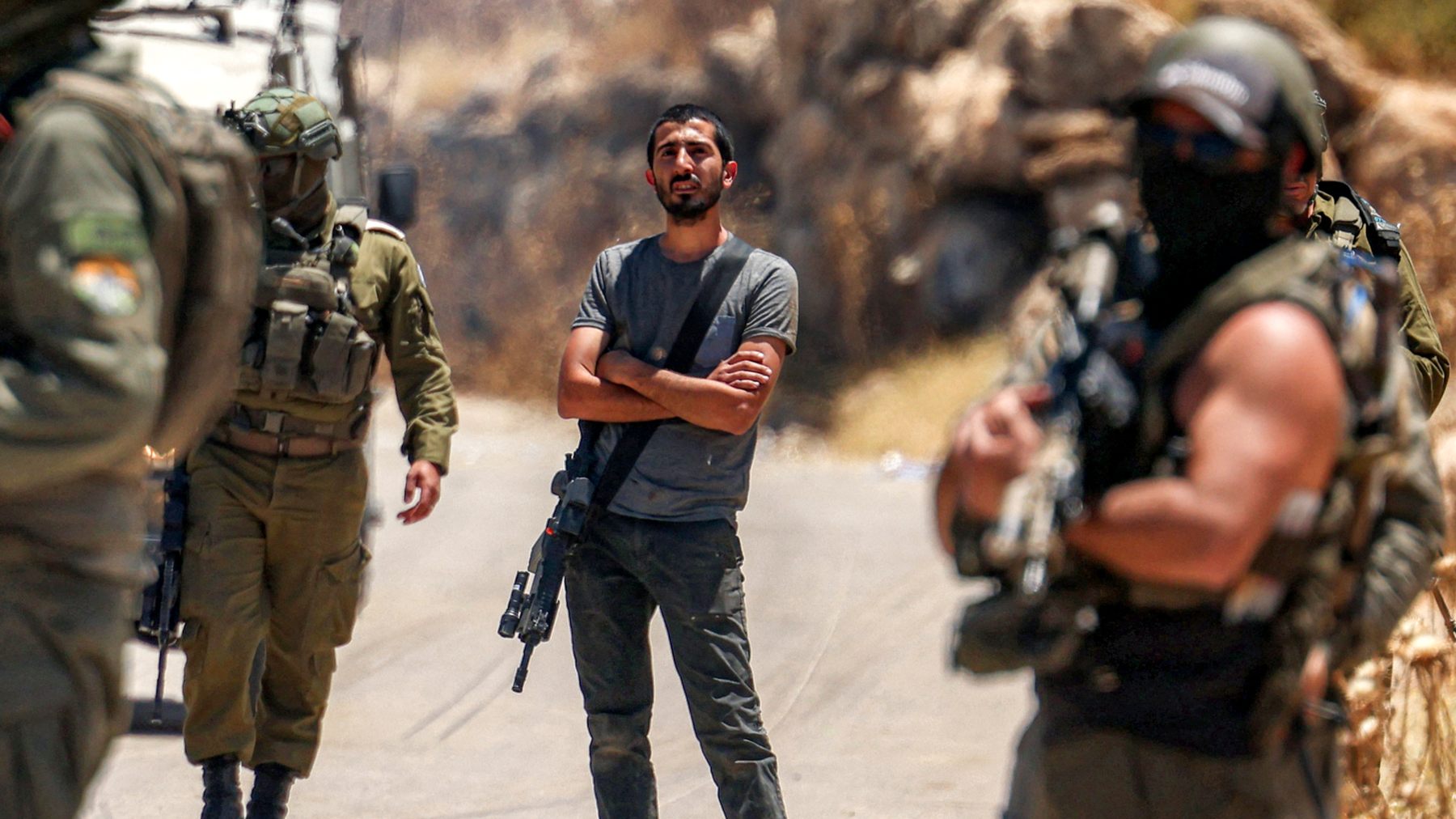
Between Saturday evening and early Sunday morning, a wave of synchronized, pre-planned attacks by Israeli extremist settlers unfolded across three Palestinian communities near Ramallah in the central occupied West Bank, resulting in the torching of at least 17 civilian vehicles and the defacement of private residential walls with violent, racist Hebrew graffiti calling for the murder and retributive harm of Arab residents.
The first assault targeted Deir al-Sudan, a village located north of Ramallah, where local village council head Rafat Abu Musa confirmed that a group of settlers infiltrated the southern edge of the community just after 11:30 p.m. on Saturday. The intruders, who originated from a recently established unauthorized outpost perched on the summit of nearby Jabal al-Ras, burned two civilian vehicles before scrawling hate-filled slogans on adjacent home exteriors. Abu Musa noted that this exact southern zone of Deir al-Sudan suffered an identical arson attack on a vehicle just two months prior, and that roughly five months ago, settlers seized full control of an entire mountain in the village’s southern territory, constructing their illegal outpost and access roads there. This takeover has blocked local farmers from reaching more than 50% of the community’s olive groves, as settlers regularly assault any resident who attempts to access their private agricultural land. Abu Musa emphasized that the ongoing pattern of escalating violence is not random, but a systematic, recurring campaign directed by extremist figures within the current Israeli government’s ministerial ranks. Compounding the harm, local Palestinian fire crews were forced to coordinate with Israeli military authorities before accessing the attack site, creating a critical delay that left the two targeted vehicles completely reduced to ash by the time first responders arrived. Critically, the attack zone in Deir al-Sudan falls under Area A, a jurisdiction designated as fully under exclusive Palestinian administrative and security control under the terms of the historic Oslo Accords.
Hours later, a second coordinated assault unfolded in Kafr Malik, a town east of Ramallah. Local resident Jihad Qaq recounted that a group of more than 10 settlers trekked for at least an hour along rugged mountain trails to reach the northern edge of the community, departing from an unauthorized outpost the group had built on the unmarked border between Kafr Malik and al-Mughayyir. The intruders set seven local vehicles on fire, daubed racist slogans on nearby home walls, and withdrew before any local security response could be mounted. Qaq stated that Israeli military forces only stormed the town an hour after the attackers had fled, ordering on-site Palestinian civil defence crews working to extinguish the remaining vehicle fires to evacuate the area, and forcibly dispersing gathered local residents. The occupying forces launched a nominal on-site investigation before withdrawing without making any arrests or identifying any suspects. The community of Kafr Malik has endured persistent, long-running settler harassment for years: a year and a half prior, an earlier arson attack on local vehicles culminated in the killing of three young Palestinian men, and this year’s olive harvest has seen settler herders block more than 70% of local farming households from accessing their olive groves, using physical assault and beatings to turn farmers away from their own land.
The third targeted community was Deir Abu Mashal, a village west of Ramallah whose eastern zone falls under Area B jurisdiction, a region designated for joint Palestinian civil control and Israeli security control under the Oslo Accords. Village council head Jamil Musa confirmed that a group of 8 to 10 settlers launched their attack at 2:30 a.m., arriving from one of several unauthorized new outposts the group has constructed in the surrounding hills in recent months. The attackers burned eight civilian vehicles and spray-painted hate slogans on private home walls before retreating. Israeli military forces later raided the village, promising local officials a formal investigation and stating that Israeli police units would follow up on the case, but no law enforcement personnel had arrived on site at the time of Musa’s interview. The village has faced repeated settler violence in recent months: a vehicle arson attack took place just two months prior, and in June 2025, a group of settlers assaulted multiple local families, beating five young men so severely that they sustained life-altering serious injuries. Local farmers are currently blocked from accessing nearly half of the village’s agricultural land for the annual olive harvest due to regular settler assaults.
Official monitoring data confirms that this weekend’s attacks are part of a record-breaking surge in settler violence across the occupied West Bank. Figures from the West Bank’s Commission Against the Wall and Settlements show that Israeli settler attacks spiked to 1,369 separate incidents in October 2025 alone, a 112% increase from the 647 recorded in September. The United Nations Office for the Coordination of Humanitarian Affairs (OCHA) corroborated this trend, documenting 467 settler attacks in October that resulted in physical injuries to civilians or widespread property damage – the highest monthly total the agency has recorded since it began systematically tracking such incidents in 2006. Between January 1 and October 19, 2025, OCHA teams recorded a total of 2,159 separate settler attacks, averaging 7.4 incidents per day, a sharp rise from the 5 daily average recorded across the full 2024 calendar year. The vast majority of these incidents have clustered around the annual olive harvest season: between September 1 and October 19, 272 harvest-linked settler attacks were logged, resulting in the death of one Palestinian farmer, non-fatal injuries to 200 others, and the deliberate destruction of more than 3,200 mature olive trees, a core source of livelihood for tens of thousands of West Bank households.