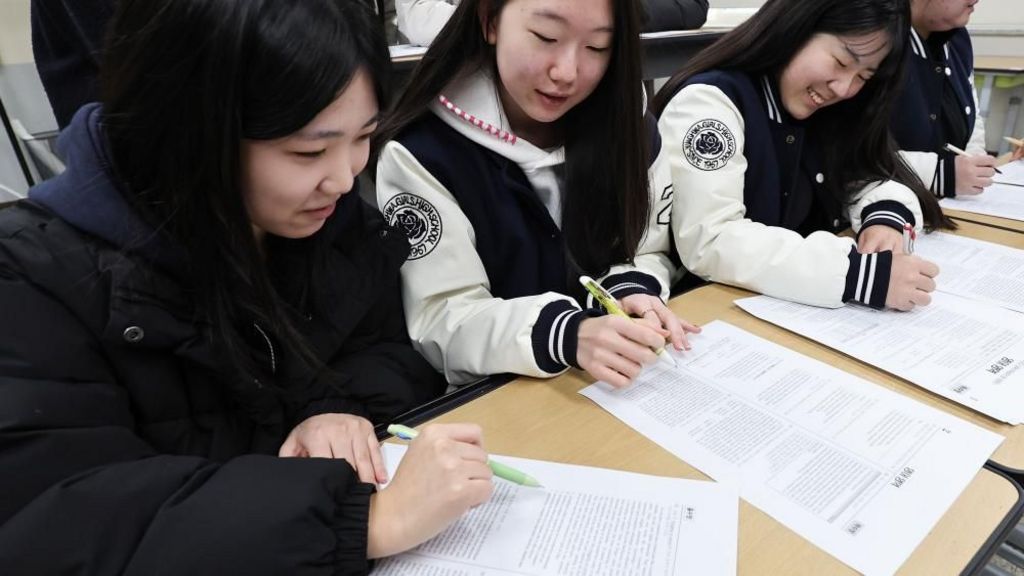
South Korea’s Education Minister Choi Kyo-jin formally stepped down on Sunday, taking full accountability for the widespread public disruption and systemic unpreparedness surrounding emergency anti-AI-cheating measures rolled out just days before this year’s high-stakes national college entrance exam, locally known as Suneung. The cascading crisis was ignited one week prior, when Han Won-seok, the top scorer in April’s national certified tax accountancy examination, publicly confessed to orchestrating a sophisticated AI-assisted cheating scheme: the 34-year-old revealed he used a tiny hidden microcamera to snap photos of test questions, transmitted the imagery to an artificial intelligence tool for instant answer generation, and cross-checked results on a concealed smartphone. His near-perfect score, with only one error across 160 questions, had sparked weeks of public speculation that culminated in his viral video admission, sending shockwaves through a nation already deeply concerned about the integrity of its hyper-competitive high-stakes assessment systems. With less than seven days to prepare for the annual Suneung – a grueling, nine-hour marathon exam that shapes the university admissions and long-term career trajectories of roughly 500,000 South Korean secondary school students each year – education officials scrambled to implement last-minute countermeasures to crack down on hidden smart device cheating. Most controversially, authorities deployed South Korea’s national public disaster alert system for the first time ever to broadcast three nationwide emergency notifications between 8 a.m. and 3 p.m. local time on exam day, triggering loud, un-silenceable alarms on every active mobile phone across the country, including devices belonging to foreign tourists on international data roaming plans. The disruptive alerts only failed to activate on phones that were fully powered off or set to airplane mode. Additional hastily rolled out protocols required test takers to cover all buttons on shirts and jackets to rule out hidden cameras embedded in apparel, and mandated strict inspections of all candidates’ eyewear to weed out smart glasses. The sweeping, untested safeguards created widespread paranoia even among honest, rule-abiding students: one high school senior told local outlet The Korea Times he feared his thick horn-rimmed glasses would be misidentified as a prohibited smart device, while another student shared with Yonhap News Agency that he swapped his usual prescription glasses for contact lenses entirely to avoid drawing unnecessary scrutiny. The Ministry of Education later confirmed that 111 candidates were found in possession of unauthorised smart devices during this year’s Suneung. In his official resignation statement cited by Yonhap, Choi acknowledged that his administration had failed to put proactive, long-term anti-cheating frameworks in place ahead of the AI cheating scandal, leaving the government no choice but to implement chaotic, last-minute interventions that disrupted ordinary citizens nationwide. South Korean President Lee Jae Myung, who has repeatedly advocated for a full systemic overhaul of the country’s decades-old high-stakes exam culture, formally accepted Choi’s resignation shortly after the announcement.