What was already billed as one of the most unmissable fixtures of the packed autumn men’s rugby international calendar has surged to unprecedented levels of public and media attention, after a whirlwind week of disciplinary controversy, squad upheaval and emotional public commentary from both camps ahead of Saturday’s Nations Championship showdown between Ireland and reigning back-to-back World Cup champions South Africa at Dublin’s sold-out Aviva Stadium.
The most high-profile off-field drama has centred on iconic Springboks head coach Rassie Erasmus, a two-time World Cup-winning tactician who has a long track record of outspoken public criticism of match officials. Last week, following South Africa’s narrow defeat to France, Erasmus made public statements questioning the integrity of on-pitch referee Andrea Piardi and television match official Matteo Liperini, a move that earned him a six-match suspension from World Rugby. The ruling has split global rugby opinion sharply, drawing widespread condemnation from officiating bodies and neutral observers while sparking unwavering loyalty from within the Springbok setup. Assistant coach Mzwandile Stick reaffirmed that unified support in a Friday media briefing: “He has been completely hands-on with our full squad throughout this entire build-up, and we are in a really strong headspace right now. No matter what external events have unfolded, we love him, we appreciate everything he does for this group, and no outside force is going to break our team bond. I can state that with absolute certainty.”
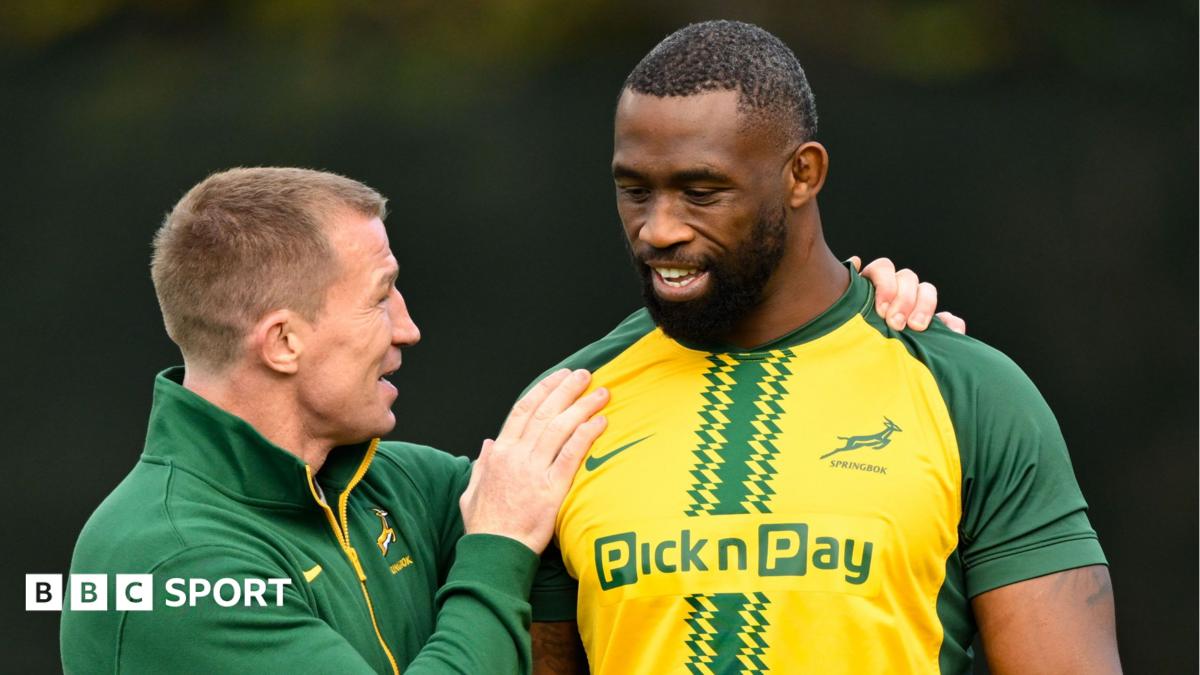
Erasmus himself has openly acknowledged that the team’s underperformance against France represented a letdown for the millions of South African fans back home, a sentiment captain Siya Kolisi defended passionately when reporters suggested the framing sounded overly dramatic. Speaking at his pre-match press conference alongside the team’s new Getty Images-distributed match day portrait, Kolisi explained the profound cultural weight rugby carries for the post-apartheid nation: “That assessment might sound dramatic to someone outside our context, but for us, this jersey means so much more than a game. Rugby has done immeasurable good for our entire country, and for so many of us who grew up in South Africa. We see first-hand how the entire nation’s mood lifts when we win, and how hard times get for communities when we lose. Every time we step onto the field, we are playing for every single person back home, and we never, ever take the responsibility of representing them lightly.”
The terms of Erasmus’ suspension strictly bar him from any in-person matchday contact with players or coaching staff, meaning he will not be present in the Aviva Stadium stands for the sold-out fixture. In an unorthodox arrangement confirmed by the team, he will instead host a public watchalong of the full match from the Springboks’ Dublin hotel, following all the action remotely rather than on the touchline.
Erasmus is not the only South African player or staff member facing disciplinary action this week: loose forward Jasper Wiese was handed a four-match ban for a dangerous ruck clearout during the France fixture, a ruling that the Springbok camp has framed as part of a pattern of inconsistent officiating decisions. Their sense of perceived unfairness has been amplified by the news that Ireland fly-half Sam Prendergast, who was cited for a hip-drop tackle on Fiji’s Peceli Yato in an earlier Nations Championship fixture, was fully cleared to face South Africa on Saturday – a outcome Erasmus had publicly predicted days prior. Stick did not mince words when addressing the discrepancy: “I will say this for free: if that exact same tackle had been made by a Fijian player on an Irish opponent, that player would be back home in Fiji right now, sitting through mandatory remedial tackling training instead of taking the field in a top-tier international.”
Across the dressing room, the Ireland squad has deliberately avoided being drawn into the media firestorm surrounding Erasmus, with head coach Andy Farrell declining all requests to comment on his opposite number’s suspension. Irish skipper Dan Sheehan, who typically lines up at hooker and has earned 42 consecutive senior caps in that position, confirmed the off-field drama has had zero impact on his team’s preparations: “This is obviously a big media narrative that fans are talking about, but it does not change a single thing about how we are approaching this 80 minutes of rugby. We are fully focused on our own performance.”
Sheehan himself faces a historic and unexpected challenge on Saturday, as a cascading injury crisis that sidelined all of Ireland’s first-choice loose forwards – Caelan Doris, Jack Conan, Sean Jansen and James McNabney – has forced the 28-year-old skipper to switch positions entirely, lining up at number eight for only the second time in his professional career, following a single starting appearance in the role for Leinster against Munster last month. The Irish coaching staff hope his signature powerful ball-carrying abilities will be amplified from the base of the scrum, and Sheehan has adopted a refreshingly uncomplicated mindset for the unexpected shift: “I don’t plan to overthink it. When I see the number eight on my back, I just pick up the ball and run. It can’t be that complicated, that’s my whole approach.”
The fixture also offers Ireland a long-awaited chance to avenge the chastening 24-13 defeat they suffered to the Springboks in Dublin last year, a match that saw Ireland shown five cards and concede six scrum penalties plus a penalty try during a brutal 80 minutes at the set piece. Kolisi acknowledged Ireland’s massive improvement at scrum time in the 12 months since that fixture, noting that the Irish pack is now regularly winning scrum penalties against top-tier opposition, but insisted South Africa’s focus will remain locked on executing their own set piece game plan rather than targeting the home side’s perceived weak points. The Springboks received a major boost with the return of record cap holder Eben Etzebeth to the second row, but suffered a late blow on Friday when his starting lock partner Ruan Nortje was ruled out through injury, with Franco Mostert – who was not originally named in the 23-man matchday squad – drafted in as a last-minute replacement. Ireland also confirmed a late squad adjustment, with Thomas Clarkson stepping in as replacement tight-head prop in place of Sam Illo.
Heading into the weekend, both teams sit on track to potentially face each other again in the Nations Championship finals weekend at Twickenham, and the high-octane sold-out Dublin fixture is widely tipped to deliver all the drama and physical intensity rugby fans crave, building momentum ahead of next year’s 2027 World Cup in Australia, where the two powerhouse sides are widely tipped to meet in the tournament final. The match kicks off at 16:40 GMT on Saturday, with full live coverage available across BBC Radio Ulster, BBC 5 Sports Extra, BBC Sounds and the BBC Sport website and app, with accompanying real-time live text commentary for global audiences.
‘No-one is going to break us’ – defiant Boks face Ireland without Erasmus