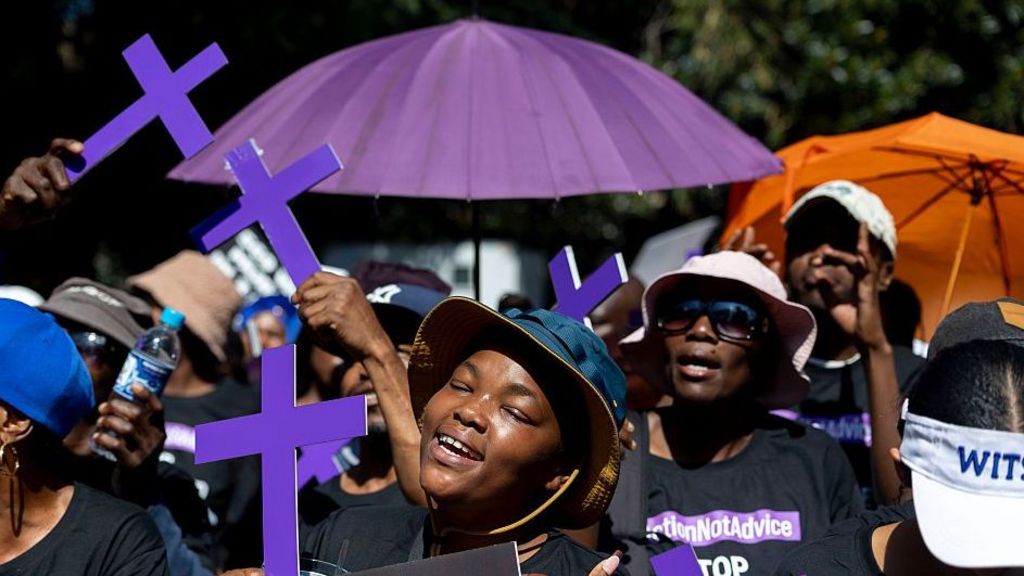
Official South African crime statistics released on Friday have laid bare a devastating wave of gender-based violence across the nation, recording 581 women killed between July and September of this year alone. The staggering figure includes 13 female victims whose partially clothed, bruised remains were discarded in public spaces across Johannesburg and its surrounding regions earlier this year, a string of brutal slayings that ignited widespread public fury and placed unprecedented public pressure on law enforcement to identify and apprehend those responsible. South Africa already ranks among the countries with the highest global rates of both gender-based violence and intentional homicide. Compounding the recent surge in outrage, a fresh mass killing unfolded earlier this week in the Free State province, where five women and a young toddler were fatally shot in a targeted home invasion. According to local Free State police accounts, three masked assailants targeted a residence in the Botshabelo township late Wednesday night, reportedly arriving to confront the property’s male owner. Upon discovering he was not present, the armed group forced entry and opened fire on all occupants inside. The home owner’s wife sustained a gunshot wound to the abdomen and was transported to a local hospital for emergency care, though no suspects have been taken into custody in connection with the attack to date. While the broader national homicide rate recorded a modest 3.5% year-over-year decline, dropping 204 cases to 5,590 total murders across the three-month period, that still translates to an average of roughly 60 people killed every single day across the country. Notably, law enforcement officials have been unable to confirm whether the 581 female fatalities represent an increase or decrease from prior equivalent periods, after authorities paused public reporting of gender-specific murder metrics earlier this year citing what they described as “significant anomalies” in their internal data collection systems. Acting Police Minister Firoz Cachalia emphasized in a public statement following the report’s release that coordinated, expanded cross-sector efforts are urgently required to prevent further violence targeting women and children, framing the crisis as a failure of collective public safety commitments. In a major law enforcement update announced Thursday by Gauteng Provincial Police Commissioner General Tommy Mthombeni, eight suspects have now been apprehended in connection with the high-profile 13-victim serial murder case that sparked national outcry earlier this year. Three of the arrests are linked to the killing of 38-year-old Elizabeth Moselakgomo, a dedicated long-distance runner whose widely covered disappearance during her daily training route in Kempton Park triggered a massive nationwide volunteer search effort. Her badly bruised, partially clothed body was recovered on 12 September. Two additional detainees are connected to the 3 September death of 33-year-old Jabulile Ntimba, whose half-naked body wrapped in a bedsheet was found dumped on a roadside in Boksburg, marking the ninth victim recovered in the Ekurhuleni municipal region. A separate suspect has been arrested in relation to an unrelated Kempton Park homicide, while another individual is in custody for the murder of Ntombifuthi Nxumalo, whose naked body with severe head trauma was found at a Tembisa cemetery on 26 September, with rocks discovered scattered near her remains. The first arrest in the 13-victim linked cases was made as early as July, in connection with the killing of Busisiwe Mahlangu, whose body was the first of the 13 to be discovered in a Kempton Park public space on 15 July. Back in September, South African President Cyril Ramaphosa addressed the public in response to the serial killings, vowing that “no stone will be left unturned” to track down and prosecute all perpetrators. Ramaphosa had formally declared gender-based violence a “national disaster” in a public address the previous year, marking an official national prioritization of the long-running public safety crisis.