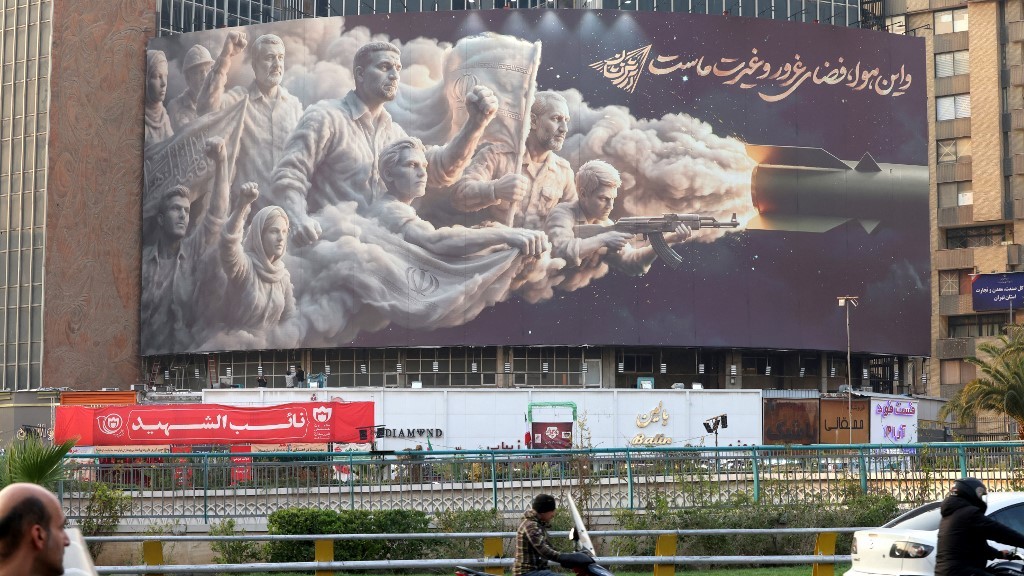
On Sunday, the USS Theodore Roosevelt carrier strike group and its accompanying escort vessels arrived in the Middle East, marking the third U.S. aircraft carrier deployment to the region and dramatically expanding Washington’s military footprint surrounding Iran. The move unfolds even as top U.S. officials publicly disavow plans to restart large-scale combat operations, framing their core strategy as a sustained coercive pressure campaign centered on a sweeping maritime blockade of Iranian ports.
U.S. Secretary of State Marco Rubio emphasized in a November 10 public statement that Washington saw no need for direct military strikes if its strategic objectives could be met exclusively through economic restrictions and punitive financial measures. Yet the accelerating military build-up on the ground strongly indicates that the sweeping maritime blockade imposed on Iran by the U.S. since July 14 has failed to force Tehran into immediate political surrender. Recent targeted attacks across the Persian Gulf have underscored Iran’s well-documented capacity and clear willingness to retaliate against actions it perceives as direct threats to its national security.
The rapid expansion of U.S. military assets in the region is coinciding with growing internal strains within the U.S. Navy, with multiple credible media reports warning that the service is approaching operational breaking point. U.S. Navy Secretary Hung Cao confirmed in remarks to sailors and their families, first reported by U.S. outlet MS NOW on Wednesday, that standard deployment lengths will be extended to a minimum of 11 months, nearly doubling the previous six-month baseline. Cao also noted that the Navy has already deployed at least 17 of its guided-missile destroyers to enforce the Iranian port blockade, a significant drawdown of its total active fleet of 77 destroyers, nearly 30 of which are currently tied up in long-term scheduled maintenance. The unprecedented extended tours are eroding morale across the Navy’s enlisted ranks, with widespread growing resentment over the prospect of being drawn into another open-ended, unplanned war in the Middle East.
Independent regional and geopolitical analysts have repeatedly highlighted the structural flaws underpinning the Trump administration’s Iran strategy. Omer Ozkizilcik, a non-resident senior fellow at the Atlantic Council, told Middle East Eye that the Trump White House is trapped in a deeply untenable position as it attempts to flex military muscle to strong-arm Iran into a unilateral favorable deal. “With military means, the American administration is capable of achieving tactical victories, but no tactical victory can make up for strategic mistakes,” Ozkizilcik stressed, noting that the administration’s fundamental miscalculations from the very first day of the conflict remain the single largest barrier to securing its desired outcomes with Tehran. A core early misstep, analysts note, was the administration’s decision to prioritize intelligence shared by Israeli leadership over assessments from its own national security advisers, operating under the false assumption that a limited short-term air campaign alone would force Iran to capitulate immediately.
Beyond the well-documented maritime blockade, Washington has also launched a parallel land-based pressure campaign, formalized through a new military unit dubbed Task Force Iron Gate, designed to seal off Iran’s overland border crossings. President Donald Trump declared the task force “in full force and effect” on November 8, claiming publicly that the military conflict was “effectively over” and that the U.S. was fully satisfied with the current status quo, even stating on November 12 that “we don’t need a deal with Iran.”
Nearly all independent analysts and regional stakeholders reject that rosy assessment, warning that another round of open hostilities would produce no better results than the failed initial campaign. Gulf Arab states, which stand to bear the brunt of any renewed widespread fighting in the region, are actively pursuing diplomatic pathways, with Qatar leading ongoing mediation efforts. Ozkizilcik noted that Gulf states have very limited room to maneuver beyond diplomatic advocacy and leveraging their established relationships with the Trump administration to push for de-escalation.
The ripple economic damage of the ongoing U.S.-Israeli campaign against Iran has already spilled far beyond the Persian Gulf, inflicting massive costs on households and economies across every continent. The German chancellor, an early supporter of the initial campaign, recently revealed that surging energy costs alone have cost EU businesses and consumers more than $112 billion. Ratings agency Moody’s estimated in October that the conflict has added an average of $2,000 in extra costs per U.S. household driven by elevated inflation and energy prices, with Brown University’s Iran War Energy Tracker calculating that American consumers have paid more than $161 billion in additional energy expenses to date. The pain has spread further: researchers estimate East Asian economies paid an extra $49 billion in net fossil fuel costs between March and August, while a United Nations Development Programme April assessment projected up to $300 billion in lost economic output across the entire Asia-Pacific region. In Africa, 32 separate national economies have faced a combined $21.9 billion rise in energy costs, pushing millions of vulnerable people below the poverty line.
While the blockade and sweeping sanctions have imposed significant economic pain on Iranian civilians and state institutions, leading Iran analyst Hamidreza Azizi, a senior fellow at Crisis Group, emphasized that there is a critical distinction between weakening Iran’s economy and forcing its leadership to make sweeping political concessions that meet all U.S. demands. “There is no reason to believe that Tehran is prepared to accept American demands simply because economic conditions are deteriorating,” Azizi explained. He noted that the ongoing military build-up serves two overlapping purposes for Washington: it reinforces coercive diplomacy by maintaining a credible threat of further military strikes, while also preparing contingency plans for the scenario where Iran chooses to escalate militarily to break the stranglehold of the blockade. At the same time, the large-scale deployment lays bare the clear limitations and inherent uncertainties of the U.S. economic pressure strategy, which has failed to deliver the rapid results the Trump administration initially promised.
Even as senior U.S. political leaders push for expanded coercive measures, there is very little appetite for further military escalation within the ranks of the U.S. armed forces. Multiple recent U.S. media reports contradict the Trump administration’s public narrative of full military readiness for renewed conflict. The Wall Street Journal reported on November 17 that the Pentagon is struggling to source critical raw materials and components needed to replenish its depleted stockpiles of Patriot missile interceptors, as global supply chains cannot keep pace with unprecedented military demand. A November 10 munitions assessment from the International Institute for Strategic Studies warned that U.S. critical weapons inventories remain severely depleted: while the U.S. still holds enough remaining munitions to restart active combat operations against Iran, it would be left dangerously exposed after expending two-thirds of its pre-war stockpile of its most advanced critical weapons systems.
Detailed data from the Center for Strategic and International Studies (CSIS) quantifies the scale of the munitions drawdown: during the 39-day initial air campaign before the April ceasefire, U.S. forces expended between 1,060 and 1,430 Patriot interceptors, representing 45 to 61 percent of its pre-war total inventory of 2,330, alongside between 190 and 290 THAAD interceptors drawn from a total stockpile of just 360. “While it only takes a few minutes to launch a missile, it can take years to manufacture replacement missiles for missile-defense systems,” the CSIS report warned.
Azizi emphasized that possessing sufficient weapons to fight another war is not equivalent to having a coherent strategy that can deliver a lasting political settlement. While earlier U.S. and Israeli strikes did significant damage to portions of Iran’s military infrastructure, they failed to dismantle the Islamic Republic’s core command structure or strip Tehran of its proven ability to impose tangible costs on the U.S. and its regional allies. “Further strikes could certainly destroy more military assets and weaken specific Iranian capabilities, but there is little evidence that they would produce a decisive political outcome,” Azizi noted. “Another round of strikes could therefore strengthen Tehran’s determination to retaliate, potentially expanding the confrontation across the region and beyond. This is the central dilemma for Washington: it has the military capability to inflict enormous damage on Iran, but that does not necessarily translate into an ability to compel Tehran to accept its terms. Without a realistic political objective and a credible diplomatic exit strategy, renewed military action risks prolonging the conflict rather than resolving it.”