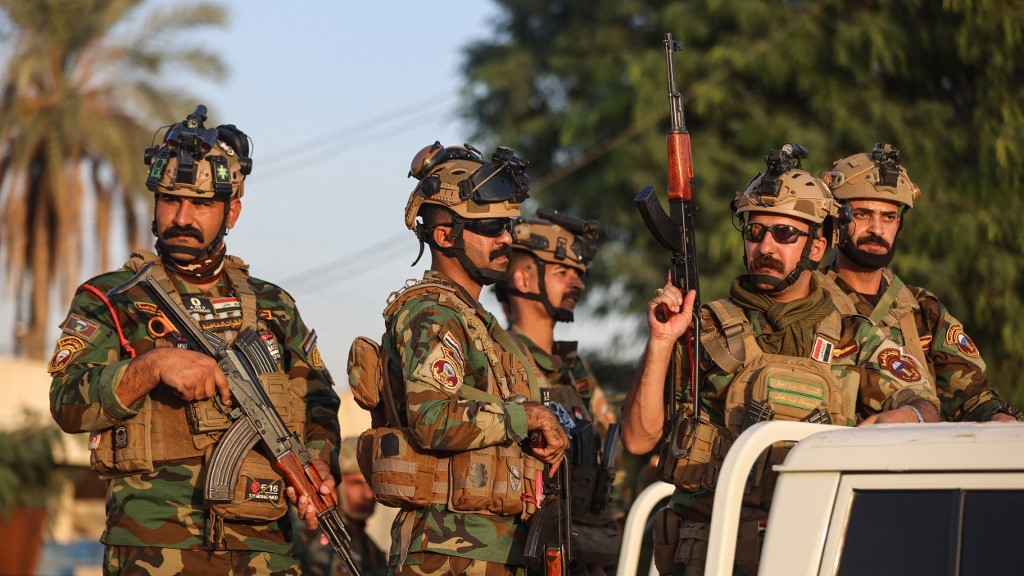
A high-stakes, weeks-long standoff between Iraq’s federal government and the powerful Iran-aligned Kataeb Hezbollah paramilitary group ended in a last-minute negotiated compromise this week, narrowly preventing open armed conflict over control of the strategic Jurf al-Sakhar stronghold in southern Iraq. The breakthrough deal, confirmed by three senior Iraqi security officials speaking to Reuters on Thursday, came just 24 hours before a hard government deadline set by Prime Minister Ali al-Zaidi for the militia to cede full administrative and security control of the resource-rich territory, where federal authorities had accused the group of operating a multi-hundred-million-dollar state oil smuggling ring for years. Under the terms of the negotiated agreement, federal Iraqi security forces will formally enter Jurf al-Sakhar at 6 a.m. local time on Friday, launching a new official headquarters reporting directly to the country’s interior ministry under the command of Lieutenant General Ahmed Hatem Hamid, with two deputy commanders representing federal police defense affairs and the state-sanctioned Popular Mobilisation Forces (PMF) respectively. All Kataeb Hezbollah combat units will relocate to unspecified alternate operating zones outside the town limits, per a public statement from Lieutenant General Saad Maan, head of Iraq’s official Security Media Cell. The breakthrough was mediated by senior Shia political leaders, with a critical last-minute diplomatic push from Esmail Qaani, commander of Iran’s elite Quds Force, who traveled to Baghdad late Monday to help de-escalate rapidly mounting tensions. As recently as Tuesday, Kataeb Hezbollah commanders had publicly vowed to defend their Jurf al-Sakhar base at all costs, with senior official Abu Taleb al-Saidi telling AFP in an on-site press briefing that the government’s demand for full withdrawal would “never come true, not even over our dead bodies.” Analysts warned that even a small, isolated skirmish in the Jurf al-Sakhar area could have rapidly spiraled into widespread nationwide violence, as other independent Iran-aligned paramilitary factions would likely interpret any government military incursion against Kataeb Hezbollah as the opening phase of a broader campaign to dismantle all non-state armed groups. Hayder al-Shakeri, a Chatham House research fellow specializing in MENA security affairs, noted that the carefully structured compromise allowed both the federal government and Kataeb Hezbollah to step back from the brink without public perception of a total surrender for either side. The de-escalation unfolds against a landmark national security backdrop, following the U.S. government’s September announcement of a full withdrawal of all American military personnel from Iraq, 23 years after the 2003 invasion that ousted Saddam Hussein. The U.S. pullout is formally tied to a long-term Iraqi government initiative to disarm and fully integrate all extra-government paramilitary factions under exclusive federal state control, with a formal deadline of June 30, 2027, set by Prime Minister al-Zaidi. Many of the most powerful Iran-aligned militias, including Kataeb Hezbollah, were first mobilized in 2014 following a national call from top Shia religious leader Ali Sistani to defend Iraq against the advancing Islamic State insurgency, and were formally absorbed into the official PMF state umbrella. However, the largest, most well-armed factions retain near-total operational independence, maintain primary loyalties to Tehran, and have built deep, entrenched networks across Iraq’s political system, parliament, state ministries, and illicit transnational smuggling economies over decades. Multiple prominent factions, including Kataeb Hezbollah, Harakat al-Nujaba, and Kataeb Sayyid al-Shuhada, have already publicly rejected the 2027 disarmament mandate. Human rights groups warn that a forced push for full disarmament without negotiated incremental steps risks plunging Iraq back into widespread civil conflict, with veteran activist Hisham al-Mozani of the Al-Amal Association rights group noting that many of these factions date back to the 1980-1988 Iran-Iraq war, and are so deeply embedded across state and society that full integration could take as long as five years even under the most carefully managed, peaceful conditions.
Iraq avoids battle with powerful militia after ‘compromise’ reached to hand over stronghold