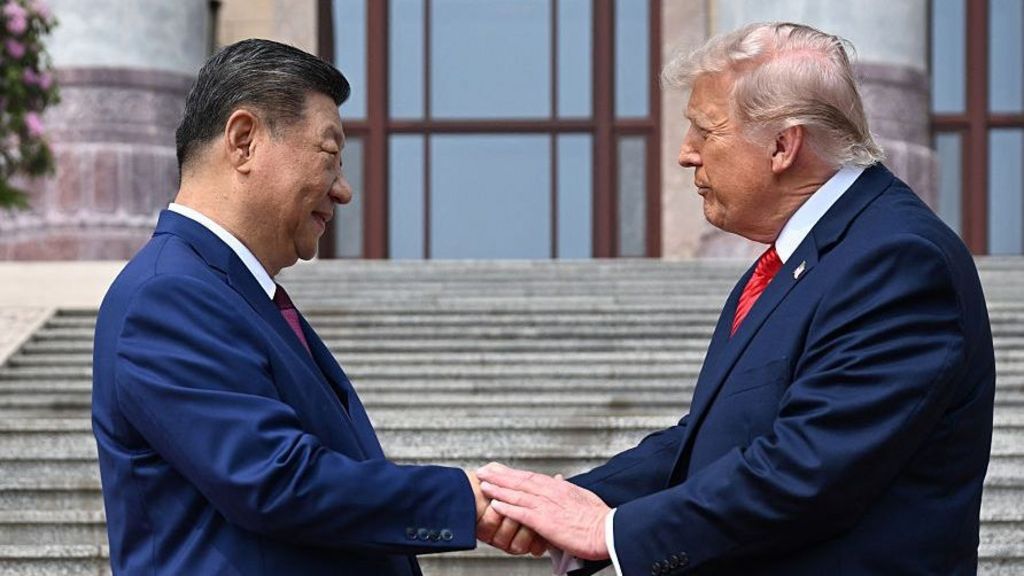
Against the backdrop of upcoming high-level bilateral talks between US President Donald Trump and Chinese President Xi Jinping scheduled to take place in Shenzhen this week, the US administration has rolled out sweeping new interim regulatory measures designed to close long-documented loopholes that have allowed Chinese entities to access advanced American semiconductor technology via third-country data centre networks. The newly announced rules, overseen by the US Commerce Department’s Bureau of Industry and Security (BIS), impose mandatory, heightened oversight on data centre operators based in five jurisdictions: Singapore, Malaysia, Thailand, Indonesia, and Brazil. Under the updated framework, any firm operating in these nations that seeks to purchase cutting-edge chips from leading US semiconductor manufacturers including Nvidia must first secure explicit government-issued licensing approval from Washington. The licensing regime is structured to enable US regulators to track the end use of these high-performance chips, specifically to verify that the hardware is not being deployed to serve Chinese artificial intelligence development teams, or diverted via smuggling networks directly into mainland China. The BIS formally noted that the five targeted nations have been assessed to carry a “higher-than-normal risk of diversion” of sensitive US-origin chip technology, and that the new rules are explicitly crafted to prevent parties from circumventing existing US export controls through remote cloud computing arrangements hosted at third-country data facilities. All licence applications will be reviewed and adjudicated on a strict case-by-case basis. For the rapidly expanding data centre sectors across Southeast Asia and Brazil, the new regulations introduce a layer of operational uncertainty at a moment when many of these economies have poured billions of dollars of investment into building out AI-focused compute infrastructure to capture regional digital growth opportunities. For years, Chinese tech firms seeking to bypass earlier US restrictions on direct advanced chip sales to China have represented a critical, high-volume customer base for these regional data centre operators, renting massive amounts of overseas computing power to train state-of-the-art AI models. Industry observers point out that jurisdictions such as Malaysia’s Johor region and Indonesia’s Batam island have emerged as thriving regional data centre hubs in recent years, actively rolling out incentives including subsidised land costs to attract foreign investment, including from major Chinese tech conglomerates Alibaba and Tencent, after Singapore moved to cap new data centre construction to manage energy consumption. A prominent case that fuelled calls for tighter regulatory oversight involves Singapore-headquartered data centre operator Megaspeed, the largest single buyer of Nvidia chips across Southeast Asia. The firm stands accused of illicitly diverting large volumes of purchased advanced semiconductors to Chinese tech entities, after originally acquiring the hardware to deploy in its own data centre facilities across Malaysia, Indonesia and Thailand. Allegations surrounding Megaspeed intensified following public reports that the company’s former director Alice Huang was suspected of operating as a Chinese intelligence asset, and that Nvidia CEO Jensen Huang had resigned from his post after admitting to an extramarital affair with her. Megaspeed has categorically denied all allegations of illegal activity, stating that all its operations are fully legitimate and compliant with applicable laws, that Alice Huang stepped down from her director role in late 2023 and left the firm entirely in 2024, and that it has retained independent external legal counsel to lead a full internal audit of its supply chains and operations. Multiple trade and industry analysts have weighed in on the projected impact of the new rules. Naoise McDonagh, an international trade expert at Australia’s Edith Cowan University, notes that economies whose data centre expansion has been most heavily dependent on Chinese customer demand, such as Malaysia and Thailand, are likely to face the most pronounced near-term disruptions. However, Reema Bhattacharya, a senior analyst at global risk advisory firm Verisk Maplecroft, argues that the broader regional data centre boom is unlikely to be derailed, as facilities backed by large, well-established global tech firms serving clearly identifiable, non-sanctioned customer bases will remain relatively resilient to the regulatory changes. According to independent research published by the US-based Institute for Progress think tank, an estimated minimum of 30% of China’s total advanced AI computing capacity is projected to be sourced via overseas rental arrangements or smuggling channels by 2027, following successive rounds of US export restrictions that have severely constrained China’s direct access to frontier semiconductor hardware. The new interim rules effectively eliminate one of the most reliable, practical pathways that Chinese AI developers had previously relied on to access high-performance computing power to train their models. Chinese AI developers including emerging firms DeepSeek and MoonShot have already narrowed the technological gap with leading US counterparts such as Anthropic and OpenAI to a mere 6.5 months, per the Institute for Progress analysis, even with US AI companies enjoying far greater access to high-end compute resources and capital funding. Chinese government officials have long framed domestic semiconductor self-sufficiency as a core national strategic priority, as the country seeks to ensure its leading AI models remain globally competitive. In response to the announcement of the new US rules, China’s Ministry of Foreign Affairs issued a formal statement condemning the measures as blatant “economic coercion”, and pledged that Beijing will take all necessary countermeasures to robustly defend its legitimate national interests. The five targeted national governments have been approached for official comment by the BBC. Singapore’s authorities stated that they are actively engaging with relevant US regulatory bodies to gain a full, clear understanding of the new rules, and are exploring policy pathways to support trusted, compliant access to critical technology for local domestic firms. Malaysian officials previously noted that while the country remains committed to welcoming responsible data centre investment, it will never allow its national territory to be exploited as a conduit to bypass international export control regimes. Many analysts have highlighted the long-running strategic dilemma that the new rules crystallise for Washington: continued restrictions on China’s access to advanced semiconductors carry the clear risk of accelerating China’s domestic semiconductor innovation drive, pushing Chinese firms to pour greater resources into local hardware development, which could ultimately erode the long-term global market dominance that US chip manufacturers currently hold. In the long run, the new restrictions may well act as a catalyst to speed up China’s roadmap to full domestic semiconductor self-reliance, even as they create immediate, significant barriers for Chinese AI teams seeking to access the latest generation of US-designed computing hardware.