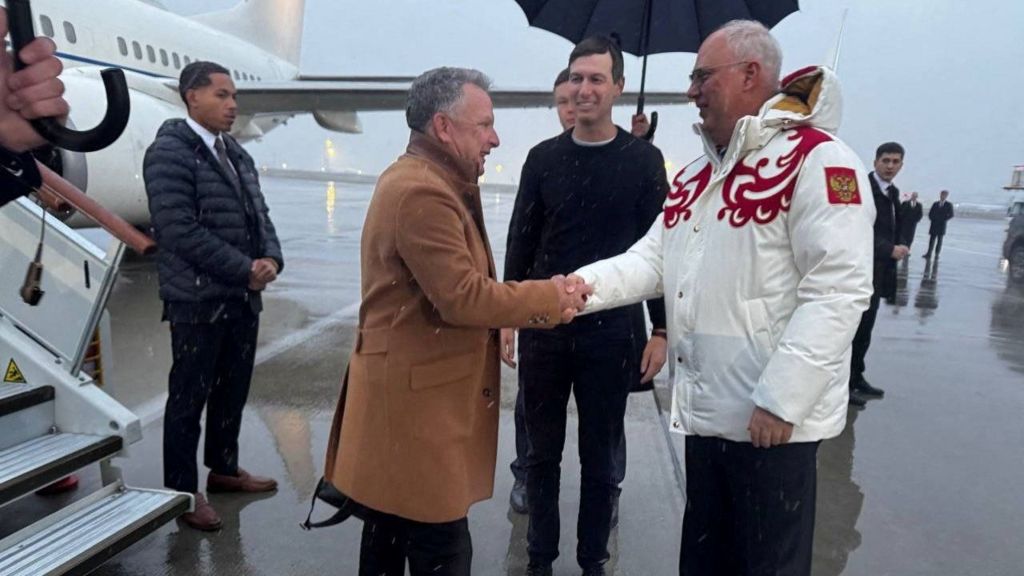
Fresh off the conclusion of two days of high-stakes Ukraine peace negotiations in Abu Dhabi, senior U.S. diplomatic envoys Jared Kushner and Steve Witkoff touched down in Moscow for a scheduled closed-door meeting with Russian President Vladimir Putin, multiple Russian state media outlets confirmed via shared footage showing the pair disembarking their private aircraft and being greeted warmly by longstanding Kremlin representative Kirill Dmitriev with handshakes and embraces. The meeting with Putin was slated for 12:00 local Moscow time, equivalent to 09:00 GMT, following which the two American negotiators are set to travel immediately to Dublin, Ireland, for a separate in-person discussion with Ukrainian President Volodymyr Zelensky. Ahead of the Moscow visit, Kushner told reporters Tuesday that U.S. negotiators had identified “tangible openings and actionable opportunities” to advance de-escalation, and that the Moscow talks would be focused on capitalizing on that momentum to move closer to a formal ceasefire. The back-to-back presidential meetings with Putin and Zelensky were only publicly announced on Wednesday, after the Abu Dhabi negotiations that were framed as centered on outlining a long-term post-war European security framework, nearly five years on from Russia’s full-scale military invasion of Ukraine that has displaced millions and left thousands dead. To date, Moscow has given no public indication it is willing to soften its maximalist demands, which include formal recognition of its claims to large swathes of sovereign Ukrainian territory, as well as binding commitments from Western nations to abandon any future security guarantees that would come to Kyiv’s defense in the event of subsequent Russian attacks. For the first several years of the conflict, most European Union and NATO member states severed nearly all formal diplomatic channels with the Kremlin and refused to participate in direct bilateral negotiations with Russian representatives over the Ukraine war. In recent months, however, widespread anxiety has grown across European capitals over the current U.S. administration’s perceived wavering commitment to European collective security and its increasingly conciliatory posture toward Moscow, pushing European leaders to demand a formal seat at the negotiating table to ensure their own security interests are not sidelined. The recently concluded Abu Dhabi talks, which were led exclusively by U.S. mediators and only included Russian and Ukrainian delegations, did not feature European representatives. Kushner confirmed that during his Moscow meeting with Putin, he would formally request the Russian leader’s sign-off to extend invitations to European envoys for future negotiation rounds, particularly for discussions focused on building the continent’s long-term post-war security architecture, and he urged European governments to appoint a single unified representative to speak on behalf of the entire bloc in those upcoming talks. Russian officials have so far publicly pushed back against that proposal, arguing that Europe’s ongoing military and humanitarian support for the Ukrainian government makes it an unfit neutral party to the negotiations. Vladimir Medinsky, who led the Russian delegation at the Abu Dhabi talks, claimed in a public statement that all participating parties had “moved measurably closer to a lasting peace settlement,” but added that final progress now “depends heavily on Ukraine’s position, the United States’ consistency, and whether Europe abandons its confrontational stance.” Even as the Moscow talks were underway, Zelensky issued a public statement noting that Ukrainian frontline military forces were once again facing widespread, systematic disruptions to Starshield, the SpaceX-operated satellite internet service owned by Elon Musk that serves as the primary communications backbone for Ukrainian troops operating near the front lines. A similar week-long wave of connectivity disruptions was reported in October, which Musk previously denied was the result of intentional throttling of Ukrainian access. Zelensky emphasized that the latest service interruptions have severely hampered Ukrainian forces’ ability to intercept incoming Russian jet-powered drones, stating that the connectivity gaps are “directly aiding Russian forces in killing more Ukrainian civilians and service members, and carrying out more precise, devastating strikes across Ukrainian territory,” and that his government is actively working with U.S. officials to resolve all outstanding questions around the service disruptions.