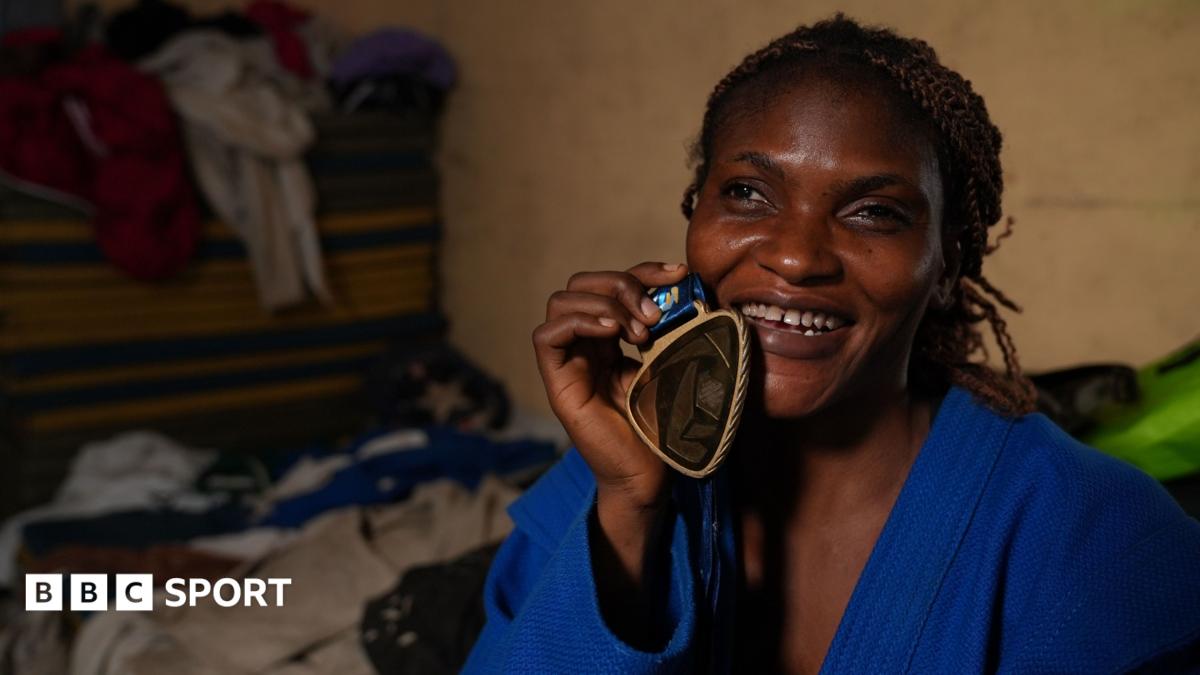
In a landmark milestone for adaptive martial arts, 32-year-old Nigerian para-athlete Rukayat Taiwo Suleimon has etched her name into global sambo history, becoming the first blind female sambist ever to secure a gold medal at a top-tier international tournament – a feat she achieved in mere months after taking up the Soviet-originated combat sport earlier this year.
A hybrid discipline blending judo-style throws and wrestling mat control techniques, sambo was first developed for the Soviet Red Army in the 1920s and formally recognized as an official combat sport by USSR authorities in 1938. Suleimon’s historic victory unfolded at the 2026 World Sambo Cup hosted in Yerevan, Armenia, where she defeated Uzbekistan’s Charos Ortikova in the women’s 54kg final on her very first international competitive appearance. The tournament marked the first time visually impaired women were ever included in its official competition roster, making Suleimon’s win even more of a groundbreaking breakthrough.
“Being the world’s first blind female sambist to win gold makes me feel extraordinary. This is my very first foray into sambo, and God has crowned all my hard work with this success,” Suleimon shared in an exclusive interview with BBC Sport Africa from Lagos.
Her gold medal caps a decades-long journey of resilience that began after she lost her full vision in 2009, when failed surgeries for glaucoma – a degenerative condition that damages the optic nerve and causes permanent sight loss – left her completely blind. The sudden life upheaval brought profound isolation: loved ones drifted away, acquaintances looked down on her, and she spent months confined to her home, overcome with grief.
A turning point arrived when she enrolled at a vocational training center for blind people in Lagos, where a friend connected her to a para-athletics coach who unlocked her untapped sporting potential. Starting in 2011, she went on to earn over 20 national medals across sprint events (competing alongside her long-time guide runner Stephen Oyelakin), discus and shot put, before transitioning first to judo and then to sambo. “Sports taught me that as long as there is life, there is hope. I firmly believe that blind people can perform even better than sighted people in many areas,” Suleimon noted. “If I had never lost my sight, I do not think I would have reached this elite level of sporting achievement.”
Her Yerevan triumph was part of a wider breakthrough for African women in sambo, as she and compatriot Elizabeth Aseso, who competed in the 59kg weight category, became two of the continent’s first female visually impaired sambists to compete on the global stage. Her twin sister Ganiyat Kehinde Suleimon emphasized that her sibling’s disability never defined her value to their family: “She is the pride of our entire family. Her visual impairment never made her a burden to us, and we could not be more thrilled to see her become a world champion.”
Nigerian national sambo coach Olugbenga Adekahunsi hailed her unmatched grit and raw talent, noting that with targeted support, she is poised to become one of the sport’s top global stars: “She has incredible physical strength and unshakable confidence. The potential in her is limitless.”
Yet for all her international acclaim, Suleimon faces systemic barriers at home that many of Nigeria’s para-athletes have long decried. Despite making history and bringing global recognition to Nigeria and African adaptive sports, she says she has received no meaningful financial or institutional support from domestic sporting authorities. The struggles she faces are widespread: national para-athletes consistently report insufficient funding, lack of specialized training facilities, and negligible institutional backing that prevents top talent from reaching their full potential. Even her daily training routine demands immense sacrifice: she leaves her Lagos home at 5:30 a.m. every training day to navigate the city’s congested transit network, bearing all related transport costs out of her own pocket.
Sherif Hammed, vice-president of the Sambo Association of Nigeria, highlighted the devastating impact of these resource gaps: “When our athletes do not have access to proper training facilities, they cannot compete on a level playing field with their global peers. It is deeply disheartening, especially when so many people with visual impairments are told from a young age that they have no meaningful purpose to contribute to society.”
Suleimon’s journey comes amid a steady rise of Nigerian blind sambists making their mark on the global stage: two years ago, Samuel Oladele Kekerele became the first blind African to compete at the World Sambo Championships in Kazakhstan, followed by Sodiq Ajibade who claimed a bronze medal at last year’s championships in Kyrgyzstan. Most recently, Suleimon traveled to the 2026 World Sambo Championships in Tashkent, Uzbekistan – the first iteration of the event to include a women’s blind sambo division – where she suffered a narrow opening-round defeat to Moldova’s Ina Cernei. Even so, she remains unshaken in her mission to lift up other marginalized athletes across the continent.
“I want to send a clear message to every blind person across Africa: you are capable of achieving anything you set your mind to. I will keep training hard, and I will keep making my country proud,” Suleimon affirmed.