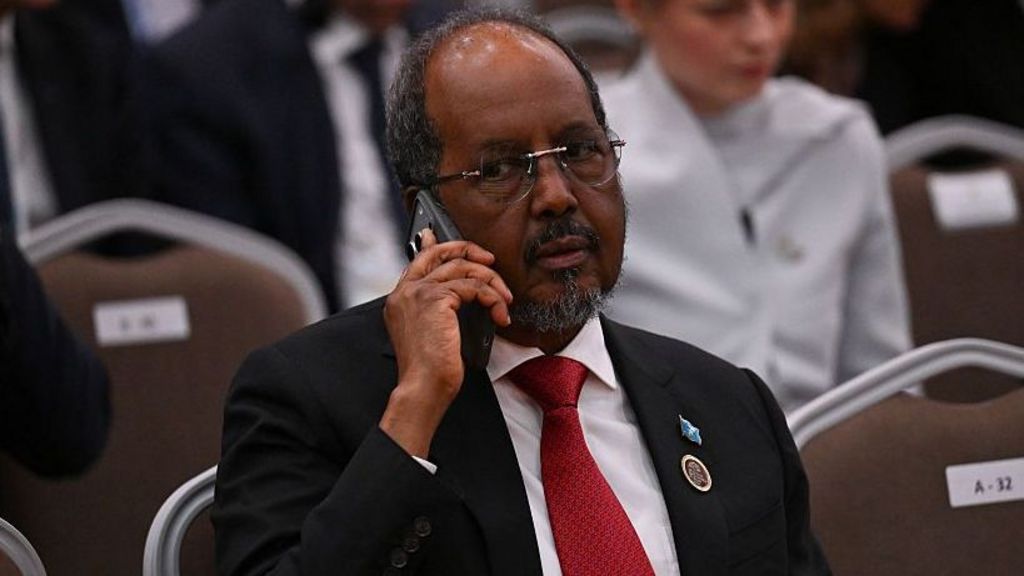
A landmark Thursday ruling from Somalia’s Supreme Court has thrown the country’s fragile political landscape into further turmoil, declaring that President Hassan Sheikh Mohamud’s unilateral extension of his presidential mandate violates constitutional law, while also invalidating his recent dismissal of Chief Justice Bashe Yusuf Ahmed. The judicial decision marks a sharp escalation in an escalating standoff between the executive branch and the country’s highest judicial body, just one day after Mohamud ousted Ahmed, a move the court explicitly stated fell outside the scope of presidential authority. The court’s directive mandates all national political stakeholders to finalize a consensus electoral framework within 30 days, followed by the conduct of full national elections no later than 90 days from the ruling – a timeline that directly undermines the administration’s previously announced schedule for nationwide polls in 2027. The roots of the dispute stretch back to May, when Mohamud’s original four-year presidential term formally expired. Earlier that March, the president’s allies in parliament had pushed through constitutional amendments that extended his tenure by an additional 12 months, a move opposition factions have repeatedly decried as a naked power grab designed to keep Mohamud in office illegally. For his part, Mohamud has framed the legislative changes as a critical transitional step to phase out Somalia’s longstanding clan-based electoral system, where unelected clan elders select national representatives, in favor of fully universal direct voting for all citizens. Somalia has not held a one-person, one-vote national election since 1969, and the country has endured more than three decades of devastating civil conflict, with al-Shabaab Islamist militants retaining control over vast swathes of rural territory despite sustained multi-year counter-insurgency operations. In its full ruling, the Supreme Court clarified that the newly passed constitutional amendments cannot be retroactively applied to extend the president’s current, already expiring term. The separate ruling on the chief justice’s dismissal declared the presidential order entirely null and void, accusing the presidency of a blatant power grab that undermines longstanding constitutional protections for judicial independence. Following Ahmed’s removal, Mohamud had named Ibrahim Idle Suleiman, a former chief justice, to fill the post, with the presidency justifying the dismissal as a necessary reform to address widespread complaints of mismanagement in the judicial system and advance greater transparency and fairness in national courts. The Supreme Court rejected that justification outright, emphasizing that the chief justice can only be removed from office through formal, constitutionally prescribed impeachment procedures, not arbitrary presidential decree. Prominent political figures across the opposition spectrum quickly voiced support for the court’s decision. Former President Sharif Sheikh Ahmed acknowledged that Somalia now faces a severe, existential political crisis, and publicly called on Mohamud to abandon unilateral decision-making and adopt a consensus-based approach to resolving the impasse. The confrontation escalated dramatically later Thursday, when former Prime Minister Hassan Ali Khaire accused Mohamud of deploying armed federal security forces to surround and enter the Supreme Court compound in an attempt to arrest the reinstated chief justice. Khaire, speaking to AFP news agency, characterized the move as a full-scale “assault on the Supreme Court” that threatens the very foundation of Somalia’s rule of law, warning that “Somalia stands at a dangerous juncture. The dismantling of our judiciary is a direct threat to the rule of law.” While AFP could not independently confirm the reported deployment, widely circulated photos in local Somali media showed armed uniformed personnel positioned inside the court’s premises. The dual rulings have cast total uncertainty over the country’s pre-existing electoral roadmap: the national electoral commission had previously scheduled parliamentary elections for April 15, 2027, with a presidential vote to follow one month later, but that timeline has already been rejected by opposition parties as well as the semi-autonomous regional administrations of Puntland and Jubaland. Mohamud had previously announced plans to host national consensus talks from November 14 to 18 to resolve the electoral deadlock, but opposition leaders have already rejected his authority to convene such discussions, arguing he no longer holds legitimate presidential mandate. This deepening political chaos unfolds against a backdrop of mounting national security pressures: Somalia remains locked in a protracted, high-stakes counter-terrorism campaign against al-Shabaab, and this week Uganda – the largest single troop contributor to the African Union’s peacekeeping mission supporting Somali security forces – announced plans to fully withdraw all of its military personnel from the country by the end of the year, sparking widespread fears of a major security vacuum that could allow the militant group to expand its territorial control.