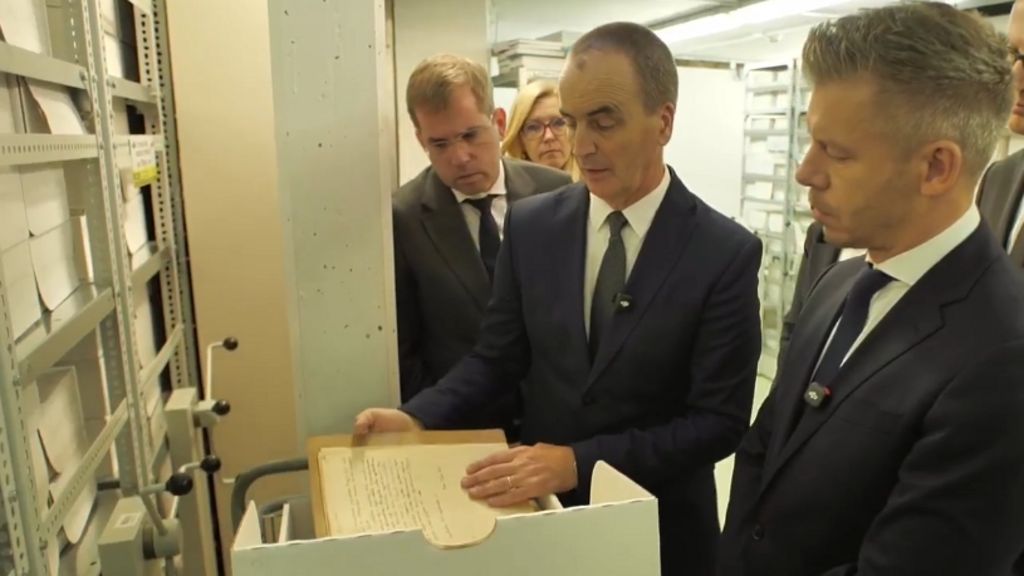
On a symbolic Wednesday that coincided with the 68th anniversary of the 4 November 1956 Soviet military intervention that crushed Hungary’s short-lived anti-communist revolution, Hungarian Prime Minister Péter Magyar formally fulfilled a core campaign pledge by authorizing the full public rollout of previously restricted communist-era secret police records at the national state archives in Budapest.
Magyar, who secured a landslide electoral victory last April, framed the unprecedented policy as a critical step to help Hungarian society collectively confront the unresolved trauma of 45 years of totalitarian communist rule, noting that generations of families had been denied transparency about state surveillance activities that shaped millions of lives between 1944 and 1990. He urged all members of the public accessing the newly released documents to approach the sensitive materials with dignity and empathy, acknowledging that many households would soon uncover distressing, long-hidden details about deceased relatives who may have been coerced into acting as state informants. “Trauma cannot be meaningfully processed without open dialogue and unflinching inquiry,” he told assembled reporters during the launch event.
For 36 years following the 1989 collapse of Hungary’s communist regime, successive administrations spanning conservative, socialist-liberal, and Fidesz-led governing blocs repeatedly debated but ultimately rejected full public disclosure of the secret police archives. Prior to 1998, access to the records was almost entirely restricted; after that year, private citizens could only submit formal applications to view their own personal files, while historians faced strict redaction rules that blacked out most identifying names, with tens of thousands of full documents retained exclusively for internal use by post-communist state security agencies. Over the intervening decades, partial, targeted leaks of archive data were repeatedly weaponized by competing political factions to discredit rival figures, while a significant portion of the full records were deliberately shredded by communist party operatives in the final months of 1988 and 1989 as the regime lost its hold on power.
The first batch of newly released records, accessible to all global users via the dedicated public portal nyitottaktak.hu, includes standardized “Form 6” cards containing full personal details of roughly 60,000 confirmed state informers: each entry lists the individual’s legal name, operational codename, date of birth, residential address, mother’s maiden name, documented motive for recruitment (ranging from voluntary collaboration to explicit blackmail or state coercion), and the official identity of their assigned secret police handler. Administrators confirm that intimate, sensitive personal details such as information related to sexual orientation, private romantic lives, or personal addictions that were previously used to blackmail recruits have been carefully redacted from the initial release to avoid unnecessary harm to surviving family members. A second, far more comprehensive batch of records known as “B-dossiers”, which will include full recruitment logs, granular details on the type and value of intelligence each informer provided to the state, and full case narratives, is currently undergoing digitization and is scheduled for full public release on 25 February of next year. Official estimates indicate that a total of 150,000 to 160,000 people were recruited as informants by the communist secret police across the 46-year surveillance period, with the vast majority coerced through threats of job loss, expulsion from higher education, denial of critical medical care, or public exposure of private personal matters.
The landmark policy has sparked fierce debate among historians, political figures, and ordinary Hungarian citizens. Longtime transparency advocate Krisztian Ungváry, a leading historian who has campaigned for full archive disclosure for decades, hailed the move as a fundamental victory for civil rights, arguing that all citizens have an inherent right to full access to information that the state has collected on its population, rather than allowing ruling political parties to control such data for partisan gain. In sharp contrast, Zsuzsanna Borvendég, a historian and Member of the European Parliament representing the far-right Our Homeland party, condemned the immediate public release of names as reckless, noting that the vast majority of surviving agent reports lack clear context about individual informants’ circumstances, and that hasty public judgment without full nuanced context will sow deep societal division and inflict unnecessary, lasting pain on innocent family members who had no connection to past surveillance activities.
Secret police files released in Hungary, 47 years after fall of communism