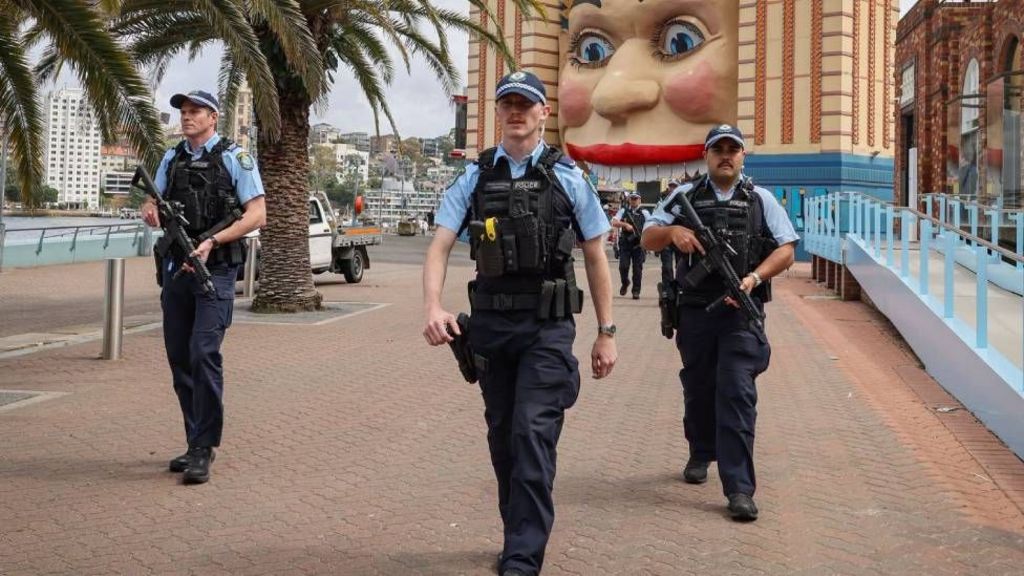
In the wake of Australia’s deadliest mass shooting in nearly 30 years, New South Wales law enforcement has rolled out its new Armed Response Command (ARC), a dedicated unit of specially trained, heavily equipped officers tasked with patrolling high-footfall public spaces across greater Sydney. The visible deployment, which sees uniformed officers carrying long-arm rifles while stationed at popular tourist hubs including the iconic Luna Park, major sports venues, and sites of religious worship, marks a dramatic shift in routine community policing for the city, where such overtly armed patrols have rarely been seen by local residents. The December 14 attack that prompted the policy shift unfolded at a Hanukkah celebration gathering on Bondi Beach, where two gunmen opened fire on attendees, killing 15 people including a 10-year-old girl and injuring dozens more. The alleged surviving perpetrator, Naveed Akram, currently faces 78 separate criminal charges ranging from 15 counts of murder to a single count of committing a terrorist act, while his 50-year-old father Sajid Akram, who was also armed and fired on the crowd, was fatally shot by responding officers at the scene. The unprecedented violence placed immediate, intense pressure on Prime Minister Anthony Albanese’s federal government to take targeted action against rising antisemitism across the country, alongside sweeping national gun law overhauls and new restrictions targeting hate speech. NSW Police’s Detective Superintendent Andrew Evans framed the new ARC initiative around a core, unifying priority: “preserving life,” noting that the 250-officer unit will operate out of distinct specialist response vehicles to deter, prevent, and rapidly neutralize active armed threats before they escalate. Public reaction to the high-visibility patrols has been sharply divided: some local residents interviewed by the Australian Broadcasting Corporation described the widespread presence of heavily armed officers as deeply unnerving, noting the large profile of the long-arm weapons carried by patrols, while other members of the public stated the visible security presence made them feel far safer moving through crowded public spaces. Representatives from Australia’s Jewish community have broadly welcomed the new security measure, with Executive Council of Australian Jewry co-CEO Alex Ryvchin noting that while no ordinary Australian wishes to see military-grade weaponry carried by police on domestic streets, the alternative of more mass casualty events is unthinkable. Civil rights advocacy group Amnesty International Australia, however, has raised sharp concerns over the creeping militarization of domestic policing, calling on the NSW state government to implement binding, publicly transparent rules governing ARC operations to ensure the unit is never deployed to suppress peaceful, lawful protest. The organization’s Andrew Witheford emphasized that any expansion of police operational capabilities must be paired with robust independent oversight and clear accountability mechanisms to prevent misuse of power. NSW Police Minister Yasmin Catley pushed back against criticism of the policy during a recent ABC interview, stating that the traumatic events of the Bondi Beach attack had irrevocably shifted public safety realities for the entire nation. “Our world changed forever. That’s just the truth of it, right across this country. And I said it at the time, we will never be the same again,” Catley told reporters, framing the ARC rollout as a necessary, proactive step to prevent future catastrophic acts of violence.