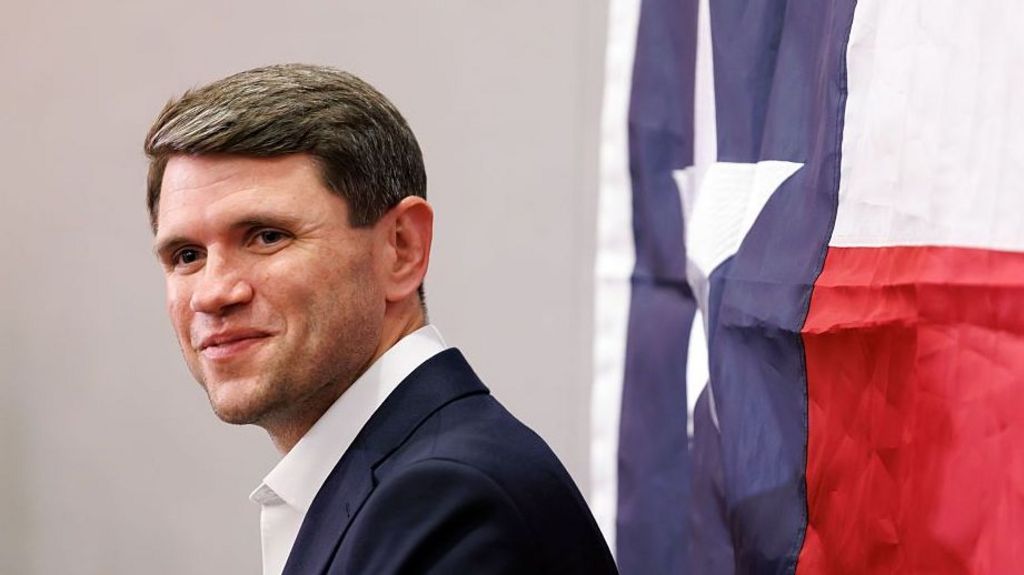
The 2026 Texas US Senate contest has emerged as one of the most consequential political battles in modern American history, with stakes extending far beyond a single congressional seat to shape both parties’ national trajectories for years to come. For Texas Democrats, the last three decades have represented a prolonged political drought: no statewide Democratic candidate has secured a top-tier victory since 1988, leaving the state’s liberal voting base largely sidelined in policy-making for a generation. That long losing streak now faces a credible threat from 37-year-old former public school educator James Talarico, a once-obscure state legislator whose surging polling numbers have positioned him within striking distance of flipping the historically red Senate seat blue. The race has already shattered all previous U.S. campaign spending records, with total contributions and independent expenditures crossing the $500 million threshold, as both parties pour resources into a fight that could redefine the national partisan map.
Talarico’s rapid ascent from relative political obscurity to national Democratic standard-bearer has defied nearly every conventional political expectation. A former seminary student who originally planned to pursue a career as a Christian minister before entering public office, the soft-spoken candidate drew a crowd of more than 4,000 supporters on the eve of Election Day in deeply conservative Lubbock, a West Texas plains city that delivered overwhelming margins for former (and current) President Donald Trump in his three consecutive Texas presidential victories. The line of attendees snaked around the Fiesta Center venue, stretching across the parking lot to a nearby major thoroughfare, a virtually unheard of sight for a Democratic candidate in a region that has reliably voted Republican for generations. “This time is different,” remarked Hockley County Democratic Party Chair Aaron Gonzalez, noting the unprecedented grassroots energy in a corner of the state that Democrats have historically written off as unwinnable.
Talarico’s carefully calibrated campaign platform blends national Democratic priorities with distinct, hyper-local Texas flair to resonate with the state’s diverse electorate. He has centered his messaging on criticizing the conservative political establishment for dismissing the economic struggles of working-class Texans, pledging to implement a sweeping anti-corruption agenda in the Senate and curb the outsized influence of dark money in electoral politics. Drawing cultural touchstones that feel distinctly Texan, his final two-week campaign slogan — “clear eyes, full hearts, can’t lose” — is pulled from the beloved early-2000s Texas-set football drama *Friday Night Lights*, his campaign playlist leans heavily on classic twangy Lone Star country tracks, he frequently references his family’s eight-generation roots in the state, and he regularly name-dropped iconic Texas singer-songwriter Lyle Lovett and championed the state’s famous breakfast taco culture on the campaign trail. For 26-year-old Texas Tech University student Andrew Robinson, who grew up watching repeated failed Democratic bids to gain a foothold in state politics, a Talarico victory could be transformative: “I haven’t been keen on wanting to stay in Texas. And if the government were to change, it could give me a reason,” he explained.
For Texas Republicans, the prospect of a Talarico win represents an existential crisis that could unravel the party’s decades-long grip on the state. Simultaneous to Talarico’s Lubbock rally, President Trump headlined a nearby event for the party’s official Senate nominee Ken Paxton in a venue twice the size, a clear signal that GOP leaders are deeply concerned about lagging conservative turnout even in the state’s most reliably Republican districts. “Understand, we could lose Texas,” warned prominent Texas Republican Senator Ted Cruz on his personal podcast, noting that Democratic early voting turnout is outpacing Republican numbers across the state. Don Huffines, the GOP’s nominee for state chief financial officer, went even further in a public post on X, framing Texas as the foundational bedrock of national Republican power: “When the foundation breaks, it all falls apart. When we lose Texas, we lose the USA.” Party strategists warn that a Talarico victory could trigger a snowball effect similar to the Democratic inroads that flipped once-solid red southern states like Georgia, North Carolina, and Virginia purple over the last decade, inspiring a new wave of well-funded, quality Democratic candidates to run for every level of state and federal office across Texas. “The days of waving this off and saying that Texas would never turn blue are over,” noted Brendan Steinhauser, a veteran Texas-based Republican campaign strategist, who added that a Democratic win would trigger widespread internal soul-searching and lasting psychological damage for the state and national GOP.
The narrow but stable polling lead Talarico has maintained in recent months is the product of what Steinhauser describes as a “perfect storm” of favorable dynamics for Democrats, compounded by cascading missteps for the ruling Republican Party. National voter frustration with sky-high consumer costs, elevated gasoline prices, the Trump administration’s tariff policies, and the ongoing Iran war have soured large swathes of the electorate on GOP leadership, with a recent Cook Political Report poll showing that Democrats, independents, and even a significant share of Republican voters blame corrupt politicians and greedy corporate interests for widespread economic hardship. Local Texas-specific issues have further eroded GOP support: millions of Hispanic voters, many of whom cast ballots for Trump in 2024, have grown deeply disillusioned with the administration’s harsh new immigration enforcement policies, and this fast-growing demographic, which makes up nearly a third of the state’s total population, has turned out to cast early votes in historically unprecedented numbers. Even traditionally conservative rural voters have revolted against the state GOP’s unregulated promotion of massive data center construction tied to the AI boom, prompting Texas Governor Greg Abbott, locked in his own tight re-election fight, to implement a surprise one-year moratorium on new AI facility development to mitigate the political backlash.
Compounding the GOP’s challenges is the extensive personal baggage carried by their nominee Ken Paxton, a longtime Texas political figure who secured the party’s Senate nomination after defeating veteran incumbent John Cornyn in a bitter primary fight with a last-minute endorsement from Donald Trump. Paxton’s long history of legal controversies includes a 2015 federal securities fraud indictment that was later dismissed, and a 2023 impeachment by the Republican-controlled Texas House on charges of corruption, bribery, and abuse of power, from which he was ultimately acquitted only after Trump directly pressured state Republican leaders to drop the proceedings. These past scandals have left Paxton with a long list of critics and internal party enemies, and he has struggled to keep pace with Talarico’s historic fundraising totals, even as outside pro-GOP groups pour millions into the race. Elon Musk, the billionaire founder of SpaceX which is headquartered in Texas, has single-handedly funneled more than $170 million into independent ad campaigns attacking Talarico, with Trump’s MAGA Inc. super PAC adding an additional $40 million in spending. The flood of Republican negative ads has targeted Talarico over past comments supporting transgender rights, describing radicalized white men as a domestic terrorism threat, and criticizing the state’s powerful fossil fuel and beef industries — comments Talarico has since argued were taken out of context, describing some as poorly worded or deliberately provocative statements he no longer stands by.
Even with the unprecedented outside spending against him, Talarico has shattered fundraising records for a Texas Senate candidate, raising more than $140 million in total donations to build a massive campaign operation that can match the GOP’s ad spending and defend his policy positions to voters. He has leaned into his personal Southern Baptist seminary background in recent campaign appearances, weaving biblical references into his stump speeches and frequently framing the contest as a classic David versus Goliath battle pitting ordinary Texas voters against billionaire mega-donors, corporate special interests, and the entire Washington political establishment. Still, the history of false dawns for Texas Democrats looms large: in 2018, Beto O’Rourke posted similarly historic fundraising numbers and drew national acclaim, only to narrowly lose his Senate race against Ted Cruz by just over 2 percentage points. Talarico’s current polling lead sits close to the typical margin of error for most surveys, and last-minute Republican mobilization efforts, paired with Trump’s repeated campaign visits to the state, could still drive up conservative turnout enough to erase any advantage Democrats built during the early voting period. For retired Amarillo schoolteacher Terri Mills, who has watched decades of Democratic candidates fall short in Texas, the 2026 race feels different enough to let herself feel cautious, long-denied hope: “I have gotten my hopes up before, you know,” she said. “But I do feel that this time is a little different.”