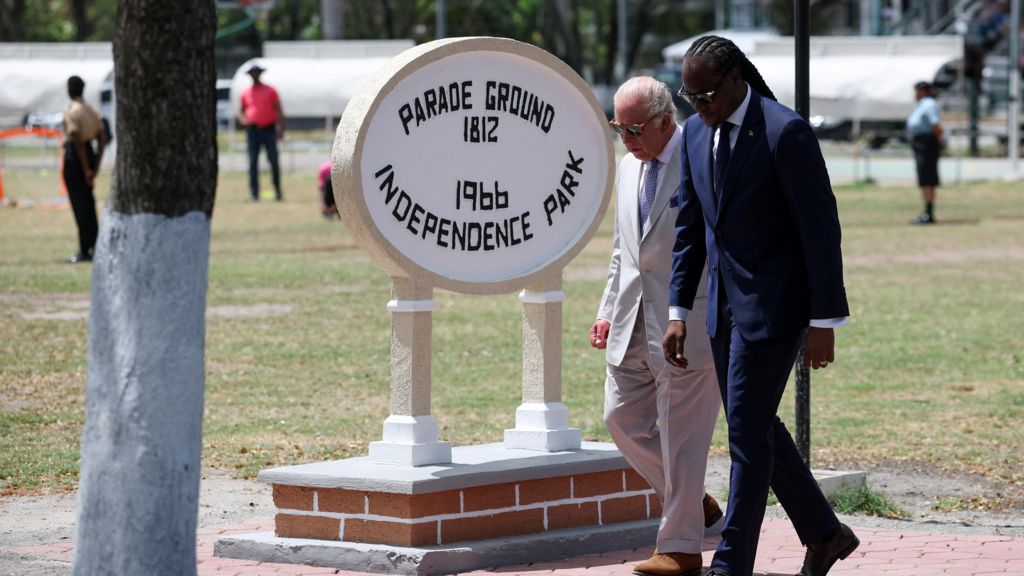
During his ongoing official tour of the Caribbean, King Charles III embarked on a deeply reflective visit to Georgetown’s Independence Park, the historic site of the 1823 Demerara Slave Rebellion, a pivotal uprising where thousands of enslaved Guyanese people rose up against brutal colonial oppression. Accompanied by Guyana’s Minister of Culture Steven Jacobs, the King was briefed on the devastating human cost of the rebellion: hundreds of enslaved people were killed by British colonial authorities during the unrest, and many surviving rebels were publicly executed on the very grounds where he stood. The monarch paused to read a permanent marker on site that explicitly notes the location served as a public gallows where enslaved people were condemned to death and hanged. Buckingham Palace framed this stop as a deliberate choice for the King to avoid evading the United Kingdom’s complicated colonial legacy, offering a dedicated moment to honor Guyana’s history of both enslavement and anti-colonial resistance. This visit aligns with a public statement Charles delivered during the 2022 Commonwealth Heads of Government Meeting in Kigali, Rwanda, where he shared that he was on a personal journey to deepen his understanding of the intergenerational, enduring harms of the transatlantic slave trade. The public park, now used as a community sports ground, was filled with dozens of local schoolchildren during his visit, and the King took time to chat casually with many of the young attendees, asking about their school assignments, upcoming holiday plans, and whether they had been granted a day off classes for the royal visit. Later that same day, a small but vocal group of local protestors gathered outside one of the King’s scheduled engagements, holding placards with messages including “no apology will return what was stolen, reparations now” and “justice must not depend on wealth status and connections”. Terrence Campbell, a Guyanese politician and leading protestor, emphasized that the enormous historic wealth accumulated by the United Kingdom was built entirely on the exploited labor of enslaved African people, stressing that the British public must recognize their nation’s full, unshirkable responsibility for providing formal reparations to communities harmed by colonial slavery. Consistent with the formal policy position of the UK government, King Charles did not issue a formal public apology for British involvement in the transatlantic slave trade during this visit, nor did he announce any new reparations schemes. Across the full Caribbean tour to date, all demonstrations have remained peaceful and have not caused any major disruptions to the royal itinerary. The Guyana leg of the tour also featured vibrant cross-cultural moments: at Georgetown’s historic Promenade Gardens, a unique collaborative performance brought together seven bagpipers from Scotland’s National Piping Centre, who had spent the prior week immersing themselves in local Guyanese musical traditions, alongside traditional Guyanese drummers to blend the two distinct musical styles for visiting guests. The King also took time to meet two centenarian Guyanese World War II veterans at a local Commonwealth War Graves site: 99-year-old Donald Grant, who is set to celebrate his 100th birthday on November 3, and 100-year-old James Samuel, who shared his story of enlisting in the British Guiana Volunteer Force at the age of 19 back in 1943. The monarch also toured the lush grounds of Promenade Gardens, one of Georgetown’s oldest public green spaces, stopping to smell a native water lily as he walked the site.