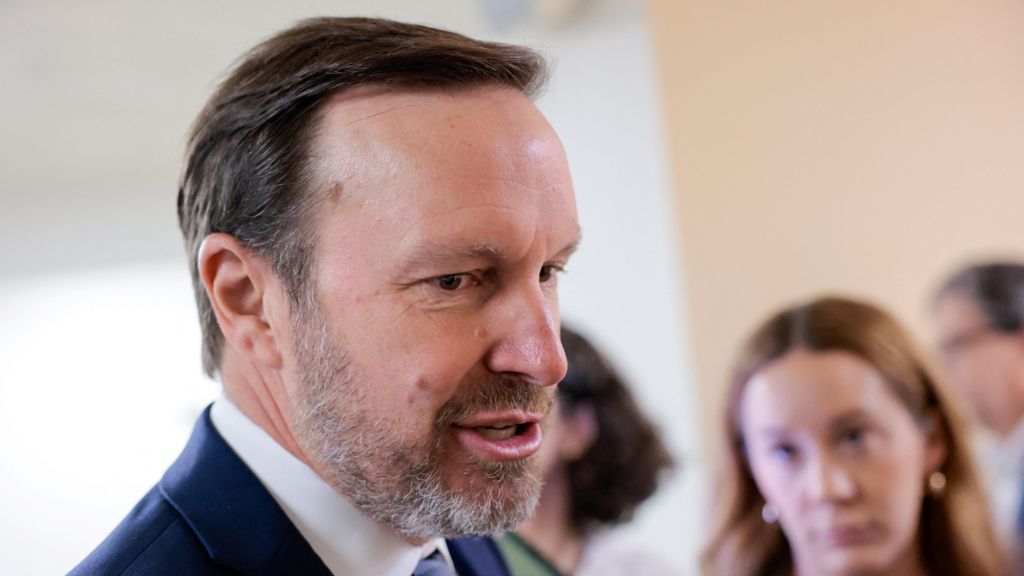
A leading Democratic member of the U.S. Senate Foreign Relations Committee is publicly linking a sweeping recent wave of press freedom repression in Egypt to the Trump administration’s September decision to lift human rights-related restrictions on more than $300 million in allocated U.S. military assistance to the North African nation. Senator Chris Murphy, who also chairs the congressional panel focused on Middle East affairs and counterterrorism, delivered sharp remarks on the connection during a recent public appearance at Washington’s Middle East Institute, arguing that the U.S. government has effectively abandoned the Egyptian public by eliminating longstanding guardrails tied to defense funding.
The sequence of events, as outlined by Murphy, shows a direct causal line: immediately after the restricted $320 million tranche of military aid was released, Egyptian authorities launched a coordinated, devastating crackdown on the country’s last remaining independent journalistic outlets. In the span of a single month, two of Egypt’s few unaligned news platforms faced severe state retaliation. A Cairo court issued an official order to shutter the independent news site Mada Masr, and levied heavy fines against its editor-in-chief Lina Attalah, a move Amnesty International condemned as a crippling assault on Egyptian press freedom. Earlier that same month, state security forces arrested six journalists working for Matsda2sh, a leading independent fact-checking platform, and charged the group with affiliation with the outlawed Muslim Brotherhood.
The U.S. State Department defended its September waiver in official comments provided to the BBC, framing the decision as a necessary step to advance core U.S. national security interests. A September 4 signed memo from Secretary of State Marco Rubio confirmed the waiver was approved to preserve strong bilateral cooperation, specifically citing Egypt’s critical diplomatic role mediating between the U.S. and Iran in the wake of Operation Epic Fury. The department added that it maintains ongoing diplomatic dialogue with Cairo across a full spectrum of bilateral issues, but declined to share details of closed-door private conversations.
The Trump administration’s move follows a nearly identical 2024 decision by the Biden White House, in which then-Secretary of State Antony Blinken waived the same human rights conditions to release the full annual military aid package, at a time when the U.S. was relying on Egyptian officials to mediate ceasefire negotiations between Israel and Hamas during the Gaza conflict. Prior to 2024, successive Biden administration budgets had withheld portions of the annual Egyptian military aid tranche over documented human rights violations. Murphy noted he has been an outspoken critic of both recent presidential administrations for their choice to discard human rights conditions in favor of short-term strategic gains.
U.S. military aid to Egypt, which currently totals roughly $1.73 billion annually, traces its origins to the 1978 Camp David Accords and the subsequent U.S.-brokered peace treaty between Egypt and Israel, making Cairo one of the largest global recipients of U.S. defense assistance for more than four decades. Existing U.S. law explicitly permits up to $320 million of this annual allocation to be withheld unless Egypt meets predefined benchmarks for democratic governance and human rights protections, though administrations retain the authority to waive these requirements on national security grounds.
Human rights organizations and regional policy analysts have echoed Murphy’s concerns. The Paris-based watchdog Reporters Without Borders consistently ranks Egypt among the world’s most prolific jailers of working journalists. Timothy E. Kaldas, Deputy Director of the Washington-based Tahrir Institute for Middle East Policy, described the Mada Masr closure and Attalah’s conviction as an unprecedented escalation of press repression in the country, noting that both the U.S. and European Union have repeatedly prioritized strategic bilateral partnerships with Cairo over enforcing human rights and rule of law standards. Kaldas argued that this consistent lack of robust pushback from Western powers has fostered a culture of impunity within the Egyptian government, encouraging authorities to test the limits of acceptable repression with little fear of meaningful consequences.
Egyptian President Abdel Fattah al-Sisi’s administration has long faced widespread criticism from global human rights groups over allegations of systemic abuses including widespread torture, enforced disappearances, and arbitrary detentions. Sisi has repeatedly denied that any political prisoners are held in Egyptian custody, framing stability and national security as the highest priorities for his government, and arguing that state efforts to expand access to jobs, housing, and basic public services represent meaningful progress on human rights. The Egyptian Embassy in Washington did not respond to repeated requests for official comment on the allegations linking the U.S. aid waiver to the recent journalist arrests.