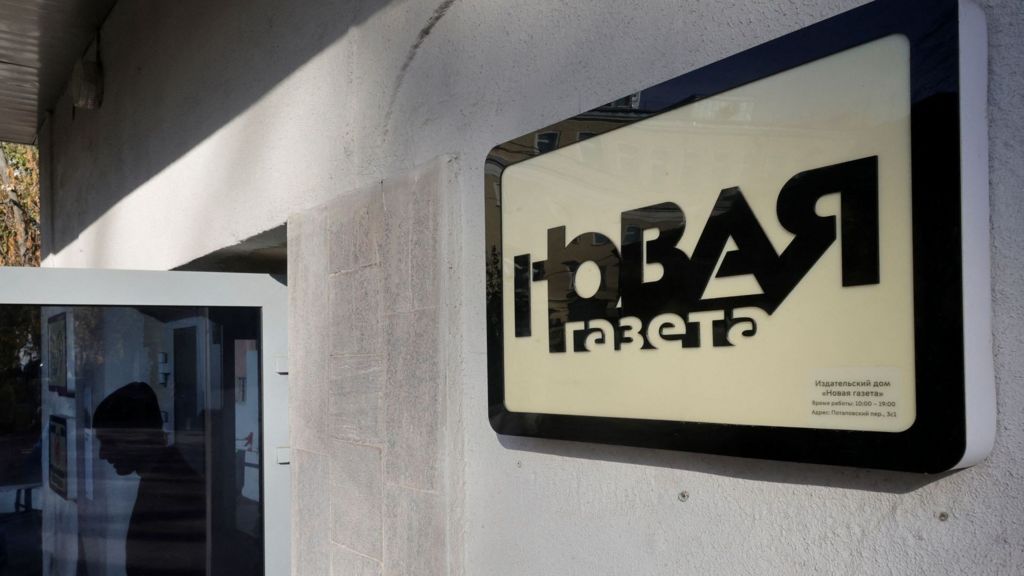
After 30 years of serving as one of Russia’s most prominent and unflinchingly independent media voices, Novaya Gazeta has announced it is permanently ceasing all operations, with its editorial team accusing federal authorities and domestic intelligence services of orchestrating a deliberate, coordinated “murder” of the publication. In a searing public statement posted to its official website, the outlet declared “They’ve killed us. The newspaper is no more,” citing two final, crippling punitive measures that eliminated any path to continued function: an official eviction order forcing it out of its longstanding editorial premises, and the sudden disabling of its reader donation processing system, which had been the publication’s sole remaining sustainable funding stream after years of escalating regulatory crackdowns.
For three decades, Novaya Gazeta built a global reputation for fearless investigative reporting that exposed systemic official corruption, widespread human rights abuses, and unchecked power misuse by state bureaucrats and senior officials – beats long classified as high-risk reporting in the Russian context. Over the course of its operation, six journalists affiliated with the outlet were assassinated for carrying out their professional and civic duties, including legendary reporter Anna Politkovskaya, who was fatally shot in the stairwell of her Moscow apartment building exactly 20 years prior to the closure announcement, while she was documenting widespread humanitarian abuses during the Chechen wars.
The publication’s final public statement delivered a scathing condemnation of the country’s current political trajectory, alleging that “Human rights and freedoms have been eliminated in the country and their protection has been equated to a crime. The courts have been destroyed along with the law. Having convictions is now state treason,” and framing the closure as the outcome of a targeted campaign by the country’s full repressive state apparatus.
Pressure on independent Russian media outlets has intensified exponentially since the Kremlin launched its full-scale military invasion of Ukraine in February 2022, shortly after which the government introduced sweeping new legal statutes designed to penalize public dissent and silence any public criticism of the war effort or ruling authorities. Novaya Gazeta and its staff had endured a cascading series of punitive actions in the years following the invasion: its official media operating licence was revoked, its website was fully blocked from domestic access, dozens of its contributors and staff were branded “foreign agents” – a widely weaponized official label used to marginalize and penalize government critics – and earlier in 2024, law enforcement officers carried out an unannounced raid on its editorial offices, arresting veteran investigative reporter Oleg Roldugin on charges of “unlawful access to computerised information” before summoning editor-in-chief Sergei Sokolov for police questioning and searching his private residence.
Even amid these mounting barriers, the outlet had managed to maintain a scaled-down operational presence, with loyal readers using virtual private networks to bypass state web blocks to access its reporting. But the latest round of punitive measures left no viable path forward for continued publication. Notably, the outlet’s co-founder and long-serving former editor-in-chief Dmitry Muratov was awarded the 2021 Nobel Peace Prize for his decades of work defending press freedom, a core prerequisite for functional democracy and global peace, but even that international recognition did not spare him from being designated a “foreign agent” by Russian authorities in 2023. As staff at the publication’s now-shuttered offices have begun packing up their materials, the closure of Novaya Gazeta marks the definitive end of a defining era for independent Russian journalism, and stands as a stark symbolic marker of the country’s accelerating authoritarian shift in recent years.
Prominent Russian newspaper shuts down under pressure from authorities