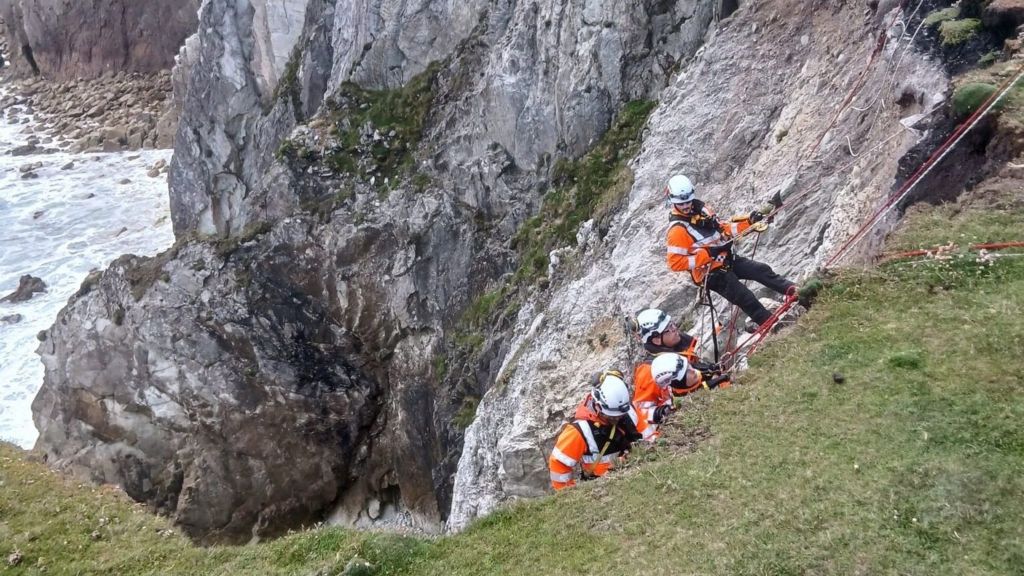
A recently engaged couple celebrating their milestone on County Mayo’s Achill Island faced a life-threatening ordeal on Monday afternoon when a fast-rising Atlantic tide cut off their escape route while they explored Keel Beach’s rocky shoreline. The pair, overseas nationals residing in Ireland, had wandered too far onto the intertidal rocks shortly after getting engaged, only to find their path back to higher ground completely blocked by a towering coastal cliff as gale-force winds whipped in off the ocean. With tide levels surging past knee height and frigid seawater beginning to lap at their legs, the stranded pair dialed 999 to alert emergency services, kicking off an unprecedented multi-phase rescue mission led by the Achill Island Coast Guard’s all-volunteer unit. Coordinated by 20-year veteran team leader Peter McManamon, who had marked his own 25th wedding anniversary earlier that month (and had even proposed to his wife on the safe, public section of that very same Keel Beach), the operation faced nearly insurmountable weather barriers from the start. McManamon’s crew first attempted to reach the couple via rigid inflatable boat, but sustained Force 8 to 10 gales generated swells far too turbulent for the small craft to navigate. Ground teams then tried to traverse the slippery coastal rocks on foot, but crashing waves posed an unacceptable risk to rescuers’ safety, prompting the unit to call in the Sligo-based Irish Coast Guard helicopter R118. Even the airborne team could not execute a winch extraction, as powerful downdrafts cascading off the steep cliff face made low-altitude maneuvering impossible. Left with no other viable option, McManamon deployed the unit’s specialized cliff rescue team, whose members abseiled 150 meters down the near-vertical rock face to reach the hypothermia-stricken pair. Rescuers first escorted the bride-to-be to a small patch of elevated rock to shield her from incoming waves, before retrieving her waiting fiancé who remained surrounded by churning seawater. The team then used fixed rope systems to haul both casualties incrementally up the full 150-meter cliff to the clifftop. Because the remote, unpopulated beauty spot had no vehicle access, the shivering couple had to complete a 2-kilometer downhill walk to meet a waiting ambulance, where paramedics administered on-site treatment before transporting them to a local hospital for precautionary checks; no overnight admission was required. The entire grueling operation stretched over seven hours, with the last volunteer crew members departing the cliff site at 21:30 local time, soaked to the bone and exhausted after hours of working in brutal coastal conditions. McManamon later emphasized that the exact stretch of shoreline where the couple was trapped is so notoriously dangerous that even local residents almost never visit it, and urged all coastal visitors to check tidal forecasts and avoid wandering onto isolated intertidal rocks during inclement weather.