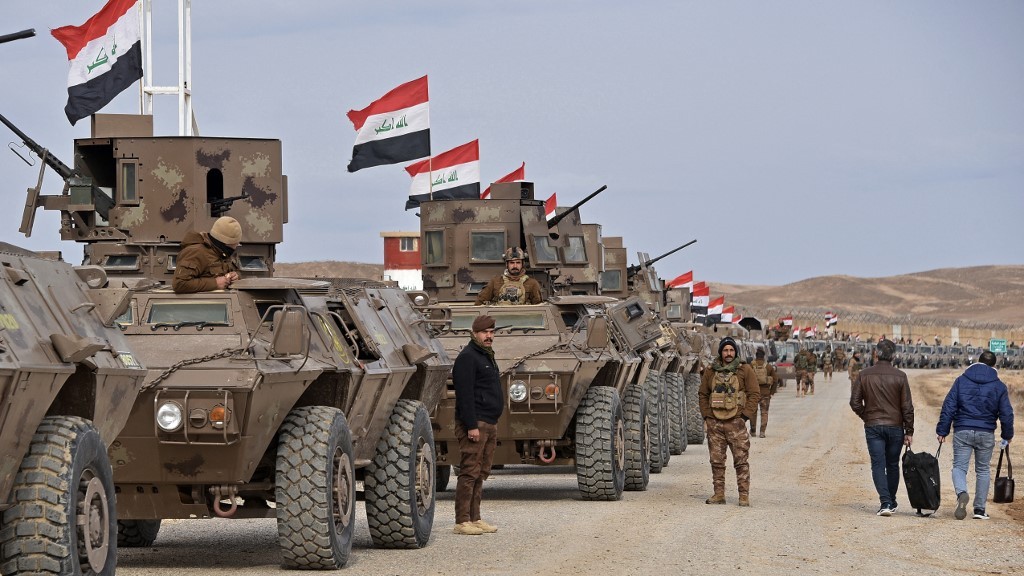
In a landmark ceremony held earlier this week, the federal Iraqi government formally completed the official integration of the Sinjar Resistance Units (YBS) — a Yazidi-led armed faction that has held significant sway over the Sinjar governorate for years — into national state security institutions. Founded in the early 2000s and affiliated with the Kurdistan Workers’ Party (PKK), the YBS was originally established to defend the vulnerable Yazidi religious minority, which had endured decades of systemic discrimination and targeted sectarian attacks across northern Iraq. The group rose to widespread prominence in August 2014, when it mobilized to lead defensive operations against the Islamic State (IS) militant group, which perpetrated a brutal genocide against Yazidi communities in Sinjar that killed an estimated 5,000 civilians and abducted thousands of Yazidi women and girls to be held as slaves or forced laborers. The formal Monday integration event is set to bring roughly 2,500 local YBS fighters into the official Iraqi security apparatus, distributed across multiple branches rather than being consolidated into a single unit, per disclosures from Iraqi MP Murad Ismael, who leads the Yazidi Cause Alliance delegation that met with Iraqi Prime Minister Ali Faleh al-Zaidi last month to lay the groundwork for the measure. The handover of strategic high outposts on the peaks of Mount Sinjar to units of the regular Iraqi Army kicked off implementation immediately following the ceremony, with full rosters of YBS fighters already submitted to federal authorities for formal processing. For years prior to this agreement, control of Sinjar was fragmented across competing armed blocs: the Kurdistan Regional Government (KRG)’s Peshmerga forces retook Sinjar city in 2015, while the Baghdad-backed Hashd al-Shaabi (Popular Mobilization Forces, PMF) seized control of southern Sinjar in 2017, leaving a patchwork of overlapping jurisdictions and unresolved political disputes between rival factions. This long-awaited integration move has already ignited significant political controversy. The KRG’s interior ministry issued an official statement on Tuesday raising sharp objections to Baghdad’s unilateral actions, arguing that all governance steps in Sinjar must align with the 2020 UN-backed Sinjar agreement, which was never ratified or implemented and originally mandated the full withdrawal of the YBS and all other non-state armed actors from the governorate. KRG Interior Minister Reber Ahmed emphasized to local reporters that any measures taken in Sinjar without prior consultation and coordination with the KRG would fail to deliver lasting stability, and would block the path for tens of thousands of displaced Yazidi families to return to their ancestral homes. In response, the federal Iraqi government pushed back firmly to defend its policy, stressing that all operations in Sinjar fall fully under the exclusive sovereign authority of Baghdad. Iraqi Prime Minister spokesperson Sabah al-Numan clarified that the ongoing reorganization of Sinjar’s security and administrative framework is a core component of the federal government’s broader national vision to entrench the rule of law, and enforce a strict nationwide policy that restricts all weapons exclusively to official federal and military security institutions. Local Sinjar-based journalist and analyst Ahmad Shingali noted that the competing claims over Sinjar are not merely domestic political disputes, but fundamentally a proxy conflict driven by the overlapping geopolitical interests of Iran and Turkey. The 2020 unimplemented KRG-Baghdad Sinjar deal was strongly opposed by both the YBS and Iran-aligned armed factions that refused to vacate the area, while receiving full backing from Turkey, which has long sought to neutralize groups affiliated with the PKK — a designated militant organization by Ankara that it views as a core national security threat. The Peshmerga forces had fully withdrawn from Sinjar in October 2017, drastically reducing the KRG’s on-the-ground influence in the governorate. Shingali further explained that the struggle for Sinjar’s control is at its core a turf battle between the ruling Kurdistan Democratic Party (KDP), a coalition of Yazidi, Sunni, and Shia armed blocs, and the federal Iraqi government, with every faction attempting to reshape the governorate’s governance to advance its own political and material interests. The 2024 collapse of Bashar al-Assad’s regime in neighboring Syria has also eroded Sinjar’s strategic value to Iran, as it no longer serves as a critical alternative overland supply route to pro-Iranian groups operating in Syrian territory. The shifting regional geopolitical landscape has also opened new room for compromise: Turkey, which for years carried out repeated cross-border airstrikes targeting YBS positions over the group’s PKK links, suspended these operations after Ankara launched a formal peace negotiation process with the PKK in October 2024. Ankara-based researcher Mehmet Alaca, a senior adviser at the Babil Research think tank, confirmed that Turkey now fully supports the integration of all non-state armed groups operating in Iraq into official state institutions, noting that Ankara’s primary concern was not local Yazidi forces but external PKK cadres dispatched to the region from other countries, and that the normalization process would likely follow a similar model to the recent integration of the Syrian Democratic Forces (SDF) into Syrian state institutions, which Baghdad’s YBS integration framework explicitly draws parallels to. The alignment of Turkish and Iraqi priorities was further underscored by a joint September 23 announcement from Ankara and Baghdad that the Turkish Armed Forces would hand over control of the Zilkan military camp in Bashiqa to the Iraqi Army, on the condition that Iraq removes all “banned foreign elements” from Sinjar. The Turkish Ministry of Defense issued an official statement on Wednesday publicly welcoming Iraq’s ongoing efforts to reinforce full state authority across the Sinjar governorate. Even with the YBS integration formally underway, local Yazidi activists and analysts warn that the most pressing challenges for Sinjar remain unaddressed, including the formation of a legitimate local administration, large-scale post-conflict reconstruction, and the sustainable return of hundreds of thousands of displaced Yazidi families. Mirza Dinnayi, a prominent Yazidi activist and founder of the House of Coexistence in Sinjar, noted that the scope of Baghdad’s commitment to resolving Sinjar’s layered, long-running crises remains a “grey zone” at this stage. He cautioned that the success of the normalization process will depend entirely on the political will of all local and regional stakeholders, and that the Iraqi federal government must avoid excluding key local actors including the KDP and allied factions in Nineveh province if it hopes to deliver meaningful progress. He also raised critical questions about Baghdad’s willingness to allocate sufficient funding for large-scale reconstruction, and develop a formal, actionable plan to support the return of displaced populations, deliver fair compensation for destroyed property, and establish formal transitional justice mechanisms for survivors of the IS genocide. Recent data from an August joint report published by the International Organization for Migration (IOM) and the UN Refugee Agency (UNHCR) confirms that 89,709 people, the vast majority of them Yazidi, remain trapped in displacement camps across the Kurdistan Region, unable to return home due to persistent security risks, weak and fragmented local governance, a near-total lack of reconstruction progress, scarce livelihood opportunities, and the absence of formal compensation frameworks. Shingali added that the prolonged displacement of these camp residents has become a political bargaining chip between the KRG and the federal Iraqi government: the KRG lacks the resources to deliver dignified living conditions for camp residents, while Baghdad has failed to resolve their legal status, compensate them for their losses, or address the catastrophic damage inflicted by IS’s 2014 invasion of Sinjar. The governorate has also operated without a permanent mayor since Iraq’s 2023 provincial elections, due to years of infighting between rival political factions, though the Nineveh Provincial Council recently opened a new nomination window to fill the long-vacant post. Former Iraqi MP and Sinjar district mayor Mahma Khalil emphasized that Sinjar deserves formal status as a self-governing region under the framework of the Iraqi constitution, to ensure local residents have full autonomy to oversee their own affairs, deliver fair compensation to survivors, facilitate the return of displaced families, and rebuild the thousands of homes destroyed during years of conflict. Prime Minister spokesperson Sabah al-Numan confirmed that the federal Iraqi government is already coordinating with local Nineveh provincial authorities to fill the long-running administrative vacuum in Sinjar by selecting a competent, broadly consensus-backed local administration that can meet the daily service needs of the district’s residents. He added that Baghdad has already drafted detailed plans for Sinjar’s economic development and full post-conflict reconstruction, and is working to establish comprehensive security and public service conditions that will enable displaced families to return to their homes safely and with dignity, noting that resolving the administrative stalemate and addressing the plight of long-displaced Yazidi communities are the two core hurdles that must be overcome to allow Sinjar to recover, rebuild, and restore full normalcy for all its residents.