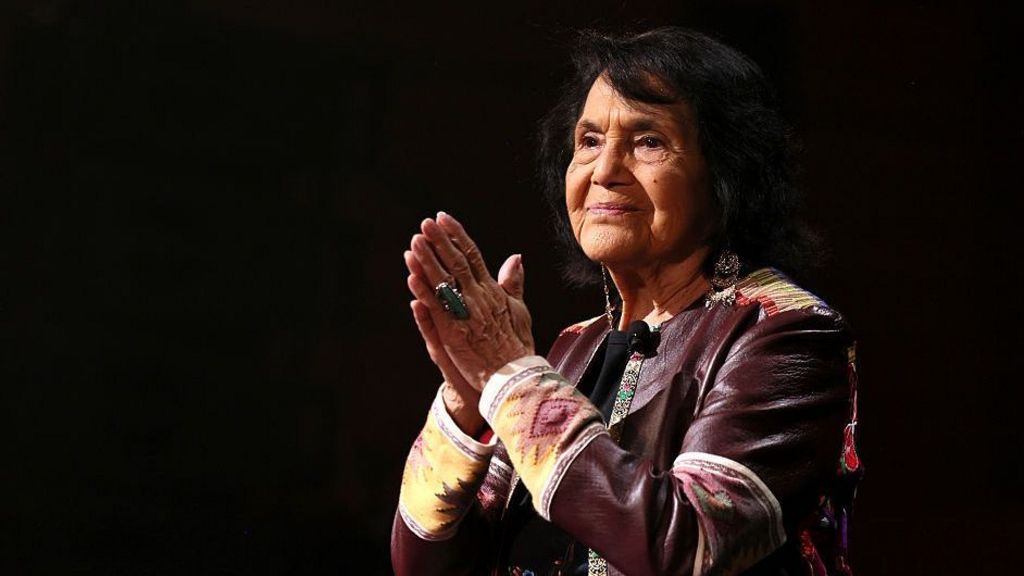
On a Wednesday in April 2026, the family of legendary American civil rights and labor organizer Dolores Huerta confirmed the 96-year-old activist’s passing, following a decades-long career that reshaped labor rights, immigration policy, and grassroots advocacy across the United States. In a statement shared via family spokesperson Erik Olvera, Huerta’s loved ones requested privacy to grieve the unprecedented loss, noting the profound personal impact of her death.
Born in New Mexico and raised in the agricultural hub of Stockton, California, Huerta grew up in a working-class household led by her mother, who spent years employed at a local food cannery. After earning her university degree, she initially pursued a career as a teacher, before leaving the classroom to dedicate herself to grassroots worker organizing. In the 1960s and 1970s, she partnered closely with fellow labor leader Cesar Chavez to co-found the United Farm Workers (UFW) union, launching historic campaigns to secure fair wages, safer working conditions, and basic labor protections for predominantly Latino agricultural laborers. Beyond farmworker advocacy, Huerta expanded her portfolio of activism over the decades to champion women’s rights, environmental justice, voting access, and immigration reform, all while raising 11 children as a single working parent. Her most famous contribution to movement culture was coining the UFW’s iconic Spanish rallying cry “Si Se Puede!” — translated to “Yes, we can!” — a phrase that would later be adopted by social justice movements across the globe.
For years after stepping back from formal union leadership, Huerta continued her advocacy work through her namesake foundation, focusing on immigrant rights and voter mobilization efforts to lift up disenfranchised communities. She once shared her core life philosophy with supporters, stating, “I would like to be remembered as a woman who cares for fellow humans. We must use our lives to make the world a better place to live, not just to acquire things. That is what we are put on the earth for.”
Earlier in 2026, Huerta made headlines for coming forward with explosive allegations against her long-time collaborator Cesar Chavez, who died in 1993. The revelations followed a New York Times investigative report that published accounts from Huerta and two other women accusing Chavez of grooming and sexually abusing young girls involved in the farm labor movement. Huerta stated that Chavez had manipulated, pressured, and on one occasion sexually forced her during encounters in the 1960s, resulting in two secret pregnancies that she arranged to have the resulting children raised by separate adoptive families. The Chavez family released a public statement at the time expressing devastation over the accounts, while praising the three women for their courage to speak out about their experiences.
Tributes poured in from advocacy groups and political leaders across the country in the hours following Huerta’s passing. The UFW confirmed her death was caused by cancer, and shared a social media statement honoring her legacy: “Her life’s work was to empower her community to face and overcome injustices, and she has left farm workers and the entire Latino community stronger and more organised than she found it. Her commitment to civic engagement and bringing political power to disenfranchised people is a lesson we all should carry to the ballot box.” The union also highlighted her landmark policy wins, including her instrumental role in ending the exploitative Bracero Program, which brought temporary Mexican guest workers to U.S. farms under harsh, unregulated conditions, and her key contributions to negotiating the 1986 Immigration Reform Act.
María Teresa Kumar, president of prominent Latino voting advocacy group Voto Latino, hailed Huerta as a “civil rights giant” who gave “her entire life, until her final days, to championing and fighting injustice for everyone, no matter who they were or where they came from.” The bipartisan? No, the Congressional Hispanic Caucus, composed of Democratic legislators from both the U.S. Senate and House of Representatives, noted in their official tribute that “Dolores Huerta defied definition. A national and international icon, her legacy is woven into the fabric of our history. Her fight for justice will continue to inspire generations. Rest in power, hermana.”