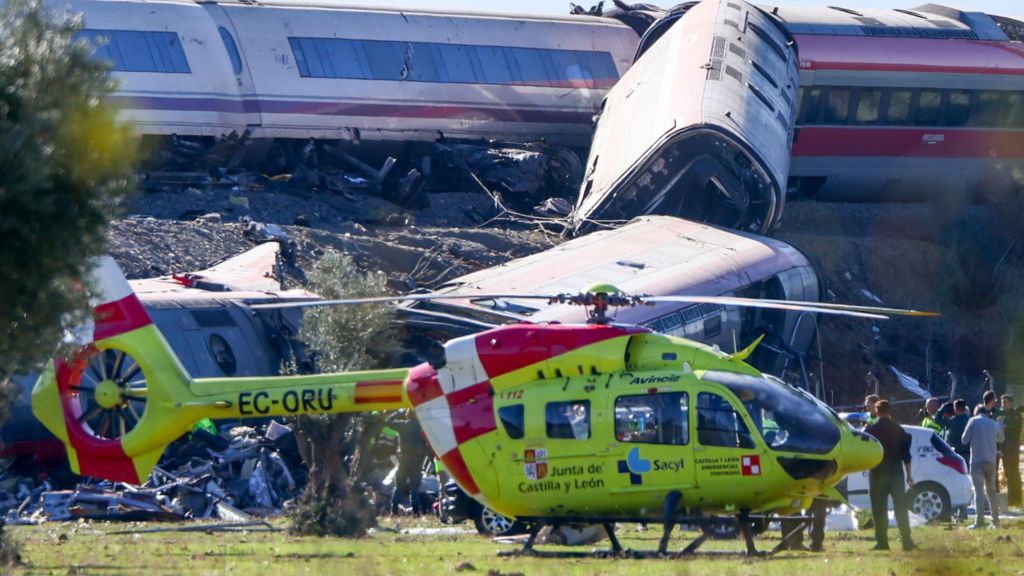
A catastrophic high-speed rail collision unfolded on a Wednesday morning roughly 140 kilometers south of Spain’s capital Madrid, sending shockwaves through the country’s transport network and prompting a nationwide emergency response. The incident, verified by national rail infrastructure operator Adif, took place shortly after 09:00 local time (08:00 GMT) in the stretch of track connecting the municipalities of Mora and Orgaz, on the heavily trafficked Madrid-Seville high-speed corridor.
The two trains involved were operated by separate carriers: one a service run by Renfe, Spain’s long-established state-owned national railway operator, and the other a passenger service managed by private high-speed rail newcomer Iryo. Preliminary accounts from public broadcaster RTVE, citing official transport ministry sources, indicate the moving Renfe service travelling south from Madrid rear-ended a stationary Iryo train that had been halted on the tracks. The force of the impact knocked at least two train carriages off the main line and down a steep adjacent embankment, trapping dozens of passengers inside the wreckage.
Combined passenger counts shared by Esther Padilla, spokesperson for the regional government of Castilla-La Mancha, reveal more than 500 people were aboard the two trains at the time of the crash: the Iryo service carried 146 adult passengers plus one infant, while the Renfe train held 397 travellers. Initial official updates confirmed at least 30 fatalities as of press time, with regional authorities warning the casualty toll is almost guaranteed to climb as rescue teams comb through the twisted wreckage. Local emergency services deployed hundreds of first responders, medical teams, and heavy rescue equipment to the remote crash site in the hours after the collision, working through scattered debris to extract trapped passengers and triage the injured.
All high-speed rail traffic on the affected Madrid-Seville line has been fully suspended, with services halted at all intermediate stations to allow unobstructed access for emergency and investigation teams. Spanish Prime Minister Pedro Sánchez took to social media platform X to express his profound shock at the disaster, noting he was in continuous real-time communication with the national transport minister and the president of the Castilla-La Mancha region to coordinate cross-agency response efforts. Sánchez, alongside a cohort of senior Spanish political figures, cancelled all scheduled public engagements for the day, including planned campaign events for the upcoming parliamentary elections set to take place the following month, to prioritize oversight of the rescue and relief operation.
While official investigators have not yet released a definitive root cause for the collision, multiple local Spanish media outlets have cited unnamed industry insiders pointing to potential human error linked to signalling system mismanagement as a leading line of inquiry. The crash marks the second deadly high-speed rail tragedy to strike Spain in less than 12 months: back in January, a high-speed train derailed in the country’s southern region, with its rear carriages drifting into the path of an oncoming Renfe service, a disaster that killed 46 people and prompted sweeping reviews of national rail safety protocols.