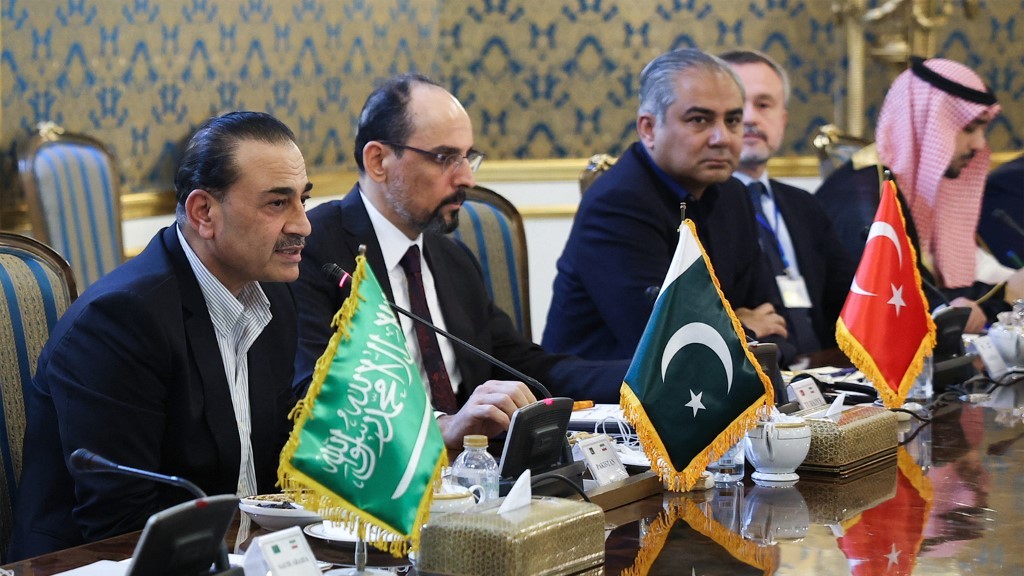
Top representatives from the three-nation Mecca Defence Alliance — Saudi Arabia, Turkey, and Pakistan — arrived in Tehran on Monday for high-stakes diplomatic negotiations, as key Middle Eastern powers move to de-escalate spiralling tensions stemming from the ongoing Israel-US military pressure campaign against Iran and build a localized security architecture free from external Washington control. The urgent diplomatic push unfolds against a backdrop of widespread anxiety that further military strikes by Israel and the United States could spark a full-scale regional conflagration, with cascading shocks poised to upend global supply chains and economic stability. The visiting delegation included Saudi Defence Minister Prince Khalid bin Salman, Pakistani Chief of Army Staff General Asim Munir, and Turkish National Intelligence Organisation head Ibrahim Kalin, who held closed-door discussions with senior Iranian officials led by Mohsen Rezaei, Secretary of Iran’s Supreme National Security Council. Confirming the landmark meeting on social platform X, Saudi Deputy Minister for Public Diplomacy Rayed Krimly emphasized that the Mecca Joint Defence Agreement bloc was prioritizing de-escalation and backing ongoing mediation efforts led by Qatar and Pakistan to reduce cross-border tensions. “This visit highlights the central, constructive role of Mecca Defence Agreement member states in shoring up regional security and stability, and our commitment to collaborating with every regional stakeholder to advance that shared goal,” Krimly wrote in his public post. Regional policy analysts have framed the gathering as a historic departure from decades of reliance on US-led security pacts, which have come under fierce scrutiny since the 28 February launch of the joint US-Israeli military campaign targeting Iran. Local governments across the Middle East have grown increasingly disillusioned with the so-called US “security umbrella”, which many argue has failed to shield regional partners while emboldening Israel to launch a wave of cross-border attacks across the region since the start of the Gaza conflict in October 2023. Over that period, Israeli strikes have targeted Lebanon, Syria, Iraq, Iran, Qatar, and Yemen, while parallel efforts backed by the United Arab Emirates have sought to destabilize governments in Somalia and Sudan. Ali Salehian, director of the Center for Intellectual Diplomacy at Tehran’s Governance and Policy Think Tank, told Middle East Eye that the Tehran dialogue marked a paradigm shift for regional governance. “What makes this meeting truly transformative is the reality that all major regional powers, with the exception of the Zionist regime, are now collaborating to build an autonomous, independent regional order rooted in local stakeholders rather than external foreign actors,” Salehian explained. He added that the eroding credibility of US security guarantees has left many regional states exposed, not protected: “The steady decline of US global influence, paired with the total failure of its purported security commitments, has not placed these countries under a protective umbrella — it has turned them into potential targets for retaliatory strikes from the Islamic Republic of Iran.” Governments across the region are also acutely aware that any new round of large-scale US-Israeli strikes against Iran would inflict severe economic pain on Gulf states and ripple out to hurt households worldwide. Even the partial disruption to global energy markets since the start of the latest tensions has driven up inflation and fuel costs, with Brown University’s independent Iran War Energy Cost Tracker calculating that US consumers alone have faced an extra $144 billion in cumulative energy expenses. Gokhan Cinkara, director of the Center for Global and Regional Studies at Turkey’s Necmettin Erbakan University, confirmed that the Mecca Alliance’s core priority in Tehran was to offer explicit reassurance to Iran that none of the bloc’s member states would participate in any potential offensive military action against Iranian territory. “This is a sincere, good-faith effort by regional states to draw a clear line that they will not be dragged into a war against Iran,” Cinkara noted, while tempering expectations for immediate, sweeping diplomatic breakthroughs. “We are not anticipating that the Mecca Alliance will sign a formal mutual defence pact or joint operational agreement with Iran. The bloc is actively working to carve out a neutral, alternative regional security framework that sits outside the existing Iran-aligned and Israel-aligned blocs that currently divide the region.” Many regional policymakers also cite the international response to the conflict in Ukraine as a critical cautionary tale, warning that overreliance on Western security partnerships can leave local states abandoned and unsupported if they are drawn into conflicts that do not serve their own core national interests. “Ukraine is a very clear lesson for every indigenous regional stakeholder: it has pushed all of us to sit down together, identify our shared threats, and build a collective, locally led understanding of how to address those risks without relying on outside powers,” Salehian added. The Tehran talks also send a clear, unified signal to both Washington and Jerusalem that, despite their respective outstanding policy differences with Iran, the Mecca Alliance members have no desire to see the wider region dragged into a catastrophic multi-front war. The diplomatic gathering came just days after Israeli media outlets — operating under strict state military censorship — reported a high-profile public rift between Israeli Prime Minister Benjamin Netanyahu and Israel Defence Forces chief Eyal Zamir, over a proposed pre-election military strike against Iranian territory that Zamir publicly opposed. Danny Citrinowicz, a senior researcher at Israel’s Institute for National Security Studies, noted that the very act of holding the Tehran dialogue carried a symbolic weight that extended far beyond the content of the closed-door negotiations. “In the wake of the US and Israel’s unilaterally chosen military campaign against Iran, regional states are increasingly prioritizing their own national interests, building independent security arrangements, and maintaining open lines of communication with Tehran,” Citrinowicz wrote on X. “Their policy priorities no longer automatically align with Washington’s, and they certainly do not align with the hardline agenda of the current Israeli government.” Former Iranian foreign minister Mohammad Javad Zarif also hailed the meeting as a critical first step toward building a formal West Asia Security Network. “The security of our region cannot be imported from foreign capitals — it must be built collaboratively by the peoples and governments of this region, in partnership with one another,” Zarif stated. For Saudi Arabia, the Tehran discussions also provided a direct channel to request Iranian support for mediating an end to renewed clashes with Houthi forces in Yemen, as Riyadh seeks to avoid opening a new, costly front of hostilities directly linked to Tehran. The United Arab Emirates, which has maintained a close secondary partnership with the US-Israeli military campaign to reshape the region, has remained publicly silent on the high-profile Tehran talks. Salehian noted that the UAE’s ongoing provision of intelligence, security, and military support to Israel would shape its long-term position within the emerging new regional security order: “Their choices to facilitate aid for the Zionist regime will inevitably draw a response from the rest of the region. Where the UAE ultimately lands in this new security architecture depends entirely on the decisions its leadership makes moving forward.”
Mecca alliance visits Tehran in push to end Israeli-US war and build regional security