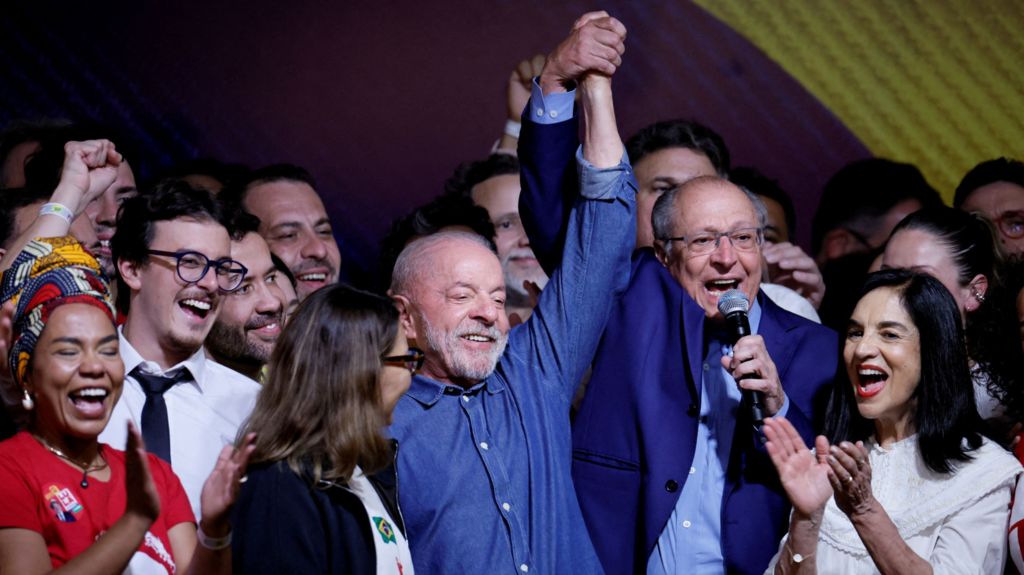
In a historic and fiercely contested Brazilian presidential race, 80-year-old incumbent left-wing leader Luiz Inácio Lula da Silva has claimed a landmark fourth term in office, overturning a first-round deficit to defeat right-wing challenger Flávio Bolsonaro in a dramatic political upset. Official electoral data confirmed Lula garnered 51.79% of the total valid votes, translating to a 4.4 million-vote lead over Bolsonaro’s 48.21% share, marking the first time a presidential candidate has won a Brazilian national election after trailing in the opening round since the country’s 1988 return to full democratic rule.
The race followed a tense final polling day marked by an unprecedented last-minute two-hour extension of voting hours, ordered by the Supreme Court just as originally scheduled closing times approached. The dual requests for extended polling came from both competing camps: Lula’s campaign argued that widespread public transit shortages left thousands of voters in populous São Paulo state and Bahia unable to reach polling stations, while Bolsonaro’s team cited severe heavy rainfall across parts of southern Brazil and São Paulo as a barrier to voter access. The eleventh-hour ruling created minor operational disruptions, as a small number of local polling sites had already locked their doors and could not resume operations, but Supreme Court President Kassio Nunes Marques – a judicial appointee of the challenger’s father, disgraced former president Jair Bolsonaro – formally validated the final results, confirming the extension did not compromise the integrity of vote counting or the broader electoral process.
The outcome defied widespread pre-second-round projections, after Flávio Bolsonaro, a sitting federal senator running on the political legacy of his father, secured 47% of first-round votes on 4 October to edge out Lula, who took 45%. Lula’s campaign orchestrated a high-turnout mobilization push in the intervening four weeks, targeting the 33 million eligible voters who abstained from the first round. The strategy delivered record results: the gap between first-round and second-round abstention rates was the largest recorded in any Brazilian presidential run-off since 1989, driving a surge of support that carried Lula across the finish line.
Addressing jubilant crowds that flooded the streets of central São Paulo to celebrate, Lula – a former steelworker who previously served two consecutive terms between 2003 and 2010, and a third partial term starting in 2023 – framed the victory as a decisive rebuke of toxic political tactics. “This election is a loss for negativity, lies, and the forces that sought to undermine our democratic fabric,” he told supporters, before declaring “long live democracy” to roaring cheers. He went on to pledge that his fourth term, running through 2030, would be the most inclusive and responsive in Brazilian presidential history: “This will be the term where I listen more closely to the Brazilian people than any leader before me, no exceptions.” His vice-president Geraldo Alckmin hailed the result, noting “You have, for the second time, saved Brazilian democracy.”
In stark contrast, Flávio Bolsonaro rejected the outcome entirely during a press conference, claiming the result was “inexplicable” and “impossible” and publicly demanding the entire election be annulled. His remarks echoed the anti-democratic rhetoric of his father, who is currently serving a 27-year prison sentence for a 2022 coup attempt launched after he lost that year’s presidential race to Lula. Leading Brazilian electoral law experts uniformly dismissed Bolsonaro’s annulment demand as legally unfeasible: Fernando Neisser of the São Paulo Institute of Lawyers noted the 4.4 million-vote margin is far too large to be overturned by procedural challenges, while academic Alberto Rollo added that the Brazilian constitution enshrines fixed presidential election dates, creating an insurmountable legal barrier to voiding the results.
The watershed victory positions Lula to steer Latin America’s largest economy through a fraught geopolitical landscape defined by open hostility from U.S. President Donald Trump’s administration, which has advanced the self-styled “Donroe Doctrine” to assert unilateral U.S. dominance across the Western Hemisphere. Flávio Bolsonaro had secured explicit U.S. backing earlier in the year during a White House meeting with Trump, and his defeat ensures Brazil will remain at diplomatic odds with the Trump administration. Lula explicitly addressed this dynamic during his victory address, asserting that Brazil “will not accept being anyone’s backyard” as he commits to an independent foreign policy.
Lula’s win also defies a broader regional political shift that has seen voters in Argentina, Chile, and Colombia swing toward right-wing incumbents and reject progressive leadership in recent electoral cycles. Global leaders have lined up to congratulate Lula on his victory, with European Commission President Ursula von der Leyen declaring “Democracy and multilateralism have won in Brazil.” French President Emmanuel Macron pledged to deepen bilateral cooperation to build “a more just world,” while Spanish Prime Minister Pedro Sánchez framed the outcome as proof that “the comeback of global progressivism has just begun.” South African President Cyril Ramaphosa celebrated the result as a milestone for the global south, Pakistani President Asif Ali Zardari committed to expanding longstanding bilateral friendly ties, and Ecuadorian President Daniel Noboa Azin noted that regional nations share common challenges and will gain far more from collaborative action than division.