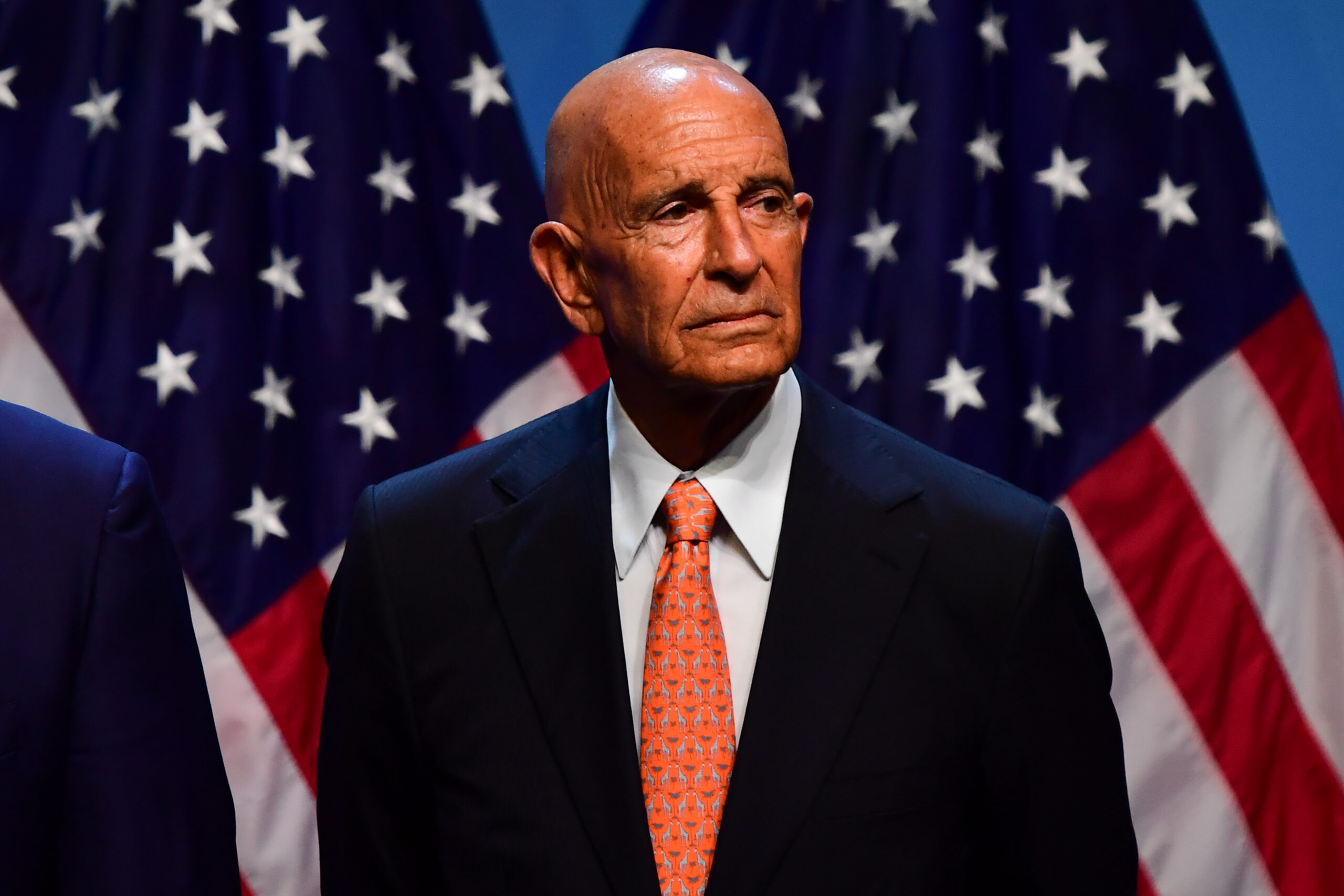
In a widely viewed Friday interview published on social media platform X with prominent commentator Mario Nawfal, Tom Barrack, the U.S. Ambassador to Turkey and designated special envoy for Syria, laid out a series of unvarnished observations about simmering tensions across southern Syria’s Sweida province, regional alliances, and the long-term trajectory of Israeli-Syrian relations.
Contrary to widespread public speculation that U.S. officials were prioritizing concerns over Israeli military activity in southern Syria, Barrack shifted focus to an unnamed high-profile Druze sheikh operating in the Sweida region, whom he accused of leveraging widespread public perceptions of Israeli military backing and implicit U.S. support to target and persecute fellow members of the Druze religious community. “Let me be clear: Israel is not the source of my primary concern here,” Barrack stated during the discussion. “The real risk comes from one specific Druze leader who is exploiting the widespread belief that he has both Israeli and American backing to carry out abuses against his own community members.” Barrack explicitly clarified that any claims of formal U.S. support for this unilaterally acting leader were “absolutely wrong”, pushing back against circulating rumors that Washington was backing separatist activity in the region.
While Barrack declined to name the sheikh during the public remarks, the timing and context of his comments align directly with rising public tensions surrounding Hikmat al-Hijri, the influential Druze spiritual leader based in Sweida who has openly rejected the authority of the Damascus-based Syrian government, publicly called for Israeli military support, and formally advocated for full regional independence from Syrian national governance. Earlier this month, supporters of al-Hijri sparked widespread controversy by raising Israeli national flags during a Sweida rally held to mark the third anniversary of the 7 October 2023 Hamas-led attacks on Israel. In May 2026, al-Hijri publicly declared that his community’s push for self-determination was irreversible, outlining a formal policy goal of establishing a fully independent Jabal Bashan administration completely separate from Damascus’s jurisdiction.
Barrack went on to level additional allegations about the local economy in Sweida and neighboring Daraa, claiming the contiguous region operates as the global epicenter for captagon production, an illicit amphetamine whose trade generates massive unregulated revenue that local armed Druze factions use to fund weapons purchases. “The corridor running from Sweida to Daraa is effectively the world’s captagon manufacturing hub,” Barrack explained. “That is the core of its local economy right now: producing and selling this illegal drug, which is functionally similar to the mass production of methamphetamines, and the profits from that trade are what arm local Druze armed groups.”
These allegations drew an immediate, fiery rebuke from the al-Hijri-affiliated Bashan Administration, which published a formal response on Facebook dismissing Barrack’s claims as deliberate, misleading fabrications. “The Bashan Administration expresses profound anger and unreserved condemnation of the baseless falsehoods and irresponsible accusations Special Envoy Tom Barrack has made in his recent public comments,” the statement read. “We categorically reject his reckless attempt to paint Jabal Bashan as a captagon production center. It is a well-documented public fact that our community has stood on the front lines fighting smuggling networks for years, losing some of our most promising young men in the effort to stamp out this harmful illicit trade entirely.”
Barrack also offered nuanced context for longstanding Israeli ties to Druze populations across the region, noting that the relationship extended far beyond cynical political interference. He highlighted that Druze communities in the Golan Heights and along the shared Israeli-Syrian border have a decades-long history of standing as formal allies to Israeli forces, with generations of community members serving alongside IDF troops and paying a heavy personal price for that alliance. Israeli authorities have repeatedly framed their periodic military interventions in southern Syria as protective measures for local Druze populations, including a July 2025 strike that targeted Syrian government forces during active fighting in Sweida.
The U.S. envoy went on to note that the current Syrian government under President Ahmed al-Sharaa has exercised notable restraint in responding to repeated Israeli cross-border incursions, warning that a single retaliatory strike by Damascus could rapidly spiral into a large-scale regional conflict. “Syria has been extremely cautious, because it understands that any aggressive response to these incursions will ignite a fire that no one will be able to contain,” Barrack explained. “Damascus has exercised remarkable patience while Israel maintains its self-declared buffer zone across the border, even as local Druze actors conduct activities that undermine Syrian national authority.”
Looking ahead to long-term regional diplomacy, Barrack expressed cautious optimism that Israel and Syria would eventually reach a formal mutual understanding, even amid ongoing deep mistrust and persistent border tensions. He noted that al-Sharaa has repeatedly communicated that he has no interest in initiating a confrontation with Israel, and that the two sides have already completed five formal rounds of border and boundary negotiations, launching the process with initial talks in Paris back in May 2024. “We came very close to reaching a full agreement in earlier rounds, and I am confident we will get there again,” Barrack added. He acknowledged that Israeli officials remain wary of Syria’s new leadership due to al-Sharaa’s past background as a fighter with the al-Nusra Front, as well as the presence of unvetted foreign fighters deployed in Syrian army units posted near the Israeli border, leaving Israeli security teams unconvinced that Syria’s verbal assurances of non-aggression are sufficiently credible to guarantee long-term border stability.