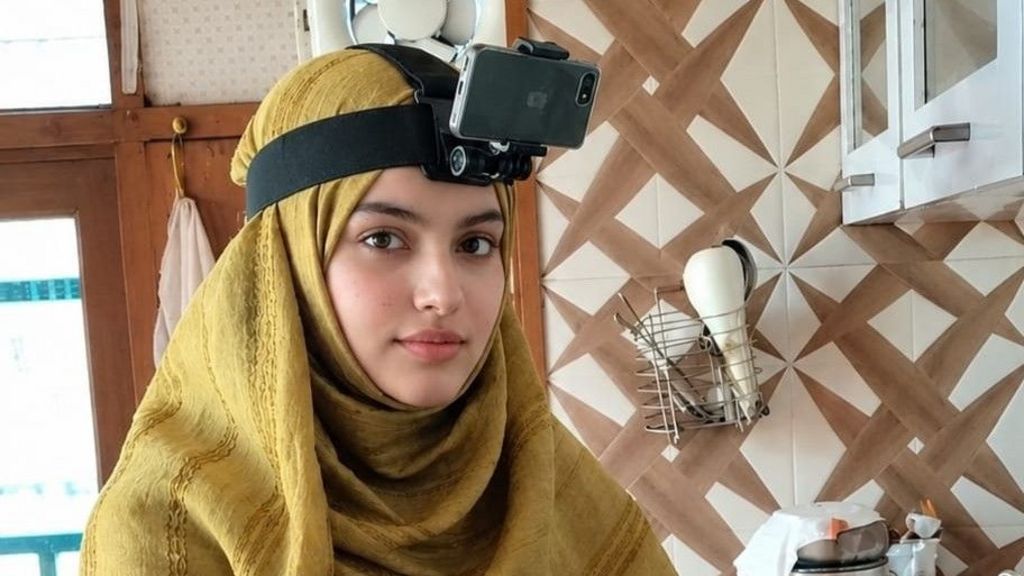
In bustling Bengaluru, 22-year-old barber Mohammed Ashim has spent four years honing his craft of cutting hair and shaping beards for local clients. But in recent months, a new layer has been added to his familiar daily routine: a lightweight head-mounted camera that captures nothing but the precise movements of his hands as he works, with all client faces automatically blurred to protect privacy. Ashim now wears the device for 5 to 6 hours per shift, adhering to strict guidelines from his operations team to keep his hands fully in frame, maintain crisp lighting, and avoid sudden head tilts that could disrupt footage quality. While the extra pay is a welcome boost to his income, Ashim says the greatest thrill comes from an unexpected source: “I never imagined my razor-sharpening and trimming techniques would end up in the hands of a global tech company, contributing to something as futuristic as advanced AI.”
Ashim is part of a fast-growing, little-seen global workforce of hundreds of thousands of people who are paid to record their daily manual labor, generating raw visual data that feeds directly into the development of physical AI — a rapidly evolving branch of artificial intelligence designed to control robots operating in unstructured real-world environments. His footage is first collected by local Indian data firm Rashdan Technologies, which aggregates recordings from hundreds of workers across diverse trades before packaging and selling the curated datasets to international tech giants and AI research labs.
Shahil Baig, co-founder and CEO of Rashdan Technologies, explains that robotics and frontier AI labs have highly specific, unmet data needs spanning every conceivable physical task: from industrial manufacturing and agricultural labor to household chores, pottery making, garment stitching, embroidery, and small-batch candle production. His firm pays workers between $5 and $10 for 8 to 10 hours of recorded work, a sum that represents meaningful additional income for most participants. Baig emphasizes that worker consent and privacy are non-negotiable priorities: all footage is processed to remove identifiable features, with faces blurred, no full names or contact details shared with clients, and all data stripped of any markers that could trace back to the individual collector. As client demands grow more sophisticated, however, the work becomes more complex: many buyers now request multi-camera rigs with 4 to 6 separate lenses to capture full 360-degree views of task environments, rather than just close-ups of hands. Baig notes that negotiating worker buy-in for these bulkier multi-lens headsets requires far more careful discussion, and the firm pays premium rates for this higher-tier data collection to compensate participants fairly. The market is expanding rapidly, too: Baig projects dozens of new competing data collection firms will launch in India alone before the end of the year.
The rush to source this type of human activity data stems from a critical gap in existing global AI training resources, explains Manish Agarwal, founder of Humyn Labs, a Bangalore and San Francisco-based data processing firm. Simulations alone cannot train robots to navigate the messy, nuanced physical world, he argues, because physical tasks demand hyper-specific, high-quality data tracking limb movements, finger pressure, wrist angles, and even dynamic force application — for example, the exact grip strength needed to hold a fragile plastic bottle without crushing it, versus the firmer grasp required to lift a heavy steel mug. No comprehensive public archive of this embodied human movement data currently exists; there is no pre-existing dataset showing the exact motion patterns for cleaning a residential kitchen, or the precise force levels used by a seasoned factory worker to assemble a car part. All of this data has to be captured from scratch, in real-world settings across diverse geographic and cultural contexts. At present, Humyn Labs works with 96,000 data collectors across Latin America, Southeast Asia, and India, filtering thousands of hours of raw footage to select the highest-quality clips, labelling every movement so AI systems can identify what they are viewing, and packaging the datasets to meet client specifications. Agarwal adds that sourcing data across varied regional contexts is critical to building AI that works reliably for different markets: footage of Indian residential kitchens, for example, will not provide an accurate proxy for training a household robot designed for U.S. suburban homes.
The fast-emerging industry has sparked urgent, nuanced debate about long-term ethical and labor implications. Bino Paul, a senior professor at Mumbai’s Tata Institute of Social Sciences School of Management and Labour Studies, warns that there is currently little clarity on whether the data workers are generating will eventually be used to build robots that automate their own jobs. “By the time workers realize that the movements they recorded have been used to replace their livelihoods, it may already be too late to course-correct,” he cautions, calling for targeted government regulation of the physical AI sector that frames the technology not as a neutral technical tool, but as a socio-technical system bound by strict ethical guardrails to ensure it delivers widespread public benefit rather than harm to workers.
For now, though, the steady flow of investment into physical AI development continues to create tangible, immediate income opportunities for Indian workers across skill levels. Mohammed Arman, a 10-year veteran of Bengaluru’s textile industry who can stitch and cut garment fabric with near-automatic precision, recently signed on to record his daily tailoring work with a head-mounted camera. For him, the arrangement is a straightforward way to support his family back in Bihar: “I am already doing the exact same stitching and cutting work I have done for a decade. Wearing a camera adds no extra effort, but gives me extra cash to send home. There is no reason for me to say no.”
The flexible, part-time nature of the data collection work also draws participants like Jolly Arifur, a science teacher based in Guntakal, Anantapur, who balances recording work around her professional duties and care for her young son. For seven months, she has worn a camera rig for 3 to 5 hours a day while completing routine domestic tasks: scrubbing surfaces, cooking, sweeping tile floors, and folding laundry, earning $2 to $3 per hour in the process. “It is a perfect extra income stream that fits perfectly around my teaching schedule and my responsibilities to my son,” she says. “It has made our household finances much more stable.”
Agarwal notes that India currently occupies a relatively low position in the global physical AI value chain, operating mostly as a low-cost supplier of raw unprocessed footage, a dynamic that risks eroding profit margins as more competitors enter the market. He argues that the country must move rapidly up the value chain to retain long-term economic benefit, shifting from simply recording raw video to building end-to-end pipelines that clean, structure, validate, and set global quality standards for physical AI training data, rather than ceding that high-value work to overseas firms.