### Introduction
In early October 2025, a deadly clash between two of the Sahel region’s most powerful jihadist groups underscored the intractable instability plaguing West Africa’s borderlands – just days after China laid out a new framework for international engagement on African conflict resolution during a high-profile diplomatic meeting in Beijing. The convergence of these two events has drawn fresh attention to how Beijing’s stated principles align with the messy, fragmented security dynamics across the Sahel, where non-state armed groups control vast swathes of territory and China has growing economic and strategic interests.
—
#### The Deadly Clash in Northern Burkina Faso
On October 9, heavy fighting broke out near the village of Gonadaouri in Burkina Faso’s Oudalan province, just kilometers from the Malian border. The combatants were longstanding rivals: Jama’at Nusrat al-Islam wal-Muslimin (JNIM), al-Qaeda’s official affiliate in the Sahel, and Islamic State Sahel Province (ISSP), the group formerly known as the Islamic State in the Greater Sahara. The two extremist factions have engaged in intermittent territorial clashes along this frontier since August 2025.
Three days after the confrontation, ISSP issued a statement claiming it had killed more than 400 JNIM fighters, including multiple senior commanders. To date, international news outlets including Agence France-Presse have not been able to independently verify this casualty count. Specialist sources cited by Radio France Internationale have reported heavy losses on both sides, noting that JNIM also killed several ISSP commanders in the fighting. JNIM itself has not released any public statement on the battle.
This clash is only the latest chapter in a years-long inter-jihadist rivalry that has already claimed thousands of lives. Data from the Armed Conflict Location & Event Data (ACLED) project records more than 2,100 deaths from fighting between JNIM and ISSP since 2019, with the conflict spreading to Niger’s Tillaberi region for the first time this past April. Unlike conventional interstate conflicts, this violence is waged by two non-state groups that both oppose the Sahel’s military governments, compete for control of smuggling routes and local resources, and govern the territories they hold under their own harsh extremist doctrines.
Weaken by decades of political instability, many Sahel states already exercise limited control over their territory. Roughly half of Burkina Faso is reportedly beyond effective central government rule, and the country hosts 2.1 million of the Sahel region’s 2.8 million internally displaced people. Just days before the Gonadaouri clash, on October 6, Malian government forces alongside fighters from Russia’s Africa Corps retook the strategic northern town of Kidal without resistance, five months after it fell to a joint offensive by Tuareg separatists and JNIM. Separatist leaders have described their withdrawal as temporary, with regional power Algeria – which has long had tense relations with Mali’s junta – reported to have brokered the handover agreement.
—
#### China’s Four Principles for African Conflict Resolution
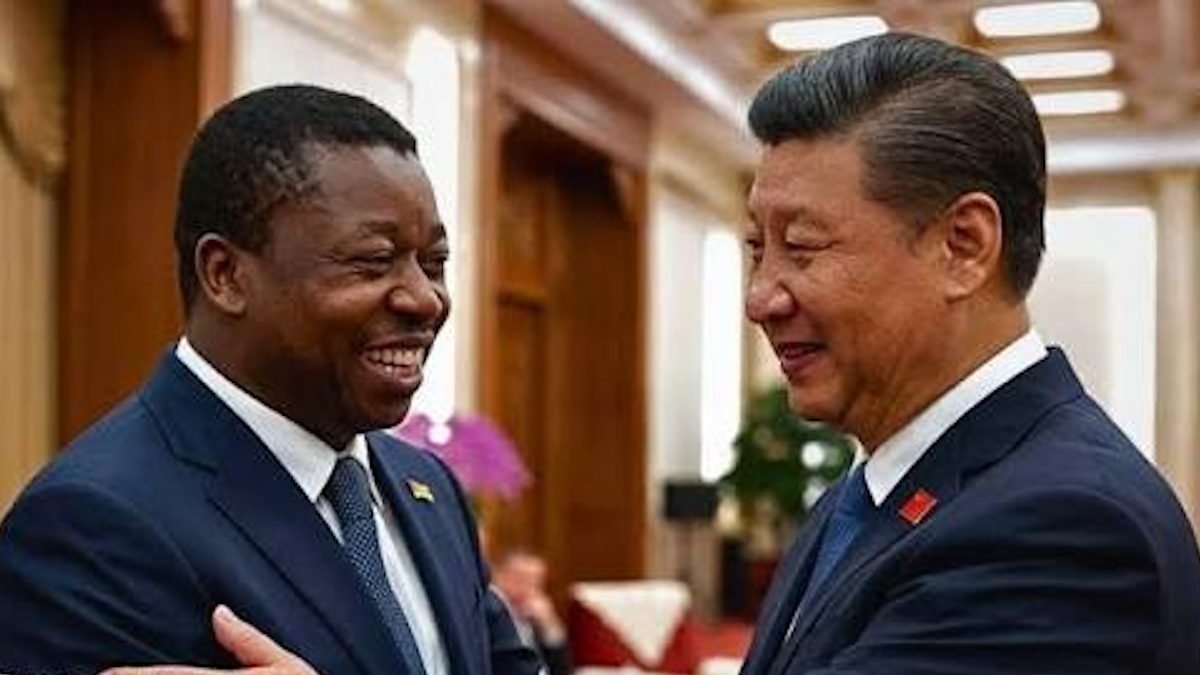
Four days after the Gonadaouri clash, on October 13, Chinese President Xi Jinping welcomed Togolese President Faure Gnassingbé for a bilateral meeting in Beijing. The talks covered a range of economic cooperation issues, from expanded zero-tariff access for Togolese goods to greater adoption of the renminbi in bilateral trade. A major focal point of the meeting, however, was Xi Jinping’s announcement of four core principles for external engagement to resolve African “hotspot issues”, a framework that Gnassingbé fully endorsed. While Xi did not name any specific conflict, and the principles are not intended as a direct comment on Sahel instability, the region presents a critical test of their applicability.
The four principles laid out by Xi are clear and principle-driven: first, that African people are the “true masters of Africa” and must play the central role in resolving regional affairs; second, that all external actors must respect the UN Charter and the sovereignty and territorial integrity of African states; third, that consultation and dialogue should replace armed conflict, as neither war nor unilateral sanctions can deliver a lasting resolution to disputes; and fourth, that conflict resolution efforts must address both the immediate symptoms and the underlying root causes of violence.
The emphasis on resolving disputes between states carries particular weight in the context of the Sahel, where most active violence involves non-state armed groups that do not recognize existing state borders or answer to sovereign governments. Unlike the interstate conflicts Xi referenced, JNIM and ISSP have no government to mandate negotiations, making a call for dialogue far harder to implement than it would be in conventional conflicts.
—
#### China’s Growing Footprint and Interests in the Sahel
China has long had a presence in the Sahel, but its role has evolved significantly in recent years. From 2013 to the end of 2023, Chinese troops deployed as part of the UN peacekeeping mission in Mali, based in the northern city of Gao, where one Chinese peacekeeper was killed in an attack in 2016. After the UN mission closed at the request of Mali’s military junta, China’s presence in the region has shifted to bilateral engagement.
Over the past two years, Beijing has expanded its diplomatic and security ties across the Sahel: it posted its first ever defense attaché to Niger in 2024, and Mali has received deliveries of Chinese-built short-range air defense systems. Economically, Chinese investment is deeply embedded: China National Petroleum Corporation (CNPC) constructed Niger’s major oil export pipeline to the coast of Benin, while Chinese firms operate mining and infrastructure projects across western Mali.
This growing engagement has not come without risk. Data shows that of the 89 foreign nationals abducted across Africa in 2025, 38 were Chinese citizens, most of them working in Mali’s gold-rich southwestern region. Kidnapping for ransom makes up an estimated 40% of JNIM’s annual revenue, according to the Institute for Economics and Peace, and Chinese nationals working at unregulated artisanal gold mines are among the most vulnerable targets. The Chinese embassy in Mali explicitly warned its citizens of the poor security at these sites in a public advisory last December.
China’s approach to Sahel sovereignty has also drawn scrutiny. Mali’s military government expelled the UN peacekeeping mission in 2023 and scrapped the 2015 Algiers Peace Agreement with northern armed groups in January 2024, a decision widely cited as a key factor driving the renewed outbreak of conflict in northern Mali. Despite this, Beijing has continued to supply military equipment to the Malian junta and maintain economic relations, without public criticism of the government’s decision to abandon the peace deal.
That said, China has not been a passive actor in the region, and has already used diplomatic mediation to resolve cross-border disputes. In 2024, when Benin closed its border to block Niger’s crude oil exports during a bilateral dispute, it was China’s ambassador in Cotonou that negotiated an agreement to resume loading operations. Just this year, when Niger’s junta ordered Chinese oil executives to leave the country amid a dispute over local hiring requirements, Beijing negotiated a deal that gave Niger a 45% stake in CNPC’s pipeline subsidiary on more favorable terms for Niamey – a pragmatic negotiation that aligns far more closely with Xi’s stated principles than conventional arms transfers.
—
#### Testing the Principles on the Ground
Xi’s principle of African-led conflict resolution also raises key questions about which African actors should be centered in the process. Beyond the military governments that make up the Alliance of Sahel States, the African Union maintains a dedicated mediation mission for Mali and the Sahel, Algeria retains longstanding diplomatic channels in northern Mali, and coastal West African states increasingly face spillover violence as extremist groups push south. China already maintains productive working relations with all of these actors, and could channel support for humanitarian access and hostage negotiation through these existing African institutions.
For China, the most immediate priority is reducing the risk to its citizens working across the Sahel. Policy experts note that working with Malian authorities to formalize Chinese mining operations, improve local hiring practices and negotiate more equitable revenue-sharing arrangements in the gold-rich regions of Kayes and Sikasso would reduce vulnerability to kidnapping without requiring the deployment of Chinese troops. These measures would not end the broader conflict over control of rural Sahel, but they would advance China’s core interests while aligning with its stated commitment to respecting African sovereignty.
Ultimately, JNIM and ISSP are unlikely to be swayed by principles announced in Beijing. For the people of Oudalan and Kidal, who have born the brunt of years of overlapping conflict, the real test will be whether China’s actions in the Sahel moving forward live up to the principles it has laid out.