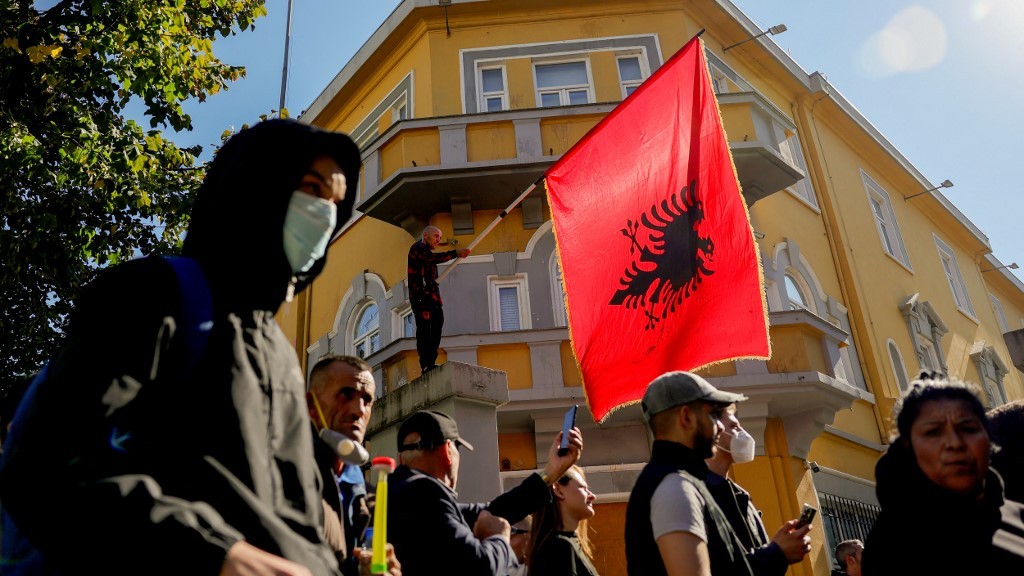
Weeks after Donald Trump secured his 2024 U.S. presidential election victory, Albanian Prime Minister Edi Rama gave preliminary greenlight to a €1.4 billion luxury coastal resort project tied to the incoming U.S. president’s son-in-law, Jared Kushner – a decision that would eventually spark a nationwide protest movement roiling the small Balkan nation. The development is earmarked for the strategic island of Sazan and the adjacent Zvernec coastline, located adjacent to Albania’s ecologically protected Narta wetlands, a habitat home to iconic flocks of flamingos. On December 30, 2024, Rama’s national Strategic Investments Committee formally granted Atlantic Incubation Partners LLC – the Kushner-linked firm leading the project – official strategic investor status, clearing a major regulatory hurdle for construction. For Rama, the deal was more than just an infrastructure investment: it offered a critical backchannel to the incoming Trump White House, a relationship the long-serving prime minister has relied on to shore up his grip on power after 13 years in office. What Rama did not anticipate, however, was that the controversial resort would become a lightning rod for years of simmering public anger over elite corruption, stagnant economic opportunity, and the hollowing out of Albanian democracy. For decades, large-scale development deals in the country have siphoned wealth to a small circle of connected political and business insiders, while ordinary Albanians have grappled with stagnant low wages, chronic unemployment, and widespread economic insecurity that has pushed millions to leave the country. Between 2011 and 2023 alone, more than 600,000 Albanians emigrated abroad in search of better prospects. Today, Albania’s total population hovers at just 2.3 million, declining by roughly one percent annually as working-age people flee the country’s lack of opportunity. To fill gaps in the workforce left by mass emigration, Rama’s government has increasingly turned to bringing in low-wage migrant workers from poorer countries like India and the Philippines – with more than 22,000 foreign work permits issued by June 2026 – even as it ignores widespread voter demands for economic and political reform. The first local protests against the Sazan resort project erupted in the affected coastal region, before snowballing into daily mass demonstrations in the capital city of Tirana starting in late May 2026. The movement quickly adopted the name the “Flamingo Revolution,” a nod to the vulnerable wetland ecosystem that would be damaged by the resort development, and the name quickly drew international attention, in large part due to the project’s ties to a senior figure connected to the incoming U.S. administration. By October 2026, university students joined the protests in force, bringing with them their own grievances over soaring education costs, crumbling university infrastructure, and the lack of professional opportunities waiting for them after graduation. Unlike traditional protest movements, the Flamingo Revolution has deliberately rejected centralized leadership, a strategic choice that movement supporters say protects it from government co-optation. “The lack of leadership figures amongst the protesters is a good thing – the government doesn’t have a chance to buy someone off or threaten their family,” explained Ervin Salianji, a former Democratic Party lawmaker who has emerged as a prominent critic of both the Rama government and the unofficial power-sharing deal between Rama and his own party’s long-time leader, Sali Berisha. Salianji accuses both leaders of colluding to control candidate selection for elections, shutting out voter input and allowing a tiny elite to accumulate massive wealth at the expense of the public. “If we had a single leader of the movement they might be in jail right now. This is an advantage at the moment. Rama now realises that he has few options to respond to the protest now,” Salianji added, noting that the prime minister has already resorted to heavy-handed tactics: threatening students, teachers, and public workers who join the demonstrations, while offering police officers a €2,000 bonus to use violence against protesters. For Fatos Lubonja, a prominent Albanian writer and long-time dissident who spent 17 years as a political prisoner under the country’s former communist regime, the protests lay bare a far deeper crisis: the complete collapse of democratic institutions in Albania, which he says has been captured by a criminalized elite. “There is a crisis of institutions and democracy. We don’t have a healthy economy but a criminal economy and crime has captured the state,” Lubonja told Middle East Eye in an interview from Tirana. Lubonja has been an outspoken critic of Rama’s authoritarian turn during his 13 years in power, noting that unlike the former communist regime, which ultimately yielded power to democratic forces, Rama has shown no willingness to step down even as public anger mounts. The controversy over the Kushner resort has also shed light on Rama’s deliberate strategy to strengthen ties with Israel, leveraging Kushner’s well-documented close friendship with Israeli Prime Minister Benjamin Netanyahu to curry favor with the incoming Trump administration. In April 2025, Israeli President Isaac Herzog awarded Rama the Israeli Presidential Medal of Honour in recognition of his strong public support for Israel. That same month, Albania’s state-owned defense firm Kayo signed a memorandum of understanding with major Israeli arms manufacturer Elbit Systems to launch a new aviation academy in the Albanian port city of Vlore. During a January 2026 visit to Jerusalem, Rama pledged even deeper defense cooperation between the two countries. Rama’s government has also invested in building three new Jewish museums in Albania, a country with almost no historic Jewish resident population, to drive tourism from Israel – a gambit that has succeeded wildly: Israeli Foreign Minister Gideon Sa’ar confirmed in October 2026 that annual Israeli visitor numbers had already surged past 100,000, a more than 500% increase from just one year prior. Critics have drawn unflattering comparisons between the Sazan resort project and Kushner’s controversial proposal to forcibly displace Palestinian residents of Gaza to redevelop the territory, while many protesters have labeled the development “another Epstein Island,” a shorthand for the unaccountable abuse of power by a global elite that disregards the needs and rights of ordinary people. Photographs from the October 2026 protests in central Tirana show violent clashes between demonstrators and riot police, with officers taking cover from Molotov cocktails thrown by protesters, and damaged vehicles littering city streets after days of unrest. For the protesters who have flooded Tirana’s streets demanding Rama’s resignation, the escalation to violent clashes in October came after months of peaceful mobilization failed to win any of their core demands: an independent crackdown on systemic corruption, the formation of a transitional caretaker government, and the end of Rama’s 13-year rule. The protest movement comes as a wave of corruption investigations has already swept up senior figures across Albania’s political establishment. Tirana Mayor Erion Veliaj has been held in pre-trial detention since February 2025 on charges of corruption and money laundering, which he denies. Former Deputy Prime Minister Belinda Balluku faces corruption charges linked to more than €200 million in public sector contracts, and she also denies any wrongdoing. In September 2026, an Albanian court placed national intelligence chief Vlora Hyseni under house arrest and suspended her from office, following a request from the country’s Special Prosecution Against Corruption and Organised Crime (SPAK). Investigators suspect Hyseni of leaking classified information to organized crime groups. Rama has repeatedly denied any connection to the corruption cases against his close political allies. International bodies have so far offered measured responses to the crisis. The European Commission, which oversees Albania’s ongoing accession process to the bloc, has condemned arson, attacks on state institutions, and property destruction, while welcoming the Albanian government’s stated commitment to protecting the right to peaceful protest and praising Tirana’s progress toward EU membership. The EC has also demanded that Albanian authorities respond to the protests lawfully and proportionately, and the EU delegation to Albania has previously called for formal investigations into widespread reports of excessive police violence against protesters and independent journalists. The U.S. Embassy in Tirana has issued a statement urging all sides to exercise restraint and ensure demonstrations remain peaceful. Speaking from Tirana, Lubonja framed the current moment as a defining crossroads for Albanian democracy. “The protests stand at a crossroads: either Edi Rama creates a police state, or with courage, a different Albania can emerge. The situation is frightening – democracies are also defended through blood,” he said.
Albania’s revolt: How Rama’s Kushner resort deal became a threat to his leadership